
blog
"Waffles are the Sponsor of my Woes"
OUT NOW ON AMAZON
"Waffles are the Sponsor of my Woes" OUT NOW ON AMAZON
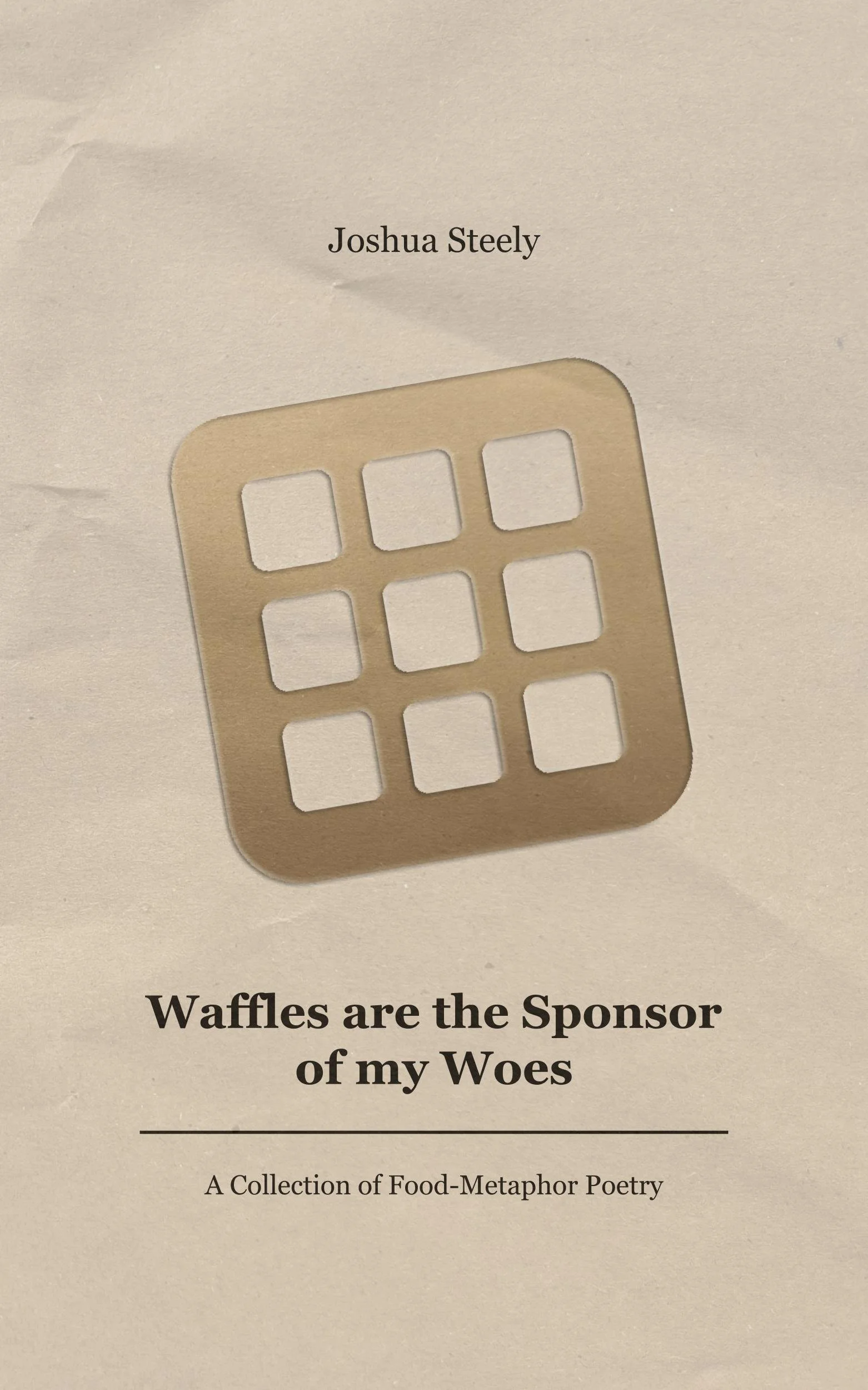
"This cooked." –Michael Howe
Joshua Steely's heart is served up on a silver platter in his debut poetry collection, Waffles are the Sponsor of my Woes. Steely's food-metaphor-based poems explore themes of Hope, Rejection, Desperation, Rage & Regret, Resignation, and Sadness as if steps for the recipe of a hopeless romantic. With chocolatey tears and stained shirts, readers can experience the feeling of grasping at straws that so inspired many of the poems within.
While Waffles are the Sponsor of my Woes is written from the perspective and experiences of a 16-19 year old boy, the emotions evoked by emptied gourds and sweet cinnamon rolls are for everyone. Is a diet from love the answer? Gorging on it until there's nothing left? Steely offers spoonful after spoonful, but each taste leaves only a desire for more...
"Waffles are the Sponsor of my Woes"
OUT NOW ON AMAZON
"Waffles are the Sponsor of my Woes" OUT NOW ON AMAZON
Why a blog?
I’ve always loved sharing my ideas with whoever will listen (or is unlucky enough to be within earshot). Most of them go nowhere after that, but a couple end up worthwhile! This site is a way for me to share my ideas with people beyond earshot, and doubles as writing practice!
I hope one day somebody may be inspired by what I’ve shared and go on to do things greater than I could have ever dreamed of. I couldn’t exactly take credit, but if I’m even a slight influence towards something greater, that’s a win.
Like a Smiling Headless Chicken
I admire Elementary school art teachers… tremendously. Recently, because I spent over 8 hours preparing for a single 60-minute class, and that one hour drained a whole day's worth of energy. The ability to repeat that hour back-to-back three, five, or even six times a day is well beyond my capacity. I would have to start drinking caffeine to even make it through two.
If you haven't caught on yet, I taught a CRATE workshop this week at a senior center. Of the 20 participants that registered, 25 showed up. And I, like a typical Elementary school art teacher, had no help to instruct all 25. I hadn't even taught this age group before. I'd received some advice, but I was not confident in what to expect...
Written by Joshua Steely on the week of July 20th, 2026
I admire Elementary school art teachers… tremendously. Recently, because I spent over 8 hours preparing for a single 60-minute class, and that one hour drained a whole day's worth of energy. The ability to repeat that hour back-to-back three, five, or even six times a day is well beyond my capacity. I would have to start drinking caffeine to even make it through two.
If you haven't caught on yet, I taught a CRATE workshop this week at a senior center. Of the 20 participants that registered, 25 showed up. And I, like a typical Elementary school art teacher, had no help to instruct all 25. I hadn't even taught this age group before. I'd received some advice, but I was not confident in what to expect.
Luckily though, I'm a pretty thorough over-preparer for things like this. So I had plenty of materials to make 25 Bottleflies, as long as they didn't all have to cut them at the same time.
What I didn't quite have was the bandwidth to help 25 people at the same time. Three people tried to help me out by quitting, either because they weren't happy with how their project was turning out, or they hadn't known what they were actually signing up for (or showing up for) in the first place. But even then, 22 people is a lot for 1 person to try and help at the same time.
It was definitely a learning experience! One that deserves thorough evaluation and reflection. The following are a few of the systems which I either successfully implemented, or would like to implement in future workshops. They would do a great deal to make me less like a headless chicken, and more like a prepared adult.
Worms
"The early bird gets the worm," is how the saying goes. But that's assuming there are worms.
15 minutes before the workshop was scheduled to start, I already had a table full of ready participants. But I had no worms to give them! So for future workshops, I need to bring worms.
Now obviously, I don't mean actual worms. I mean "something for the early arrivals to do before the main instruction". These "worms" need to be simple but engaging, require little instruction or cleanup, use few materials, and allow for me to keep greeting arrivals. Do I have any ideas for worms right now? Not yet. But I'll schedule a brainstorming session to develop some in the coming weeks. They wouldn't necessarily have to be precisely tied to the project participants will make, but I'd like the worms to at least be somewhat relevant.
The early arrivals also showed me how early I need to be set up, which is 15 minutes before the starting time. And the actual starting time is five minutes after the written starting time, because of stragglers. But they're ready to start doing something, so they need the worms!
Smile
When in doubt: smile.
A ready smile can save you from a whole lot of backlash, if used appropriately. Genuine smiles go a long way in making a stranger comfortable. When approaching a participant to instruct or advise, it should always be with a smile to reaffirm that your intentions are not critical.
If you laugh, it needs to lack judgement. Laughs need to be with a participant, never at a participant. If they don't know you, they'll try and find out who you are by your face. If your face is in a frown, or a perpetual worried crinkle, then they won't know that your intentions are for them to have fun! To enjoy themselves!
Outline your Intentions
I certainly did not have the time to exercise small talk with 20+ people simultaneously, but one of them commented, "You'd better tell us about yourself. We want to get to know you, we want to know your intentions!" and I felt bad for not introducing myself more. And I had intended to give an introduction, but I got caught up in the speed of things as the tables overfilled and we had to set up new ones.
To fix this, I need to develop some sort of quick, but thorough, introduction for instructors to give to the participants. Mainly so that the participants can start to trust the instructor, even if only for a short while. If they know nothing about who is teaching them, they may be more skeptical and hesitant to receive the instruction.
This "outline" should also provide the intentions for the workshop itself: what are the vague steps you can tell them ahead of time? the overview of the project they'll be tackling? If you give them some sort of reference for what will be happening, then they won't be as quick to skip steps or leave early (which both happened in my Bottlefly workshop, since I hadn't presented an outline).
Table by Table
To be blunt: this audience had some trouble hearing. So instead of addressing the whole room, I went around to different tables one at a time to share the next steps. 3 tables would have been more manageable than the 4 I ping-ponged between, for sure.
I think going table by table is one effective way to instruct, especially with hearing issues. I remember my school days when that's how the art teachers would monitor: table by table. With that method, you can also see which individual members of the group need specific help, which you wouldn't be able to tell as easily while addressing the whole room.
Splitting a group up into four tables would be perfect for two instructors. They could each have two tables to manage, and give much more personalized instruction.
Exit Tickets
When participants thought they were done, they just got up and left. However, some of them didn't even know I had more steps for them! Or a game that didn't get played!
This is why I need the Outline of Intentions, or something of the sort that is printed out as a short list for them to reference, to see how far along in the workshops we are. The final thing on this outline should be an "exit ticket" that can include things like:
a photo of their final product
a feedback survey (with photo release)
any testimonials about their experience
Without this structure, there was no good point for me to try and address the whole room about feedback surveys. (I was bummed they went unused).
Better Organization
Organization systems are hard to plan for, but obvious once you're in it. You know what you need once you don't have it.
Tackle boxes. That's what I need, but on a massive scale. Things you can set down on a table, open, and then it's already all spread out and organized for you. It's a lot harder when you have to pull things out of a large crate and spread them across a random sink's countertop. You don't know where things are, and it loses precious time.
I need to organize the materials in a more quickly accessible manner. I'm talking, 3d-printed scissor holders that fit nicely in a crate, and better containers for coloring supplies. Otherwise, they'll only grab what's on top, instead of what they actually want to use.
This list of systems is definitely a work in progress. I will be adding more to it as I recognize the need for more–
and there is definitely a need.
What silence says…
I have been aggravated lately by the sound of my own voice. And before you say "who isn't?"--rude–let me explain. I'm particularly aggravated when I'm explaining (yet again) that I don't want to say anything. That I want silence. What was that quote parents loved? "If you don't have anything nice to say, then don't say anything at all"? Welp, that just simply does not work. It turns out, saying nothing can often have as much of an impact as saying something, after all!
Written by Joshua Steely on July 6th, 2026
I have been aggravated lately by the sound of my own voice. And before you say "who isn't?"--rude–let me explain. I'm particularly aggravated when I'm explaining (yet again) that I don't want to say anything. That I want silence. What was that quote parents loved? "If you don't have anything nice to say, then don't say anything at all"? Welp, that just simply does not work. It turns out, saying nothing can often have as much of an impact as saying something, after all!
After studying communications for a few years now, there's no longer any irony when talking about talking, so I've moved on to talking about not talking. You see, silence can come across as polite, as parents want it to be, sure, but also as rudeness, boredom, distractedness, and any number of other negative interpretations. Even when silence is your best answer, other people may not hear it that way. It's quite a bother, if you ask me (but then again, if you did ask me, I wouldn't say anything, and then I'd ask you why you're so annoyed–oh wait! you had an expectation that I failed to meet! on purpose!)
When someone sets an expectation, like that their friends will laugh at their jokes, then they are bound to be disappointed when that expectation goes unmet. Silence is the unmeeting of expectations. The sought after response was often exactly that: a response, and yet you have given a non-response, contradicting the very notion of their initial action or comment.
My Father, for example, is the classic example of a closeted standup comic (often simply called a Dad). When it comes to jokes, it's roughly 90% of his vocabulary. And no, quantity certainly does not equate to quality. But when he makes them, even my eyes rolling is a reaction, sometimes exactly the reaction he wanted!
That's right, nonverbals can qualify as "breaking the silence". Silence isn't only verbal (unless you're having a conversation over the phone). Silence is a lack of reaction. Gorick Ng, in his 2021 book "The Unspoken Rules" (Ch.11), uses the term "'bids'–requests from others for human connection" (p.167). Well, when you leave a bid unanswered, then that person feels unanswered. Feeling unanswered is not a good feeling.
Silence is worse than a no. If you're in sales, you know this already. With silence, you can continue to spend resources on someone, hoping to hear back. But with a no, you know to cut off resources and move on to a new lead. Silence sucks when you send a cold email, hoping to connect with your dream mentor or land a new deal, and you never get a response. Self-doubt creeps in faster than a shadow in a sunset and makes its home in the back of your mind, saying nasty things while the possibility of a spam folder fiasco scratches like nails on a chalkboard. Their silence makes your inner critique scream.
In reality, silence is open to as many misinterpretations as speech is–as many as nonverbals and metacommunication (tone, inflection) are. It is those misinterpretations that make speaking out only in your mind so dangerous. Let me give you an example. Say a girl asks me out. What do I say? Well, what if I have nothing nice to say? Should I say nothing at all? That's the catch. If I walk away without answering her, doesn't that make me the same douche as if I'd said something mean?
Bad example. Relationships (especially fletchling ones) are WAY too nuanced to address the innumerable ways silence can be misinterpreted. Talk about trouble–a husband not picking up his phone when his wife calls? Goner.
Okay, but what if you know a person so well that it's as if you can read their mind? What if you are that imaginary, idyllic couple? Like, silence has no place between you and this person, because you're just so in sync? Well guess what, there will still be plenty of opportunities for your overconfident "understanding" to mess things up. Think of a time you misinterpreted silence as wanting to be alone, when really all that person wanted was someone to be with them. Sure, it's not the same if you have to ask them, but what if you had? Communicating isn't always as sexy as correctly interpreting silence. But communication is almost always a better option than risking misinterpretation.
On another note, some people are afraid of silence! It seems like they can't stand hearing themselves think. If you get in a car with them and don't hear their voice, they're either asleep or dead. Perhaps it's a defense mechanism. Perhaps it's oversharing. And perhaps it's just a ramped-up version of normal. Plenty of people are uncomfortable in silence. The real trick is finding people that you are comfortable sitting with in silence. It's a sort of rawness, not having the music of conversation to mask emotions. A less muddled existence, existing side by side without words. No semantics clogging the drain of your experience. Peaceful input, alone, together.
Dallas Willard talks of the Discipline of Solitude in his book "Renovation of the Heart", but he shares that it could have just as aptly been named the Discipline of Silence. Silence in the spiritual sense can allow God to speak in a way that speaking cannot. Physiologically, silence gives the brain space to "catch up" and process. Silence can be good, even great. Silence can also be bad, even really bad. It can be the most poignant synonym, the most solid point. Or it can undermine your expertise, ruin your reputation.
What silence says is… not up to you. And that's what makes it so tricky.
One last point, that I shall credit to Albert Camus: "Silence is the last word in every argument".
So here is my final word:
First Bite Conversations
A "First Bite Conversation" is simple. You've probably had one within the past week, even. Maybe multiple. A "First Bite Conversation" is the kind of conversation initiated by an interested party before you have time to properly form a conclusion. Most famously, these are initiated by parents regarding food, events, and unfamiliar topics. But first bite conversations aren't only happening around the dinner table. They're in interviews and ads, classrooms and bus rides, the U.S. and the U.K. Most significantly, though, they're at the beginning of countless arguments, no matter the relationship status: parent/kid, husband/wife, friends, coworkers. To understand why, we'll start with the simplest form: at the dinner table.
Written by Joshua Steely on May 25th, 2026
A "First Bite Conversation" is simple. You've probably had one within the past week, even. Maybe multiple. A "First Bite Conversation" is the kind of conversation initiated by an interested party before you have time to properly form a conclusion. Most famously, these are initiated by parents regarding food, events, and unfamiliar topics. But first bite conversations aren't only happening around the dinner table. They're in interviews and ads, classrooms and bus rides, the U.S. and the U.K. Most significantly, though, they're at the beginning of countless arguments, no matter the relationship status: parent/kid, husband/wife, friends, coworkers. To understand why, we'll start with the simplest form: at the dinner table.
How does it taste?
You've just put the first bite of your Grandma's new enchilada recipe in your mouth, and she's already asked you what you think. "HOW SHOULD I KNOW?" you want to scream. But you can't, because your mouth is still full.
This premature, food-based question is probably universal, in some obscure parenting guide everyone learned by osmosis. It's also surface-level, making for a great name and example for all kinds of "first bite" conversations.
The key here is not that you don't want to answer the question, or even if you should lie to your Grandma about your opinion (moral debates are found in Aisle 3). The key is that it's just too soon. You haven't swallowed! You haven't digested! You haven't taken the time to really think about the new recipe, because you haven't had the time.
But how long do you need to think about it? to formulate your opinion? Once you've decided, can you change your mind later? Good questions. Instead of answers, here's another example.
How was your day?
Your Mom is picking you up from school and you're just happy to be done. You sink into the backseat, slouched beyond the chiropractor's recommendation. And then she asks it. "How was your day?" Ugh. "I dunno, fine, I guess," you verbally shrug, and physically sigh. Depending on the mood your Mom is in, you either get grilled more, or sit in silence for the rest of the ride.
This question suffers from both being too soon, and too broad.
If you went to a public school like me, you probably had a half dozen classes throughout the day. Some you liked, and some you didn't. So if you went beyond the "fine, I guess" answer, it may have been something like "we had a test in math today. I think it went alright." Or you would have talked about another specific event, like a convocation, or a fire drill, or what there was for lunch. However, none of those single events can really summarize your entire day. And even if they did, within the 8 hour school day you're bound to have both highs and lows. Summarizing would be like estimating your average happiness or interest level from a day you just finished–the day that you are tired from. That tiredness can tank both your average perceived happiness, and your average effort put into answering.
Maybe there are better first bite conversations for those car rides. Being specific could help solve the "too broad" issue. "How was math?" or "What was for lunch?" could be less overwhelming, and result in a better answer than "fine" or "pizza," or they too could flop.
As for being "too soon", a better example is this:
You just got back from a week-long Christmas break trip where SO much happened, and you just want to unpack your suitcase and lay down. But your Mom has been waiting with bated breath to hear about the trip. So when she asks, you set down your full suitcase in the doorway and start to tell her about it. But you're tired, so it isn't a full-effort retelling.
This is not the same as the "doorway conversations" I talked about in a recent post. This time, the doorway is the front door, or the car door, and it's a first bite conversation. And the metaphorical bite is whatever you just experienced that the conversation initiator wants to know about. It's not the same uncomfortability of the doorway conversation, it's an uncertainty that comes with under-developed opinions. Have you had time to sit down and think about the week? to come up with the story you want to share? the way you want to share it?
I get it, not everybody wants to think through everything that happens to them or everything they learn about in writing. Some people are verbal processors, or internal processors, or just process a lot faster than I do. To them, first bite conversations may not be a problem wanting solving. But for me, before I jump off a diving board, I want to have time to take a breath. Who knows how deep the conversation will go–I want to be prepared.
What do you think about…?
It's Thanksgiving dinner, and your politically-charged Uncle asks, "What do you think about Bob running for office?" You don't know anything about Bob besides something you overheard on a train. Do you just repeat what you overheard? let it overrule the potential development of your own opinion?
You're asked the same question again, but you're on a podcast. Or worse, live TV. What do you say when you have no predetermined opinion?
Well, there are a few ways to approach it. You could form an opinion on the spot, make something up, sidetrack the conversation to something you do have a developed opinion on, admit you haven't considered it, or attempt a backflip. But no matter your response, the question can feel like an affront on your intelligence. "Why haven't I thought about this before?" you could think, berating yourself for your ignorance. In which case, you are almost always put on the defensive.
Defensive communication is closed-off self-preservation. That doesn't (necessarily) mean you curl up into a ball and hide under your chair. Often, it comes across as lashing out in anger, or giving up in frustration. Just know that defensive communication is rarely productive. (I'd like to write a whole blog post about defensive communication soon, so I won't get too into it, but I find it fascinating.)
I'm sure personality type also plays a huge part in how somebody would respond to a question they don't have an answer to. In my case, perfectionism results in frustration at my ignorance or lack of preparation. I'm defensive because I want to have a well-thought-out answer to everything, but that just isn't possible. Some people may easily admit "I haven't thought about that before (or enough)," but I'm still working on it.
Again, "First Bite Conversations" are when you're asked something before you have ample time to form an answer. There are plenty of complications, such as the impossible-to-answer question of "how long is long enough to form an opinion," but patience can probably help in every case. This was less of a post to "solve" first bite conversations, and more of a post to recognize their existence. Naming something can help remove its power over a situation. So now that annoying enchilada question has a name.
I've been on a theme recently of environmental communications. As in, how different environments impact different conversations. First, it was the potential of deep conversation in secluded spaces like minivans (see: Islands in an Ocean of Words) then it was the recognition of uncertain doorway conversations (see: Explanation Clarification) and recently it's the affront of first bite conversations at the dinner table. And that's only the first few cars on my train of thought. There are explorations soon to come into silence, fame, identity, defensive communication, and more.
Watch this space, I suppose.
Explanation Clarification
How explaining something to someone new teaches you what you didn't yet understand.
A particular form of clarification via explanation has struck me recently in two different ways. First, this morning when setting up a business checking account for the Crate and explaining the business to the banker. Second, this evening when explaining a type of encounter that I only recently put a name to.
Neither of those one-sentence explanations make much sense, so here's more depth:
How explaining something to someone new teaches you what you didn't yet understand.
Written by Joshua Steely May 6th, 2026. Edited May 7th, 2026
A particular form of clarification via explanation has struck me recently in two different ways. First, this morning when setting up a business checking account for the Crate and explaining the business to the banker. Second, this evening when explaining a type of encounter that I only recently put a name to.
Neither of those one-sentence explanations make much sense, so here's more depth:
The Elevator Pitch
When going through the STARTedUP program as early as 2022, I heard something along the lines of, "you should have a 10 second pitch, a 3 minute pitch, and a 10 minute pitch ready. The 10 seconds is a hook, the 3 minutes is a sinker, and the 10 minutes is a sale." I may have just made up that last part, knowing nothing about fishing metaphors, but the super short, short, and longer pitch lengths are something that just makes sense. Situationally, you want to have room to elaborate, and not take 5 minutes for your briefest explanation. If you can't grossly summarize your entire business in one sentence, your business is probably trying to do too much. That's why mission statements need to be brief: so your sole purpose shines through (see: Keller & Papasan's 2012 book, "The One Thing" which I hope to reread this summer).
Okay, but how does the elevator pitch clarify anything for the owner?
By zooming in, before zooming out.
Let me ask you this: What is the core, main, fundamental focus of your business? If you don't have that answer, then trying to explain it to a passerby is going to be extremely difficult. You can never say something like, "oh, you wouldn't understand" to a potential investor, but you also can't take 10 minutes of their time without a meeting to answer their "wut dis?" question with your convoluted, unpracticed answer.
My shortest answer to that question is (and was, this morning) "art workshops" but I know there's so much more to the Crate. Really, it should be "upcycled art-based programming for ages 8 and up" but two words is easier to remember, if slightly less accurate. But again, that's only the 2-10 second explanation. The next level is made easy by the C.R.A.T.E. acronym: Collaborative, Recreational, Artistic Thrifting Experience. Is everybody as lucky to have such an integral explanation built into their business' name? Nope. But I'm sure gonna take advantage of it whenever and wherever I can. One such case is the elevator pitch.
It's always important to somehow cater the pitch to your audience, and the Crate allows for that by offering such a diverse range of programs. Am I pitching to a parent?: emphasize Studio O's private lessons. An executive?: talk about The Lemonade Stand. A librarian?: well then, they'll want to hear about the Curiosity Crate extravaganzas (though, that name is still being workshopped..). In any case, I can explain how the acronym applies to their particular program, and end by re-emphasizing the first letter: Collaboration. Every step is a collaboration, and whatever they have in mind, we want to try and make happen, Crate-style.
That went off on a worthy tangent, but back to the concept of the post: What if you can't explain the business in a brief way? Then you need to spend some time developing exactly what your core is. What few words summarize it, but also leave enough room for questions wanting more? The goal is never to say "art workshops" or "car vinyl wraps" and have the person walk away thinking they understand your whole business. You want them to ask another question! continue the conversation! engage with you! Just, make sure that you know the concise answer for their questions. If you don't–like if you're floundering after a financial question as I so often did (and sadly still do, though I'm learning tons)–then that's a gap you need to address. You need to learn more about the financial side of your business so you stop floundering. The explanation (or lack-thereof) highlighted a weakness. Now strengthen that weakness.
Explaining the business to someone new explains your business to you. And sometimes, that explanation has a hole that you didn't see. Finding those holes is invaluable, because then you know what to work to improve next. Sometimes it just takes a fresh pair of eyes and ears to spot them.
The "Doorway Conversation"
I'll stop talking about the Crate and business stuff for a couple paragraphs, but only a couple. I'm itching to keep yapping about it, especially now, when so much progress is being made.
The "doorway conversation" is something I never had a phrase for… until now. And it's only because I needed to explain the phenomenon to someone new to prevent it from becoming an issue.
When living in the same house with other people, they can sometimes swing by your room to "check in" or just say hi, knocking on your door then standing in the doorway. Sometimes, they want to talk, but other times they really do just want to say hi. Either way, they often are interrupting something because you're in your room, most likely in the middle of something (productive or not is besides the point). So there can be an immediately defensive: 'you're interrupting' vibe, contrasting with a 'I'm just saying hi' temporary-as-the-wind vibe. It's like they have one foot in the door and one hand on the handle. Not much productive conversation happens when you aren't sure if a person is coming or going or ready to chat.
Sometimes, I would be in the mood to talk and I'd strike something up. These could last anywhere from 30 seconds to 30 minutes. But rarely would the person leave the doorway. It would remain that iffy, 'are they gonna leave once I take a breath?' and wasn't a secure conversation. Your voice would carry down the hall, begging for interjecting laughs from the peanut gallery or comments from the brother you didn't know was listening (because you're never quite sure when he's listening or not). Doorway conversations are highly prone to interruption. They're not cozy convos.
So when setting up new house rules with someone I haven't lived with yet in my adult years, the topic of "what to avoid" came up, and these came to mind. But before the topic arose, I hadn't really considered them. The name was a result of wanting to name the confusing interactions I'd had, and after naming them I finally created a clearer definition. I could explain something I'd only yet experienced.
Through explaining it, I better understand what my initial problem even was. I had to formulate what felt wrong about it because I was trying to make someone else understand what was wrong about it. I couldn't just say "vibes" and shrug. I had to actually think about it.
Explanations, man. They make you think. And when you think, you can find the clarity you didn't even know you needed.
Now back to the Crate.
Lesson Plans, Volume 1
These past couple months I've had the privilege of time. With that time I had the privilege of job shadowing four amazing teachers. With my notes from those job shadows, I wrote up a 9 page document with the conclusion that I do not find the job of a public school teacher to be appealing to me at this point in time. I have a deeper respect for what teachers do, and a greater understanding of what goes on behind the scenes. What convinced me it wasn't for me, however, was the lack of freedom and flexibility. With my Crate workshops, I can write up an entirely unique curriculum that doesn't have to adhere to any government standards. I can travel with that curriculum to any number of locations, certainly not limited to schools, retirement communities, offices, libraries, and churches. I can change the plans on a whim, as long as I follow the contracts I write up with clients. The freedom I want abounds in entrepreneurship, so why wouldn't I pursue it?
Written by Joshua Steely on April 15th, 2026. Revised on May 3rd, 2026.
These past couple months I've had the privilege of time. With that time I had the privilege of job shadowing four amazing teachers. With my notes from those job shadows, I wrote up a 9 page document with the conclusion that I do not find the job of a public school teacher to be appealing to me at this point in time. I have a deeper respect for what teachers do, and a greater understanding of what goes on behind the scenes. What convinced me it wasn't for me, however, was the lack of freedom and flexibility. With my Crate workshops, I can write up an entirely unique curriculum that doesn't have to adhere to any government standards. I can travel with that curriculum to any number of locations, certainly not limited to schools, retirement communities, offices, libraries, and churches. I can change the plans on a whim, as long as I follow the contracts I write up with clients. The freedom I want abounds in entrepreneurship, so why wouldn't I pursue it?
That being said, I have had SO many ideas for how to run a classroom. I'm also afraid that my creativity may someday dwindle and the flurries of ideas may fade. To try and combat that possibility, I've decided to start writing down the ideas for the sake of memory. Whether they will be adapted to Crate curriculum, shared with real teachers, or go unused is up to the future. Here are a few I've had thus far.
The Word of the Day
This would be a way to structure each class around that ideal "one-word takeaway" the odd class tries to hit home. But this one would be every day. It could function as a "bell-ringer" assignment, and/or be the guide for entire classes. Students could be expected to write the word–and perhaps a short summary of the class discussion–in a journal, compiling the entire class in a unique notes format: a long list of words that represent each and every day.
Each word could also be printed out, and placed around the room throughout the year as a visual representation of each completed lesson. (This could be trickier if a room teaches multiple classes, but solvable with organization such as "Period 1-3" and "Period 5-7" separate bulletin boards)
Below are two lessons based on this "Word of the Day" approach:
"Judgement"
This has the potential to be an immensely powerful lesson, based on the phrase "Don't judge a book by a cover" and the fact that "we do exactly that". Ideally, it would be the first class of the year, because that first day is full of snap-judgements and assumptions that I would love to bring to the front of the students' minds.
First on the docket would be their assumptions about me, which I would manipulate by dressing up as a complete nerd, detective, delinquent, vampire, etc. and speaking in a weird accent, all for a dramatic reveal the next day when I come back completely average (my normal self). They would be invited to share their assumptions aloud as a group, modeling a mob vs. outsider mentality. Keep this in mind.
Second, would be anonymous judgements of people on a screen. I would show mugshots and vacation pictures, celebrities and headlines. All of these would elicit responses that could be shared aloud without the worry of the photographed person hearing it. (Some pranks do this with the celebrity in earshot, popping out to shock the fan or bypasser. Jennifer Lawrence has asked questions about herself to strangers, and to her disappointment, comically few recognized her!)
Third would be anonymous chat rooms, like reddit or twitter, where people can sit in the comfort of their own homes and directly comment on people. How easy is it to criticize when there is a blanket of anonymity behind it? How does it feel to be criticized by people you don't know?
Fourth–and this is the risky one–would be face-to-face peer judgements. I would turn the desks into groups of two, facing each other, and then instruct the classmates to judge the person in front of them, and say those comments out loud. This would have to be done very carefully, as I don't actually want them to get hurt. I want it to be done safely. But I also want them to experience how much harder it is to criticize someone to their face, looking into their humanity, one-on-one, as opposed to over a text or at a screen or as part of a group.
I would assign a reflection paper (1-2 pages) over how judgements have impacted the student's life.
One word: judgement, but an object lesson based on it that wholly spotlights a cruel pattern that may arise at this time in their life if they engage in online discussions or anonymous gossip.
Interpretation
The IDOE standard for grades 9-10, RC.1 (and 11-12.RC.1) states:
"Analyze what a text says both explicitly and implicitly (e.g., inferences and interpretations) by citing strong and thorough textual evidence. (E)" What I find most interesting is the word "text" which surely is meant to mean "book" or "article" or other well-known academic sources of literature.
But what if it was interpreted explicitly–inferred implicitly, if you will–to mean "text message". Well then, that could make for an interesting class indeed.
I imagine I texted my classmates FAR below average during my time in high school, and yet I still have dozens of examples that could be used in a class such as this:
A text message thread is shared on the board, with the last message being unnecessarily ambiguous. The class then discusses what that message could possibly mean, using the context of the conversation, some minimal background of the sender, and their own personal understanding of the words/phrases/acronyms/emojis used.
My leading example could be my Dad sending me a random T-Rex emoji with no context. "WHAT DOES THAT MEAN?" I could ask the class. And there could be any number of responses: "He's just letting you know he's thinking of you" "He's calling you old" "He clicked the wrong button" "He's wondering if you want to go mini-golfing" "It's an inside joke that you forgot"
and what is the right answer? Nobody knows…
And yet, it is a fantastic way to explain "interpretation" and how meaning is also derived from different literature passages, poems, and articles. Everything can be interpreted in any number of ways. Is that helpful when it comes to figuring out if your crush likes you or you're about to get friendzoned (again)? Absolutely not. But when writing your analyses papers, knowing there is no right answer could give you so much more freedom in your approach. You can really choose what it means to you and share that with your reader.
The Progressive Bookshelf
No, I don't mean the company, or the social implication, I mean that the bookshelf progressively becomes more full.
Y'know those shelves that most teachers have in their rooms? Absolutely packed with books? It's almost overwhelming, if not jealousy-inducing (to book lovers such as myself).
I think a fantastic solution would be to start off every year with an empty shelf at the front of the room. Nothing there. Maybe even a rubber spider and faux cobwebs to emphasize its emptiness. But every time I reference a book, I put it on the shelf. Each new book we read as a class, a copy goes on the shelf. If I reference an article, a printed copy goes in a three-ring binder on the shelf. Slowly, but surely, all of the materials we use and reference throughout a year fill the shelf. The shelf will only hold relevant, referenced content. If a student is thinking back to a particular lesson wondering "what book did we use for that…?" then they can go to the shelf, peruse, and quickly locate the book in question, amid nonexistent obscurity. Everything will be relevant.
If teaching multiple classes, there would be the option of multiple shelving units, or just dividing it on different shelves in a single unit, or even mixing them all together. Perhaps the English 9 student is intrigued by the English 10 book, and wants to read ahead. Or perhaps the English 10 student who loved English 9 notices a book they didn't have in their class the previous year, and goes to read it.
It would be up to you, of course, to allow lending of the books/materials outside of class time or not. I personally would not allow the materials to leave the room, but would be happy to lend them out during work time if a student is ahead, etc. But mostly, I just think it would be satisfying to watch the shelf slowly fill, reminding students of how much they've read/seen/learned so far that year.
Mr. Disagreeable
There are, of course, IDOE standards regarding argumentative writing and application. Such as
9-10.W.1 Write arguments in a variety of forms that: a. Introduce claim(s), distinguish the claim(s) from alternate or opposing claims, and create an organization that establishes clear relationships among claim(s), counterclaims, reasons, and evidence. b. Use rhetorical strategies to enhance the effectiveness of the claim. c. Develop claim(s) and counterclaims fairly, supplying evidence for each while pointing out the strengths and limitations of both in a manner that anticipates the audience’s knowledge level and concerns. d. Use effective transitions to link the major sections of the text, create cohesion, and clarify the relationships between claim(s) and reasons, between reasons and evidence, and between claim(s) and counterclaims. e. Establish and maintain a consistent style and tone appropriate for the purpose and audience. f. Provide a concluding statement or section that follows from and supports the argument presented. (E)
Of course, what draws me to the phrasing of this standard in particular is, "...a variety of forms…" that introduce and identify claims, use rhetorical strategies to enhance the effectiveness, develop claims and counterclaims fairly, effectively transition between claims and reasons, establish a consistent style, and conclude with a supported statement. So basically, all of it piques my interest, but the most interesting part is the potential interpretations of "a variety of forms". What kinds of forms? Surely, these are not limited to essays as they so often are.
Introducing: the plea.
This is a form of writing that I am quite familiar with, as my Mother is a big fan of receiving essays of reasoning. What better way to implement persuasion than to ask a parent for something in the form of written reasoning?
But instructing my students to write an essay for their parents asking for something isn't necessarily something I want to deal with the aftermath of. So instead, I propose a sort of gameshow, featuring: "Mr. Disagreeable" played by, of course, at least to start, me. Contestants (the students) would choose from a number of topics (or propose one themselves, via another form of short essay) to submit as potential arguments. I will select several, and then in front of the class, two comfortable chairs, sidetables, and microphones will be positioned and discussions will commence. There will be a determined format of, say, introduction > claim > rebuttal > response > counterpoint > rebuttal > response > conclusion, through which the student will try to change my mind. But the idea is that they won't. My job as Mr. Disagreeable will be to always consider myself right, as they will surely encounter someone similar at some point in their life. The real goal will be to come to some sort of mutual understanding without "changing my mind". I can still disagree, and we can still move forward. Winners of the show would successfully identify a common goal that can be worked towards while both parties maintain their opinions.
That is a valid application of argumentative writing. Preparing a debate with the understanding that changing people's mind is not the goal–is sometimes impossible. Instead, students should understand that real argumentative writing should fairly present both sides, explain why they believe their side is right, but then share a goal that both sides can work towards while maintaining their position. The best arguments take a lot of creativity, and vice versa (the worst arguments involve no creativity: just screaming the same things back and forth indefinitely).
Mr. Disagreeable could expand into an even bigger school-wide event, involving a stage show and a debate team… or it may not. But having those ideas with so much room for growth is a good thing. Stale ideas have nowhere to go, but Mr. Disagreeable could make it to the stratosphere. I can imagine myself getting a monocle and going viral for the quality discussions–but the greater likelihood is me cackling to myself and my peanut butter and strawberry jam sandwich alone over my lunch break. Either is fine by me.
This post is titled "Volume 1" because I can only imagine how many more lesson plans I will brainstorm over the years to come.
Here's to Volume 2!
Start it Up!
This is a post about naive creativity: I now know why my ideas never won any of STARTedUP's competitions. I'm writing this directly following the 2026 STARTedUP Regional finals, which I attended all 7 of, "[clocking] 1,500 miles" according to Kevin Schamel, their Director of Programming who thanked me and Mariah Wright for our dedication to the bit (because for me it was partially a bit, proving that sure, why wouldn't I go to all 7? I've got nothing better to do. *shrug*). At the last two events, I even got to sit, like a fly on the wall, in the judges room during their deliberation. So now I know where I went wrong… or blissfully right.
Written by Joshua Steely on May 1-2, 2026
This is a post about naive creativity: I now know why my ideas never won any of STARTedUP's competitions. I'm writing this directly following the 2026 STARTedUP Regional finals, which I attended all 7 of, "[clocking] 1,500 miles" according to Kevin Schamel, their Director of Programming who thanked me and Mariah Wright for our dedication to the bit (because for me it was partially a bit, proving that sure, why wouldn't I go to all 7? I've got nothing better to do. *shrug*). At the last two events, I even got to sit, like a fly on the wall, in the judges room during their deliberation. So now I know where I went wrong… or blissfully right.
Naivette
When someone is naive, they don't know any better. It's a state of blissful ignorance that once passed is longed for but never regained. I had it when I pitched "cardboard.com" in 2022 and The Crate of Curious Things in the years following.
Naivette partially disappointed judges twofold: first, it meant the business idea wasn't practically considered, often in terms of financial feasibility (we'll get to that); but second, because they had forgotten what it was like. At least one of the judges commented something along the lines of "man, I miss it," thinking about the hope in the students' eyes as the student said confidently "if I make an amazing product, the money will come!" That comment gave the student points for charisma, but lost them any chance of advancing to the next round.
"He's Going Places"
Those points for charisma are valuable. They elicit comments from the judges like "that guy is the right guy, but that's just the wrong business," and "that kid is extremely hirable," and other raving praises, but again, praise of character doesn't win you an advance to the next round of an elite business pitch competition. Charisma alone doesn't win, but it does make the judges love you. It's like your favorite teacher that sucks at teaching: they're an amazing human being, but you don't actually learn what you're supposed to in their class; you would hang out with them, but not hire them to tutor your kids.
I'm confident that I got every single point possible for charisma. I've made the judges and audience laugh, I was extremely rehearsed, I showed that I cared about my ideas, and I smiled. I had a genuinely wholesome and welcoming stage presence, and handled questions eloquently. But the business part just wasn't there. The biggest part I lacked was financial feasibility.
Money as a Mindset
If only your income reflected your optimism or ambition, so many kids would be rich, and I would be one of them. Finances are hard for many young adults to grasp, not to mention the teens competing in STARTedUP (Kerry Ao, a STARTedUP alumni is trying to fix that with his financial literacy education business, Intertwined, but I was too early for it to make it to my school). I am no exception. Money has seemed to be fake, for lack of a better word, until more recently. My parents have always been extremely generous with their funding for my ideas, and I catered my wants to affordability. But businesspeople don't clip coupons. They push the price up until people won't buy it, not down until they can't produce it. Supply and demand is their golden rule, not generosity. That makes me sad. That makes innocence look like idiocy. That makes a 16 year old's suit look like a metaphorical garbage bag of stupidity.
If I want to go into business, then I have to be willing to charge people for my product or service. I can't just "do it for free" and spend my life savings on materials to improve their experience. If my money runs out, I can't do much. Sure, I can say I hate how money controls people all I want, but that doesn't mean it will let me go. I need to make money.
In high school, that's not exactly the case. The highschoolers are alright to be thinking "I can hand-sew all 300 sweatshirts and charge 80 bucks each" because their parents are paying for the roof over their head and the food in their bellies. It makes sense that they are naive in regards to money. But that can't last in the world of business.
The STARTedUP pitch competition is the first step for a lot of kids (in Indiana) to realize the realities of entrepreneurship. I'm grateful for all that I've learned through participating in and attending pitches over the years, and hope to continue to be involved in the growing network for a very long time. As Don said at each competition, he hopes to know us for the next 20 years, (which would make him 74 and me 39) and I agree with the sentiment, though not with the likely graying and balding that comes with it. What will I do in those 20 years? Perhaps finally start my own official business.
Revisiting the Crate
Once again, I have motivation to revisit The Crate of Curious Things. This time with a deadline and a goal. The deadline is four months: May through August, 2026 (yes, that started yesterday). And the goal is to teach workshops at 30 Retirement Communities and 10 Corporate Offices.
To do so, I've taken steps in finally forming "The Crate of Curious Things LLC," creating a Google Workspace account with Bookings pages, retaining the domain "crateofcuriousthings.org" and learning more about invoicing and taxes. I've also brainstormed the following two initiatives to fit each of my target markets for this summer:
The Lemonade Stand
This is the one I'm really excited about attempting. It's professional development for corporate offices using "lemonade stand" based challenges and scenarios. By using upcycled materials like manilla folders, scrapped printer paper, and cardboard boxes, employees will undergo a series of interpersonal communication challenges designed to test their teamwork and management skills. I am SO excited to see grown men in suits try to bargain with crayons or balance marbles–things they may do with their kids but never their coworkers. The workshops will, of course, maintain the five core principles of the Crate: Collaboration, Recreation, Artistic, Thrifting, and Experience. The environment will just be extremely different from a public library or a church. I'm excited to see which companies bite.
Project Orange
This is what Don Wettrick has been pestering me about trying: programming with Retirement Homes and Communities. "Project Orange" gets its name from the orange hue of pill bottles, which will function as the foundation of several upcycling-based projects with the retirees. I will be in the Indianapolis area for the four months mentioned above, so I will have access to nearly 200 retirement homes/communities (according to Don) and hope to host workshops at at least 30 of those. It'll be a challenge! but I have a great support network with experience in retirement community programming (eg. the NMPL Staff) that will help me find my groove faster than I could find it alone.
To avoid naivette, I'm learning more about invoicing, taxes, forming an official LLC, and charging clients appropriately for my time and efforts. I've set a challenging, but realistic goal, and have constructed a plan to achieve it. I look forward to succeeding,
since now I'm (hopefully) not naive enough to fail.
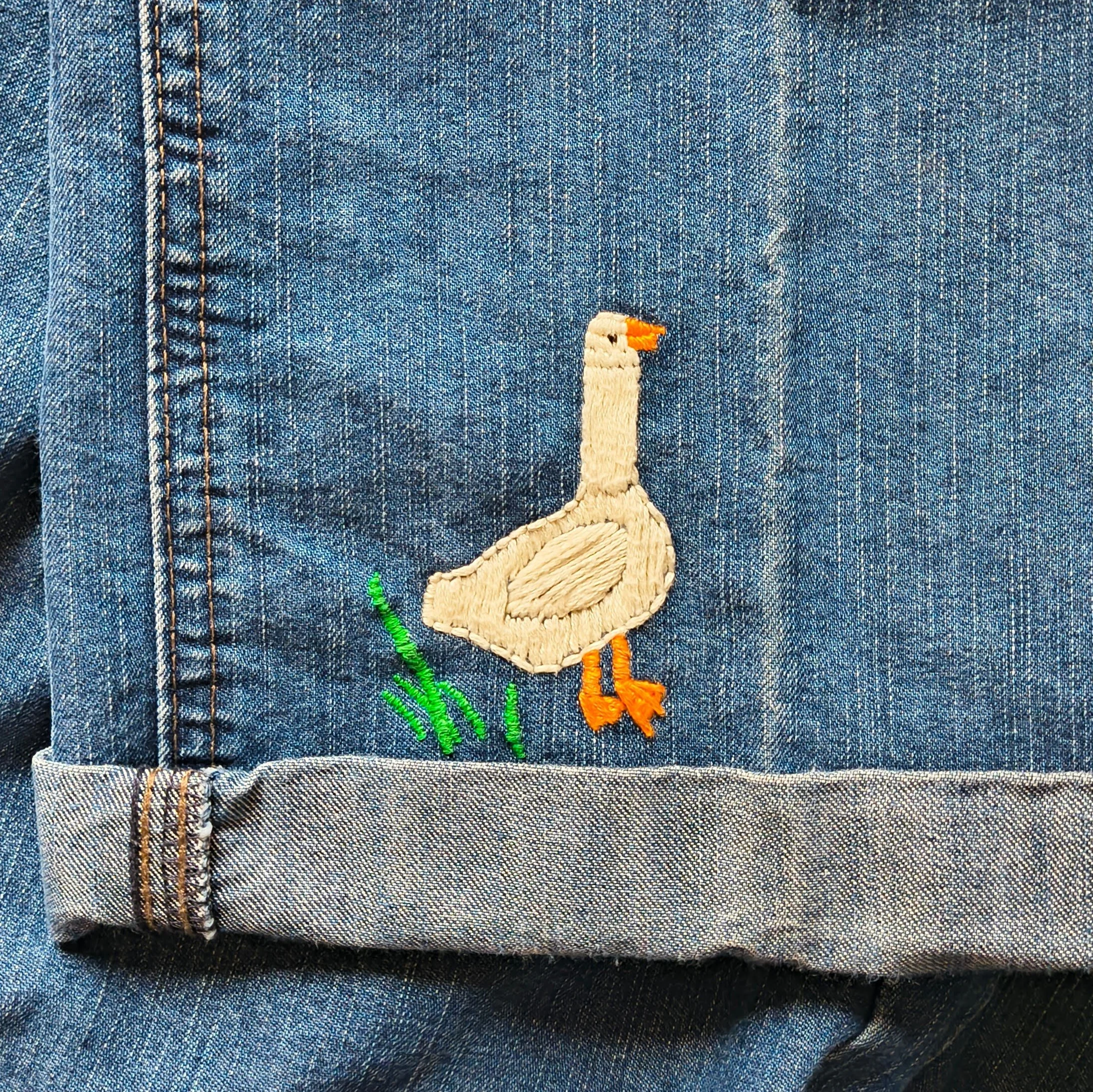
Embellish Everything
I recently changed the logistics of my closet to rotate through three seasonal collections. As a guy, I've been able to go this long (19 years) wearing all of my clothes year-round (like shorts in December), but to switch things up, I've decided to limit the selection and as a result, bring more attention to each article.
Written by Joshua Steely on March 22, 2026
I recently changed the logistics of my closet to rotate through three seasonal collections. As a guy, I've been able to go this long (19 years) wearing all of my clothes year-round (like shorts in December), but to switch things up, I've decided to limit the selection and as a result, bring more attention to each article.
For the current spring collection, I have a lot of gray pieces. An all-gray quarter zip; an all-gray semi-semi-formal collared longsleeves; a light gray oversized worker-esque, not-quite-coat jacket; a very nice dark gray tshirt. And the idea is simple: spring is very gray, yes. Lots of clouds. But there are also pops of color as early flowers poke their heads out and the risk-takers start to bloom after blue rain falls from those gray clouds.
I want to embroider every one of these major gray items, and my Mom responded with this:
"Maybe don't embellish everything."
But here's my response:
"I'm going to embellish everything." Not just as a form of rebellion (though maybe a tiny bit) but with good reason. You see…
I have a pair of Goose pants
Several months ago, I embroidered a pair of cargo-style jeans with a goose on the bottom of the right pant leg. I love this goose, and it (along with the number of pockets) makes the pants my favorite pair ever.
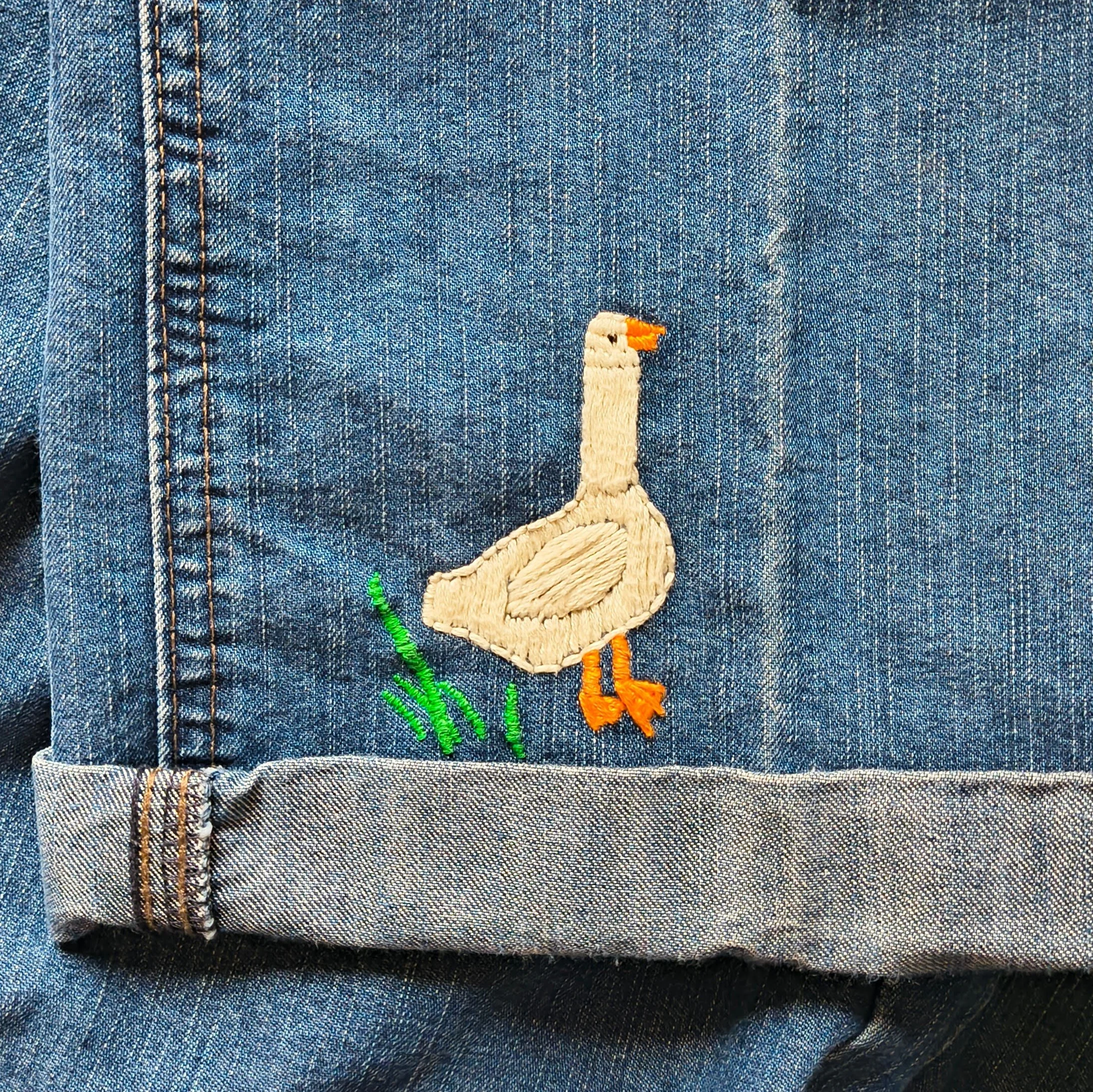
The goose in question ^^ Forgive his derpiness, he was my second-ever embroidery project.
Without the goose, the pants are just nice jeans with a bunch of pockets. But with the goose, it is a smile of denim, joy incarnate. I can't wear them without a little giggle that "ope! There's a goose on my ankle!" and if anybody comments, I can even say I embroidered it!
So the reasoning is simple: Why wouldn't I want more pieces of clothing to bring me that much joy? Why would I not embroider a silly little squirrel on a silly wobbly tree branch with a silly goofy acorn in its silly little hands?
The goal with a gray closet is to encourage me to embroider pops of colors, allowing them to "spring" to life. Little surprises that can make my day a bit more fun.
Of course, I'm not expanding my embroidery endeavors to the dress shirts and suit jackets in my closet–those have their place as unembellished formal-wear. My argument, instead, is for embellishing everything fun. Everything that I'll wear day-to-day, even just around the house, that would benefit from an added smile.
Embellish everything, I say.
You Can't Throw Away Experience
I have a particular approach to photos in my camera roll: I tend to take very few, and delete them within a couple weeks of taking them. Only a few will be transferred onto a hard drive and saved. This is quite opposite of the majority of Gen Z, who have extensive collections of screenshots, memes, and memories in their pocket at all times. I could try and explore the why behind my decision, but I'd rather explore some of the value that stems from the practice.
February 22, 2026
I have a particular approach to photos in my camera roll: I tend to take very few, and delete them within a couple weeks of taking them. Only a few will be transferred onto a hard drive and saved. This is quite opposite of the majority of Gen Z, who have extensive collections of screenshots, memes, and memories in their pocket at all times. I could try and explore the why behind my decision, but I'd rather explore some of the value that stems from the practice.
Moments Matter More
When you aren't living behind a camera, you tend to see more. The other day, I drove through some mountains and I tried to take a couple pictures, but none of them were even close to doing justice to the glory before me. So I stopped trying to capture a moment and just lived in it. It's a similar experience when I see rainbows. No camera can contain the majesty of a sky's ribbon of color. So the eyes of a moment should be the sole witness.
Less Reminiscing, More Forward Momentum
I've known some friends to be tied to the scroll of their own pasts. They'll look back every day, rewatching videos and re-zooming into photos. I have no appeal towards such revisitation. I'd much rather look forward, and see how I can improve, instead of wishing to go backwards in time and sweetening memories with an unnecessary fondness of what's been. I'd rather think of what will be.
Redirection
When I don't have the photos on my phone, I can also do something more practical: send people to this website! After all, here are ALL of the photos of my work, and plenty of writing to explain it. Not that I need an excuse or reminder to promote this website, but not having the photos in my camera roll functions as both.
The Ram Head
Recently, I spent quite a bit of time constructing a cardboard ram head. Or at least most of one. One of those mounted busts that are decently realistic, mastered by the artist Justin King (@justinkingdesigns). I was making good progress, too! The neck took a bit longer than expected, but the face was getting to a good point before… I threw it away.
Yup. Just tossed it in the dumpster after probably 14 hours of cumulative work.
But is it really lost?
Here is an argument for either side.
Yes, it was loss.
Many people would be frankly upset at what seems to be a waste of time. I remember, once, I was working on a "Thneed Factory" project using an old crate as the base. It was a bigger-ish, unnecessary project, and I lost interest halfway through. Because of the limited space of my bedroom studio, I dismantled the project instead of saving it for later completion. Nobody would have known or cared, except, at that time I had Instagram, and had been documenting its progress. So there was somebody at school who had become invested. They were disappointed–on the verge of betrayed–that I would just "give up" on something. It was potent enough of an experience to write a post about, titled "The Value of Walking Away". It ended with,
"I have all the justification I need to scrap hours of work to pursue something I want to do more."
There are some projects, like the Creativity Mural and the Head Hunt, that took a long time but were well worth the wait. There are other projects, like James, that were bigger bites than I could chew in a deadline. Then there were my favorite projects, like the Amazon Box Snail, that are too short and spontaneous to even think about "quitting". The ram was a project I had planned for a while, was aware would take effort, and was worth finishing. But I still threw it away, and now would have to start all over if I want to make another one. I didn't even make the horns! Time-wise, it appears as a waste. Marketing-wise, a travesty. How cool would it have been to show off? Why would I spend 14 hours on something and throw it away? Was I even discontent with it? Not really.
It's hard to know how somebody upset would feel, because I don't feel that way. I do consistently end projects when I've lost interest. I do delete pictures. I do throw away sketchbooks. I'm not sentimental like that. So I don't know.
No, it was gain.
I think it was gain, honestly. I now know just how long getting to that point in a project like that takes. If I want to make another, I can get to that point faster and better. It's like when I made the boats for WonderSpace. I understood how the first one was made, and could make a second boat so much cleaner (then there's the tricky part where I actually liked the first one more… but that's irrelevant). As I made more and more figurines, I could make them better and better. As I taught more workshops, I could teach them better and better.
It doesn't matter that I didn't finish a project, because the process still took place. I experienced the making, so if I need to make another, I will have that much more of the making under my belt–understood by experience.
I can't throw that experience away.
Say, if I were to delete Minecraft off of my computer (again) it wouldn't change the hours and hours I've put into the game–the deep understanding I have of mechanics and creators like Hermitcraft. I still would have been a massive fan of the game from at least as early as age 11 until 19. The memories don't leave.
I can't throw away memories like I can pictures and journals.
So even though the ram got thrown away, it wasn't lost. My hands remember the forming of the nose, the hot glue that dripped on my knuckles, and the way the side eye stared into my soul as the head lay incomplete on the floor. How I almost hugged it, because it was just the right size for hugging. That wasn't lost.
The undertone
The reason I'm exploring the permanent nature of experience and the irreplaceable gain of moments, as opposed to the impermanence of art, is that I just took another turn in my college journey. WMU didn't work out for me, so I'm onto another yet unwritten page of my book. Was WMU a waste? Absolutely not. It answered the lingering question mark–the unresolved wondering–about Paper Engineering and Kalamazoo. Those questions are now answered–in the negative. But I had to "waste time" to learn that. It was an expensive "mistake" I needed to experience to lead me to the next thing–the next experience that may or may not lead to my eventual career, that may or may not again change many more times throughout my life. Nothing is certain, except the certainty that nothing is certain. (Not to quote Descartes).
It was valuable to go. And valuable to leave. Now whatever is next will also be valuable in new ways. And
I'm excited to experience it.
Buried Under the Weight of a Thousand Shoulds
Whether it should be a collection of poetry, a novel, or even a collection of essays is my only question. But I know something needs to come of the lyrical language. My consideration of each medium is as follows:
A collection of essays lamenting an unknowable future.
It's no secret I was excited to take the course titled "Existentialist Philosophy" this spring. But now, after a class, I'm even more excited to continue.
Professor David Paul, Chair of Western Michigan University (WMU)'s Department of Philosophy, is a teacher who appears to truly love his job. He brings the room's energy up by at least ten octaves by just being himself–an unserious collaborator and lifelong learner. Prof Paul doesn't appear to have slowed in his engagement with life, and the way he ran the first week of a two-and-a-half-hour Tuesdays-only class showed it.
The format was quite reminiscent of the John Wesley Honors College (JWHC) at Indiana Wesleyan University (IWU). It was a mix between a professor offering up ideas and students engaging with them. There were partner, group, and class discussions, as well as individual reflections. As he mentioned in the class, WMU does not place prerequisites on their Philosophy courses, so the diversity of academic focus in the room is impressive, and leads to truly intriguing conversation. The blend of personalities is also obvious. There are some talkers and some listeners, some set in their ways and some open to new ideas, some who want to be right and some who don't mind disagreement. The range of backgrounds is much broader than that of IWU's predominately young Christian bubble. I look forward to bringing my spiritual background to conversations with adamant atheists in this course that I wouldn't have found at IWU.
The very first week of the course, we discussed Plato's Apology and Crito. Two complex pieces debating the extent of political obedience regarding integrity is a bombshell of a first discussion. But Prof Paul said it was only an introduction. Next class is about the book of Job.
I suppose some of the slides about Philosophy as a whole looked familiar, but once we started talking about Plato's Republic and the Allegory of the Cave, I realized I may know more Philosophy than I thought I did. After all, the cave was mentioned in nearly every JWHC course I took… multiple times. I also know some history behind Socrates, Plato, and Aristotle. Also Cicero, Hildegard, Luther, Kant, Nietzsche. Apparently I've taken some philosophy courses that simply didn't have "Philosophy" on the nutrition facts, or I didn't read them close enough to see "Contains Gluten" if Gluten is ancient ideology.
If anything can get me more fundamentally excited than discussing philosophical ideas and debating their validity, it is the music of words that write them. Every other paragraph there seems to be a sentence worth memorizing–a rhythm worth remembering.
One such rhythm, however, was shared by Prof Paul himself, not from the book but ad libbed. He was talking about the overwhelming expectations set on college students, saying we are
"buried under the weight of a thousand shoulds"and I wrote it down immediately. Whether it should be a collection of poetry, a novel, or even a collection of essays is my only question. But I know something needs to come of the lyrical language. My consideration of each medium is as follows:
Poetry
Poetry would be quite easy, I believe. But it may not be very unique.
This title would lead to a collection of expectations–the struggle of students to live up to any number of burdens. Finances, self-worth, their parents, friends, romance, academics, health… the list goes on. It would be easy to complain in a thousand ways, scribbling verse in the margins of math problems.
Maybe too easy.
Novel
Again, a novel seems a bit repetitive. (Not very novel, if I may)–like, we don't have enough complaints or coming-of-age stories already?? There are enough YA books out there begrudging expectations, and much better written than I think I could do at this time. Besides, I don't think a novel is what I need. I don't want to get wrapped into a story of a kid struggling to live up to their own expectations and realizing it's impossible. I'm living that right now. I don't need a novel to tell me that you have to accept you'll never be enough in order to be happy. I understand that now. I just…
I don't think a novel is the best choice or is nearly unique.
Essays
I think it should be essays.
In a collection of essays, I could completely explore a variety of expectations, but not worry about their continuity with one another. I can go for 8 pages about the daunting shadow of marriage as a 19 year old, and then switch to the futility of academic successes as it translates to the real world. (In reality, the grade only suggests you can learn, because if you got it the wrong way, it doesn't prove anything). I can write two dozen essays on two dozen topics, 6-10 pages each, and have a 200 page book. Maybe longer if I'm feeling loquacious.
Each essay could be a hub for research and thoughts, complaints and considerations, poetry and quotes. I can weave together a quilt of questions and answer them stitch by stitch. I can write the work this phrase deserves, all while myself being
buried under the weight of a thousand shoulds.
Choosing Cardboard
For those not yet made aware, I am transferring to Western Michigan University for the Spring 2026 semester for my second Sophomore semester to study Paper Engineering. WMU is the school I initially intended to attend until certain circumstances sent me unregretfully to Indiana Wesleyan University. I learned more about myself, communications, and Christianity at IWU, all of which will benefit me as I now pursue a career in the paper industry.
Here are answers to the frequently asked questions I have received as I share the news.
First, I want to mention that although these blog posts are public, they have always really been a self-explorative process. I'm writing as though an audience can and will read them, but the posts are intended to practice my writing skills and to answer questions I have myself. They aren't intended to produce enjoyable content for an audience–they're intended for me to be the primary audience. The process of writing often produces both answers and questions as it happens–I don't have them all before I start writing–so it's fitting that this post is starting off with some of the questions I've been answering on loop for several weeks now.
For those not yet made aware, I am transferring to Western Michigan University for the Spring 2026 semester for my second Sophomore semester to study Paper Engineering. WMU is the school I initially intended to attend until certain circumstances sent me unregretfully to Indiana Wesleyan University. I learned more about myself, communications, and Christianity at IWU, all of which will benefit me as I now pursue a career in the paper industry.
Answers to the FAQs
What is Paper Engineering?
"Guys." I want to plead, "it's engineering, but with paper." I haven't taken a single one of the classes yet, so I really can't answer the question in much depth. Besides, the question doesn't make sense to me!--I get a little annoyed, to be honest, each time I hear it, because when someone hears "Chemical Engineering" or "Civil Engineering" they don't ask "what's that?" even though those fields are NOT self-explanatory. Far from it. But now people are confronted with an entirely self-explanatory concept and they don't put two and two together: it's PAPER. ENGINEERING.
Setting my unnecessary rage aside, I often respond with something like, "Well, it's a branch of chemical engineering. Think about all the different paper products you interact with! Egg cartons are different from amazon boxes are different from cheerios boxes are different from copy paper. Not to mention sticky notes, index cards, and even those little label stickers that dry up after a couple years but my Mom still has them somewhere in a drawer. Each of those paper products has a different chemical composition that gives it the strength or smoothness it needs. That's what a paper engineer understands and alters." And people are typically content with that answer. They respond with "oh that makes sense!" or "of course paper engineering is a thing! I just never thought about it." Which is fair. But is it fair? Why have we not been made aware of basic environmental engineering positions, and instead, American highschoolers aspire to sell pharmaceuticals?
Why did I pick Paper Engineering?
Now this is a scholarship question. People aren't really asking me this as often in-person, but questions along the lines of "why do you like cardboard" pop up. I have a couple answers. Which one is the truth? I couldn't say. I think a combination is the reality–the only falsehood would be saying only one answer is true.
My go-to response is: "Well, I grew up in a big family (5 siblings) so there was always plenty of cardboard. We ate a lot of cereal, at least. So cardboard was the cheapest, most accessible material for me to make stuff with. And I'm an artist at heart." and most people are content with that answer. I can then expand it to talk about Moosey Club, my figurines, and the more recent Cardboard Club if I'm feeling chatty and they're acting receptive. It feels like a genuine response, and is one of those "cardboard has been with me through my whole life" making-of-the-hero backstories.
My more flippant answer is "it's funny," but truly, that may be an equally genuine answer. I'll dive into "the power of a niche" more later on in this post, but the short answer is this: people are going to remember you for something. So why not choose what they remember you for? Cardboard is harmless, and even lighthearted–which is what I'm going for in memories.
My third answer, that I've never really shared out loud, is that cardboard is part of my identity now. It's a mixture of both the first and second responses: I've been making stuff out of cardboard since Elementary school and people have remembered me for it (see: "So you're the Cardboard Guy?"). There was a short period of time where I thought "it's time to move on to sewing…" and don't get me wrong, I've been working on my sewing and embroidery skills more than ever, but trying to cut out cardboard hurt my spirit. My business cards are even made of cardboard! I put "Avid Communicator meets Cardboard Enthusiast" as my LinkedIn tagline and it makes sense! I was a communications major when I came up with it, but I remain a communications scholar even without taking the classes (Currently, I'm working on David Brooks' How to Know a Person (2023) which is unarguably a communications book). Tangents aside, cardboard is so folded into my past that I truly want it to remain in my present and future. There are enough memories burned into the brown paper that the smoke is all I see.
But do any of those three answer the question? Not really. They need a supplement to be a proper answer. That supplement is this: I want to learn all I can–way "too much"--about the material I love: paper (or, more accurately, cardboard). In part because I think it'd be funny, in part because the material is baked into my past, and in whole because I want it in my future.
How do I feel about Western Michigan University?
The third question typically revolves around my switching schools. Western Michigan University (WMU) will certainly be a big culture shift from Indiana Wesleyan University (IWU). There's no doubt in my mind about that. But there are certainly not only "bad" shifts.
While it's not nearly my biggest priority in a school, my family and mentors are invested in the religious quality of an institution. I am a Christian, and Christian values are important to me. At IWU, those values were largely modelled by staff and directly encouraged from students. Prayer and spiritual fellowship were not just allowed, they were recommended and enforced by chapel credit requirements. Forced religion leaves a sour taste in my mouth, as does the assumption that calling yourself a Christian makes you "better" than anyone else. While only a select few students actually may feel that way and the vast majority are far from self-righteous pricks, those few don't help schools like IWU feel welcoming to the unbelievers–as Jesus was. If anything, WMU will be a fantastic opportunity for me to leave a bubble of religious comfort, where everyone tends to fundamentally agree, into a challenging atmosphere of constant disagreement and consequent discussion. IWU was pivotal in constructing my foundational beliefs, and now WMU will give me the chance to test those beliefs.
One of those tests is drinking. Indiana Wesleyan follows the Wesleyan Church doctrine, in which alcohol is entirely prohibited on campus and even off-campus for staff. If you work at IWU, you aren't allowed to drink. On the other hand, Western has their own wine label as a result of a business class. They have–what I can imagine live up to the stories–fraternities and sororities. They have a bar in the student center. Drinking is not only allowed, it almost appears encouraged. Alcohol's prevalence will be a fantastic test for my belief that it should not be consumed–at least not by me. I have no inclination to hinder my intellectual capacity at any point. If I think thinking is too much, then I will make efforts to learn what I believe to be healthier coping and management strategies than self-inflicted blurriness. That all to say, Jesus did not view alcohol consumption as a sin (only its overconsumption and misuse) turning water into wine and all, and even if he had, he would not have shamed people for it. Likewise, I honestly hope to witness people drinking so that I can practice gracious refusal and yet Christlike acceptance as they are. While I will never buy alcohol, or allow it into my home or vehicles, I can still love and support those who choose a belief system different from mine.
Other belief systems that differ from mine are LGBTQIA+ and mixed housing opportunities, but I don't see this website as a place to discuss politics. On a similar note to alcohol, I will have the opportunity to practice accepting all kinds of people without agreeing with them.
WMU is a much larger campus than IWU, with a student population of roughly 17,000. That means it has more funding, and therefore more opportunities. I am looking forward to exploring those opportunities and meeting those people.
Western also is a very environmentally-focused campus! They have solar-powered benches, composting bins, and degrees like "paper engineering" (whatever that is!). Having such a large institution championing the environment gives me hope. Hope that we can and will choose to steward this planet well after all.
In sum, I appreciated IWU and how its tight-knit community helped me grow stronger in my faith and communication skills, and I am extremely excited to dive from that pond into the ocean that is WMU, filled with sharks but also the most glorious sunrises.
The power of a niche
Thomas Edison may have had 1,093 patents, but kids in the American school system still only know him for one thing: the lightbulb. The controversy surrounding that statement isn't the point. The point is that the general populace will associate an individual with one thing. Just one. Tom Holland? Spider Man. Tobey Macguire? also Spider Man. Andrew Garfield? Well, he actually has had some really good other roles (see: Hacksaw Ridge, Tick Tick Boom), but also… Spider Man. Well, I don't want to be another Spider Man, so I'm choosing cardboard.
When I got to my first day of college, I had a plan. And by a plan I mean three things: a red crocheted water bottle holder, the game bananagrams, and business cards made from cereal boxes. Three memorable things to establish my identity quickly and painlessly. I walked around with the water bottle at all times, so there was visual consistency (I also limited my closet to IWU colors: red, white, gray and black). I could play the game Bananagrams with anyone that wanted (and beat them every time) so there was activity consistency. And of course, I could hand them a business card from a cereal box, a novelty that could lead anybody interested to more of my work (here!). Again, something consistent that introduced part of my identity.
I learned several things from those three things. First, that the visual consistency/oddity got the most questions: I heard "I love your water bottle holder! Did you make it?" at least a hundred times. Second, that the game had the most interaction (somehow, even though they rarely won–I've scheduled entire meetings just to play Bananagrams). And third, that the business card was the most intriguing, and led to the most money. Without that business card, I wouldn't have had my Spring 2025 Cardboard Club or sold two massive cardboard boats!
But three niches don't count. So here's why they aren't three niches: First, the visual oddity can change. I could start wearing strange socks or fancy ties or this wacky hat–the point is that there is something out of the ordinary visually that can ease the start of a conversation, and then that conversation can lead to other, actually useful or engaging topics. My appearance will change and my tastes in clothing and accessories will change, but the concept doesn't. Therefore the concept isn't a "niche"--it's a conversation strategy. Second, the game doesn't count. Yes, Bananagrams is a lesser-known game, and there are 18 "versions" (of which I own all of them) but it's not something that can be discussed at length. Maybe if there were competitive Bananagrams events I could make something of it, but as it stands, collecting a game and being good at it and known for it does not qualify enough as a "niche" as I am defining it. On the other hand, the games Minecraft and Magic the Gathering (MTG) are niches, and I fall into those. But the niche to be understood in this post is paper.
Paper counts as a "niche" because there is SO much to know about it. Cardboard is just layered paper, but that makes it another layer deep into the "niche" category. Not all paper is cardboard, but all cardboard is AWESOME (ahem, I mean all cardboard is paper). Better yet, cardboard isn't famous in the same way games like Minecraft or MTG are. There aren't uber-famous creators or massive competitions for "cardboard" (barring, of course, Sherri Madison (the Queen of Cardboard), Sam Wilde (of Cardboard Adventures UK) and other incredible, but rare, cardboard creators). People aren't even as commonly known for loving "cardboard" as they are for loving frogs, let alone the superior creature: turtles! It's a rarer niche.
Remember, people are going to remember you for something. If you control what that something is, then you have consciously chosen your niche. I am choosing cardboard for the reasons mentioned above, like: it's funny. I love cardboard, and not many people say that, which makes me stand out and can be used as a platform for sharing things that are or become important to me.
The Abundantly Adaptable Medium
Perhaps even more so than when I was younger, cardboard is ever-present and entirely cheap (unless you're referring to MTG cards as "cardboard" in which case it is entirely expensive). Cardboard also has more use-cases than ever. There have been awesome breakthroughs in packaging like one that can replace some bubble wraps with paper-based self-locking wrapping, and even new methods of paper creation, like the new Ukrainian company "Releaf" making it out of old leaves! These are proof that we haven't found nearly all of the commercial uses for paper, let alone the entertainment uses. Whatever I decide to pursue, paper will be able to adapt to it.
The Rebuttals
What about Creativity? Isn't engineering all math?
Well, that's an extreme oversimplification. Besides, creativity permeates every field, especially engineering. To be fair to the asker, the question was phrased moreso in a way that was asking about my art: "you're choosing math and science over art?" In that case then yeah: career-wise, yes.
Here's the idea though. If I continue with just visual arts I could learn some more about the mediums I'm using and the processes of creating with them. That's true. But if I take the engineering route, I will learn SO much more about paper, and can continue art on the side. Math and science will be tools to enable greater creativity. Think of architecture: anybody going into it is studying for at least three separate bachelors worth of material: art, math, and engineering. I don't know much about architects, but I know they are creative and use a lot of math, as do engineers.
Where's my entrepreneurial spirit going?
Valid question. If I pursue a salaried position at a Paper Mill, it appears as though I'm abandoning previous entrepreneurial ideas. But Don, (and anyone else who supported the CRATE idea) you'd be happy to hear that may not be the case. While I certainly don't expect to start my own paper mill, I think the experience and understanding of paper and processes will transfer over. Imagine this: a person with a masters in Paper and Printing science with years of experience in the paper industry starts a cardboard-focused recreational arts facility. Now that person would know what they're doing and have connections in all the right places. IMAGINE?? That's going to be me in 20 years, having built up the capital, connections, and experience to truly realize the cardboard club of my dreams. A LegoLand, but cardboard, hosting countless creative workshops and artists from all over to master the medium of paper. The CRATE concept isn't going anywhere, it's being transformed and improved slowly and steadily.
What if I get tired of paper?
Hopefully that will never be the case. I highly doubt it will. But if I do, then I can use the transferable skills I will have learned to pursue my new interests. Project management and professionalism will improve in whatever position I'm in, and will help in any new position I enter. But let's be real,
how could you get bored of cardboard?
Looking for a particular post?
-
2023
48
- Jan 12, 2023 Hamsters Jan 12, 2023
- Jan 12, 2023 Art Museum Sketching Jan 12, 2023
- Jan 12, 2023 Frogs for a Good Cause Jan 12, 2023
- Jan 12, 2023 Art in Trigonometry Jan 12, 2023
- Jan 12, 2023 Free Caricaturist Jan 12, 2023
- Jan 12, 2023 Disney Mashup w/ @k.steely_the_artist Jan 12, 2023
- Jan 12, 2023 Art Studio in a Van Jan 12, 2023
- Jan 12, 2023 There’s a House in my Boot! Jan 12, 2023
- Jan 12, 2023 Minecraft Dungeons was a Spark Jan 12, 2023
- Jan 12, 2023 [Insert Straw Pun Here] Jan 12, 2023
- Jan 12, 2023 Oh Christmas Tree Oh Christmas Tree Jan 12, 2023
- Jan 12, 2023 Why Sketchbooks are the Greatest Thing Ever Jan 12, 2023
- Jan 12, 2023 How to make the Perfect Christmas gift Jan 12, 2023
- Jan 12, 2023 I drew a house Jan 12, 2023
- Jan 12, 2023 I designed my own Rodeo Stampede Animals Jan 12, 2023
- Jan 12, 2023 MiPads Jan 12, 2023
- Jan 12, 2023 2d or 3d Art? Which do I prefer? Jan 12, 2023
- Jan 15, 2023 Utilizing Other Peoples’ Energy Jan 15, 2023
- Jan 16, 2023 Goodwill Builds (ft. Waffle Blanket) Jan 16, 2023
- Jan 19, 2023 I spy with my artistic eye… Jan 19, 2023
- Feb 4, 2023 Art Teacher Simulator Feb 4, 2023
- Feb 15, 2023 Proportional Importance Feb 15, 2023
- Feb 23, 2023 How to sketch a sculpture Feb 23, 2023
- Feb 27, 2023 Overdoing it Feb 27, 2023
- Feb 28, 2023 Old Vehicles into Park Benches Feb 28, 2023
- Mar 27, 2023 The Word of the Day is Patience Mar 27, 2023
- Apr 5, 2023 How to have a Productive Break Apr 5, 2023
- Apr 5, 2023 Define Useless… Apr 5, 2023
- Apr 25, 2023 My Kind of American Football Apr 25, 2023
- Apr 26, 2023 Behind the Business (Cards) Apr 26, 2023
- May 7, 2023 Preserved Through Planning May 7, 2023
- May 26, 2023 The significance of June 25th May 26, 2023
- May 28, 2023 The Heads or Tails Machine May 28, 2023
- May 30, 2023 The Legend that is Harry Smiles May 30, 2023
- Jun 7, 2023 Thoughts about My First Ever Workshop Jun 7, 2023
- Jul 2, 2023 Now THAT’S how you run an Art Camp Jul 2, 2023
- Jul 10, 2023 Duck Architecture is SO COOL Jul 10, 2023
- Jul 22, 2023 Blank Space: The Game you 100% Make Up Jul 22, 2023
- Jul 29, 2023 The Tipping Point (by Malcolm Gladwell) Jul 29, 2023
- Aug 13, 2023 Creativity > Efficiency Aug 13, 2023
- Aug 30, 2023 I want a taco truck Aug 30, 2023
- Sep 15, 2023 “It’s Not Her.” Sep 15, 2023
- Sep 27, 2023 The Biggest Decision of my Life (so far) Sep 27, 2023
- Sep 30, 2023 A post about Purpose Sep 30, 2023
- Oct 11, 2023 The Idea Box Oct 11, 2023
- Oct 22, 2023 A Tentative Return to Social Media Oct 22, 2023
- Nov 15, 2023 Artistic “Style” Nov 15, 2023
- Dec 23, 2023 An Audacity Evaluation Dec 23, 2023
-
2024
17
- Jan 13, 2024 The Value of Walking Away Jan 13, 2024
- Feb 18, 2024 “The Thought Box” Event Idea Feb 18, 2024
- Feb 24, 2024 The Scholarship Essays Feb 24, 2024
- Mar 2, 2024 “Simple Pictures are Best” Mar 2, 2024
- Mar 9, 2024 Downloading a Virus to make a Cardboard Deck Box Mar 9, 2024
- Apr 14, 2024 The Deck Box Initiative Apr 14, 2024
- May 29, 2024 Trying Everything (why this website is poorly maintained and I'm okay with that) May 29, 2024
- Aug 26, 2024 (In)Finite Enthusiasm Aug 26, 2024
- Oct 4, 2024 I called it! (unsurprisingly) Oct 4, 2024
- Oct 25, 2024 Meaning in Materials and Autobiographical Art Oct 25, 2024
- Oct 31, 2024 On Adaptability and Switching Majors Oct 31, 2024
- Nov 16, 2024 What Francisco de Goya, Nick Cave, and Nathan Foley have in common. Nov 16, 2024
- Nov 16, 2024 Art and “the Media” Nov 16, 2024
- Dec 5, 2024 SPACESHIP (Visualizing Childlike Wonder and Creativity) Dec 5, 2024
- Dec 8, 2024 A Checklist Conclusion (Part 1) Dec 8, 2024
- Dec 25, 2024 A Checklist Conclusion (Part 2) Dec 25, 2024
- Dec 26, 2024 My mom said I should write about the ewok child. Dec 26, 2024
-
2025
15
- Jan 29, 2025 Blastoff in 3… 2… Jan 29, 2025
- Feb 2, 2025 “So you’re the Cardboard Guy?” Feb 2, 2025
- Feb 4, 2025 “Are you happy with that?” Feb 4, 2025
- Feb 13, 2025 Asking More Questions Than the Students… Feb 13, 2025
- Mar 11, 2025 Prioritizing Creativity Mar 11, 2025
- Mar 25, 2025 Brainstorming some Improvements Mar 25, 2025
- Apr 5, 2025 The Pilot Episode Apr 5, 2025
- Apr 25, 2025 Emphasizing Impermanence Apr 25, 2025
- May 22, 2025 Artistic Autonomy May 22, 2025
- Aug 4, 2025 Ideas? Meet your Makers. Aug 4, 2025
- Aug 5, 2025 En Masse Aug 5, 2025
- Aug 12, 2025 Observation, Creation, Communication Aug 12, 2025
- Sep 23, 2025 Communication is an Art Form Sep 23, 2025
- Nov 13, 2025 Islands in an Ocean of Words Nov 13, 2025
- Dec 9, 2025 Enjoy the Waffling Dec 9, 2025
-
2026
11
- Jan 6, 2026 “Cardboard” in 300 words Jan 6, 2026
- Jan 6, 2026 Choosing Cardboard Jan 6, 2026
- Jan 16, 2026 Buried Under the Weight of a Thousand Shoulds Jan 16, 2026
- Feb 22, 2026 You Can't Throw Away Experience Feb 22, 2026
- Mar 22, 2026 Embellish Everything Mar 22, 2026
- May 2, 2026 Start it Up! May 2, 2026
- May 3, 2026 Lesson Plans, Volume 1 May 3, 2026
- May 7, 2026 Explanation Clarification May 7, 2026
- May 25, 2026 First Bite Conversations May 25, 2026
- Jul 7, 2026 What silence says… Jul 7, 2026
- Jul 23, 2026 Like a Smiling Headless Chicken Jul 23, 2026