
blog
Why a blog?
I’ve always loved sharing my ideas with whoever will listen (or is unlucky enough to be within earshot). Most of them go nowhere after that, but a couple end up worthwhile! This site is a way for me to share my ideas with people beyond earshot, and doubles as writing practice!
I hope one day somebody may be inspired by what I’ve shared and go on to do things greater than I could have ever dreamed of. I couldn’t exactly take credit, but if I’m even a slight influence towards something greater, that’s a win.
Preserved Through Planning
This was actually the first time I had heard directed at me “So I have these cool, valuable items that no longer really serve a utilitarian purpose, and would love a display made for them.”
Well, not exactly that wording, but basically that message.
This was actually the first time I had heard directed at me “So I have these cool, valuable items that no longer really serve a utilitarian purpose, and would love a display made for them.”
Well, not exactly that wording, but basically that message.
The calipers in mention were those of my Great Great Grandfather, or someone that caliper of antique-ness, and six was the perfect number for a cool display.
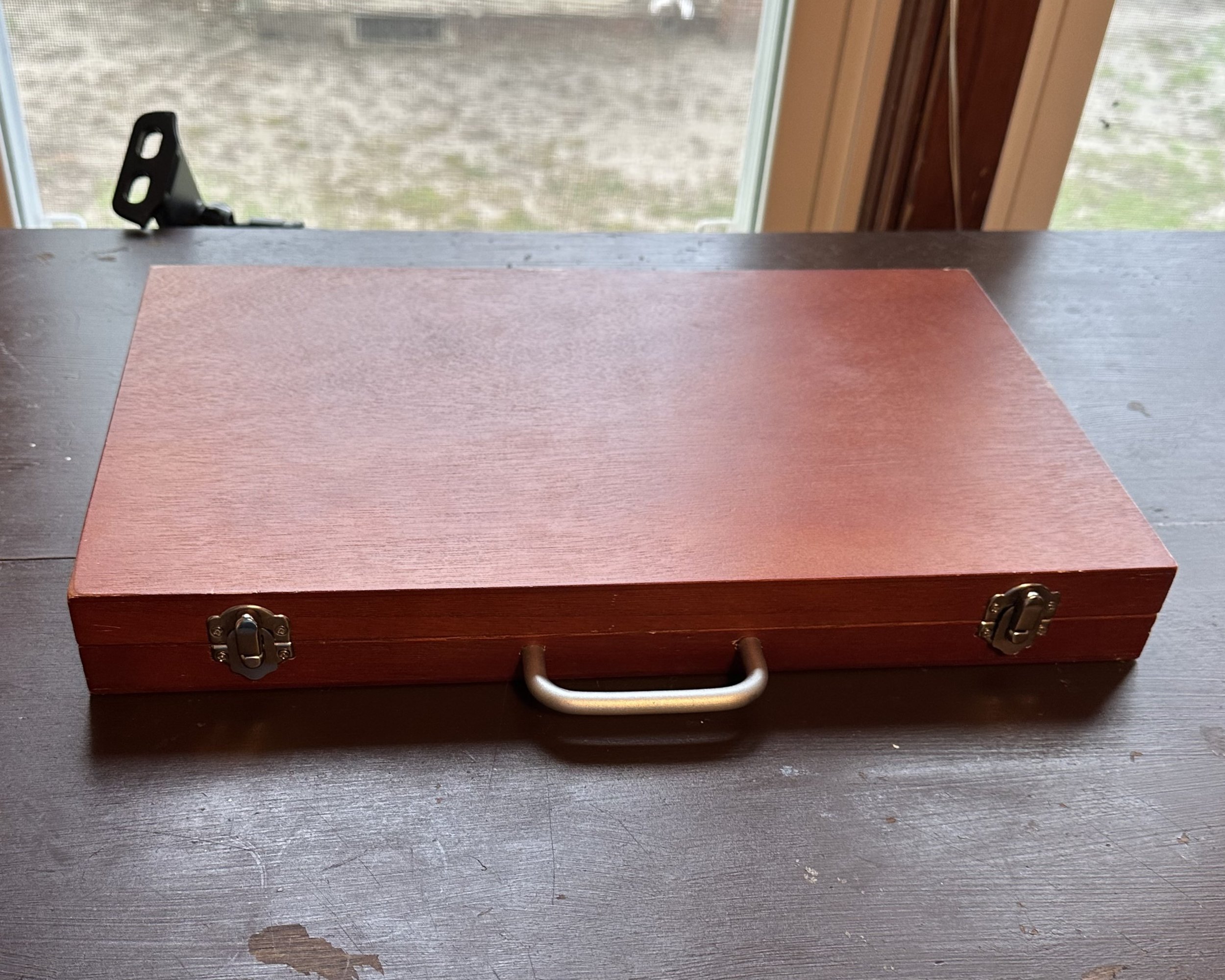
When I brought them back to my room I set them down, and for some reason decided to deep-clean my entire room. Through the process I found the perfect little wooden case with intact snaps and a handle (fulfilling step one: find a prior acquisition that fits means).

With the case in hand, I recalled watching a Colin Furze video in which he builds his dream workshop, featuring Shadow Foam. The foam is a gorgeous way to build a custom and practical display for his tools. Boy would I love to do something like that someday. (Step two: use prior knowledge to formulate a next step).
In the meantime I knew I could buy a cheaper, thinner foam online and try my hand with it.
It took plenty of time to measure and cut everything, but the result was fantastic.

The process had me comparing myself to YouTube creator Jazza, who likes to try new mediums with a “Dabble, then Dive” approach. I had watched the video from which I gained a bit of knowledge about the foam, then I tested a knife on a piece I bought in order to see how it worked, then I created a display! (Step three: create what you wanted to in the first place and be proud of your handiwork).
All in all a fantastic crafting experience.
Behind the Business (Cards)
For the longest time, cutting straight lines was a nightmare. Anything professional-looking has straight lines (or perfectly curved lines). The second something looks like it was hand-cut by scissors is when it loses credibility.
I cut hundreds of bookmarks by hand for my Moosey Club, but that practice never resulted in perfection, and even years later I still cannot hand-cut a perfectly straight line.
That is, until I got a new office chair.
For the longest time, cutting straight lines was a nightmare. Anything professional-looking has straight lines (or perfectly curved lines). The second something looks like it was hand-cut by scissors is when it loses credibility.
I cut hundreds of bookmarks by hand for my Moosey Club, but that practice never resulted in perfection, and even years later I still cannot hand-cut a perfectly straight line.
That is, until I got a new office chair.
So you see, Staples offers a warranty option with chairs, so when we bought the chair, we got the warranty with it. Thank goodness too, because within a week my hundred dollar chair had a massive rip in the seat. I stuck a pillow case over it, so it works just fine, but since we got the warranty we called Staples up. Instead of giving me a replacement chair, they refunded me the purchase price in a gift voucher for their store. So there I went to buy an incredible, eighty dollar, guillotine-style paper cutter from Staples with all the justification in the world.
Boy has it been worth it. I can make birthday cards, bookmarks, trim laminated papers, cut down posterboards, cut cereal box tabs off, and most importantly: make business cards.
I came up with the idea of making business cards out of cereal boxes shortly before the opportunity to purchase the paper cutter arose, so when I got it, I jumped straight to making them.
I tested a couple sizes, found the best one, then cut hundreds of them. Hundreds.
Of course, if my intent was to produce a professional-looking card, there’s no way I could handwrite my information on these things, as that’s the opposite of professional. So there I went to Vistaprint.com to order myself a large, self-inking stamp. So worth it. And
So. Satisfying.
Yeah, factory work turns tiring eventually, but for me nothing was more enjoyable in those moments. Try self-inking stamps sometime… they’re quite therapeutic.
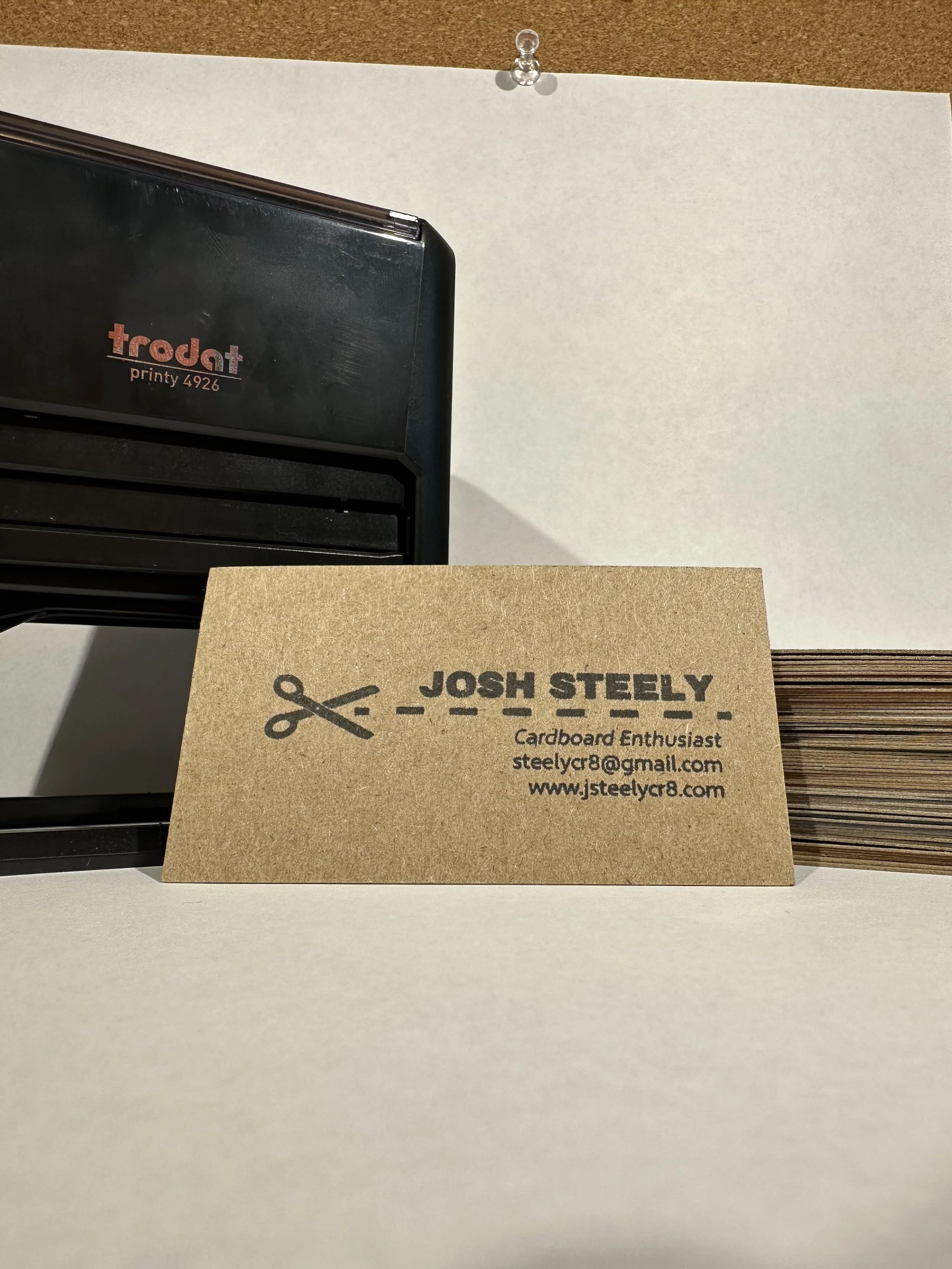
My first batch of cards included my name, a nice-looking scissor line I found on canva, and then my phone number, email, and instagram.
My newer cards are basically the same, but rather have the Cardboard Enthusiast title and my website (which you’re on! congrats) replacing the phone number and instagram, as my Instagram is on the website, and I’m not sure if I needed to be giving out my phone number anyways. I also made the font a bit clearer, and marginally larger.


The response I tend to get when I hand someone a business card is one of surprise. I’m not saying cardboard business cards are unique to me (in fact, Western Michigan University’s Paper Pilot Plant produces recycled paper cards out of their food service’s boxes for their outreach coordinator) but I am saying it’s a bit rare for a sixteen year old to hand someone something so professional-looking and resourceful. They tend to ask what it’s made out of, and most of the time I can identify the exact box just by the small rectangle (often the nutritional facts side bar of the original box). It’s quite a fun little game. (The part where I have a .com website is always fun to get reactions for as well).
Anyways, if you want to surprise people, don’t necessarily make business cards out of cereal boxes (that’s my thing), but do something unique. I read a book recently in which the author explained his deliberate wearing of bright yellow shoes to networking events. He was able to have a lucrative talk with a high-demand venture capitalist thanks to his outlandish shoes attracting their attention. People will notice something of importance in you, beit good or bad. You might as well design it yourself in the greatest way possible so as to leave the most accurate impression possible.
My Kind of American Football
You know those hat days that American schools have every so often? One of those was incredible for me thanks to my clumsiness.
Of course I didn’t mean to bump my ceramic-ish moose head off its spot on the wall and let it crash to the floor, only saving an antler… twice… but it resulted in a cool project.
You know those “hat days” that American schools have every so often? One of those was incredible for me thanks to my previous clumsiness.
Of course I didn’t mean to bump my ceramic-ish moose head off its spot on the wall and let it crash to the floor, only saving an antler… twice… but it resulted in a cool project.
This may have well been the first significant art project I made with my Dad in which we went out and actively bought supplies for it. Sure the supplies just included some fastenings, brown fur, and foam padding, but it was significant for me, as I was in my “moose” phase.
Quite a long duration of my elementary and early middle school life was centered around an obsession with moose (and yes, for the love of Pete, the plural of moose is moose). I collected dozens, if not hundreds of moose-themed and related items over those years, as well as made an entire club around a character named “Moosey” in which we participated in service projects and made moose/Moosey-themed crafts I directed.
So yeah I had a ceramic moose head on my wall from the hunting/knife store my Dad was quite fond of.
Three different times.
The third one I still have intact (knock on wood), but the first two ended in a heaping pile of shattered pieces, except for one antler from each.
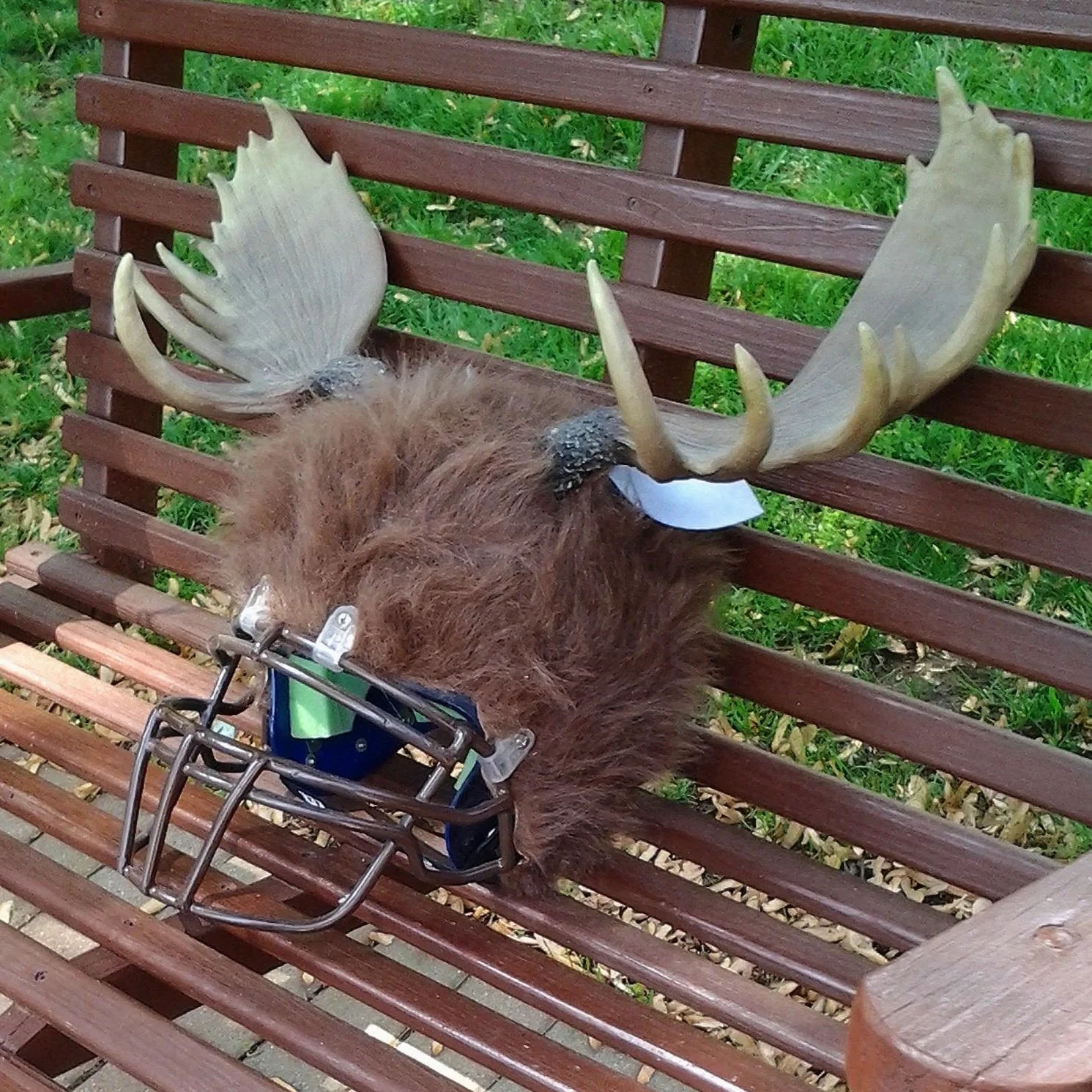
These antlers would go on to create the best football helmet I’ve ever seen:

It’s been many years since we made it (I think it was around the start of the sixth grade) so I don’t recall the exact steps we took, but I remember there was some drilling, attaching, glueing, and decorating at my Grandad’s workshop. What I do remember quite fondly is the day I wore it to school… and the teachers could do nothing about it, as it was an American School system “hat day”.
The number of looks I got was phenomenal.
I understand the negative connotations with anyone self-absorbed, but I have to admit I quite enjoy showing off the hard work (even if my Dad did most of it in this case). It was fantastic.
Define Useless…
Is anything ever truly useless?


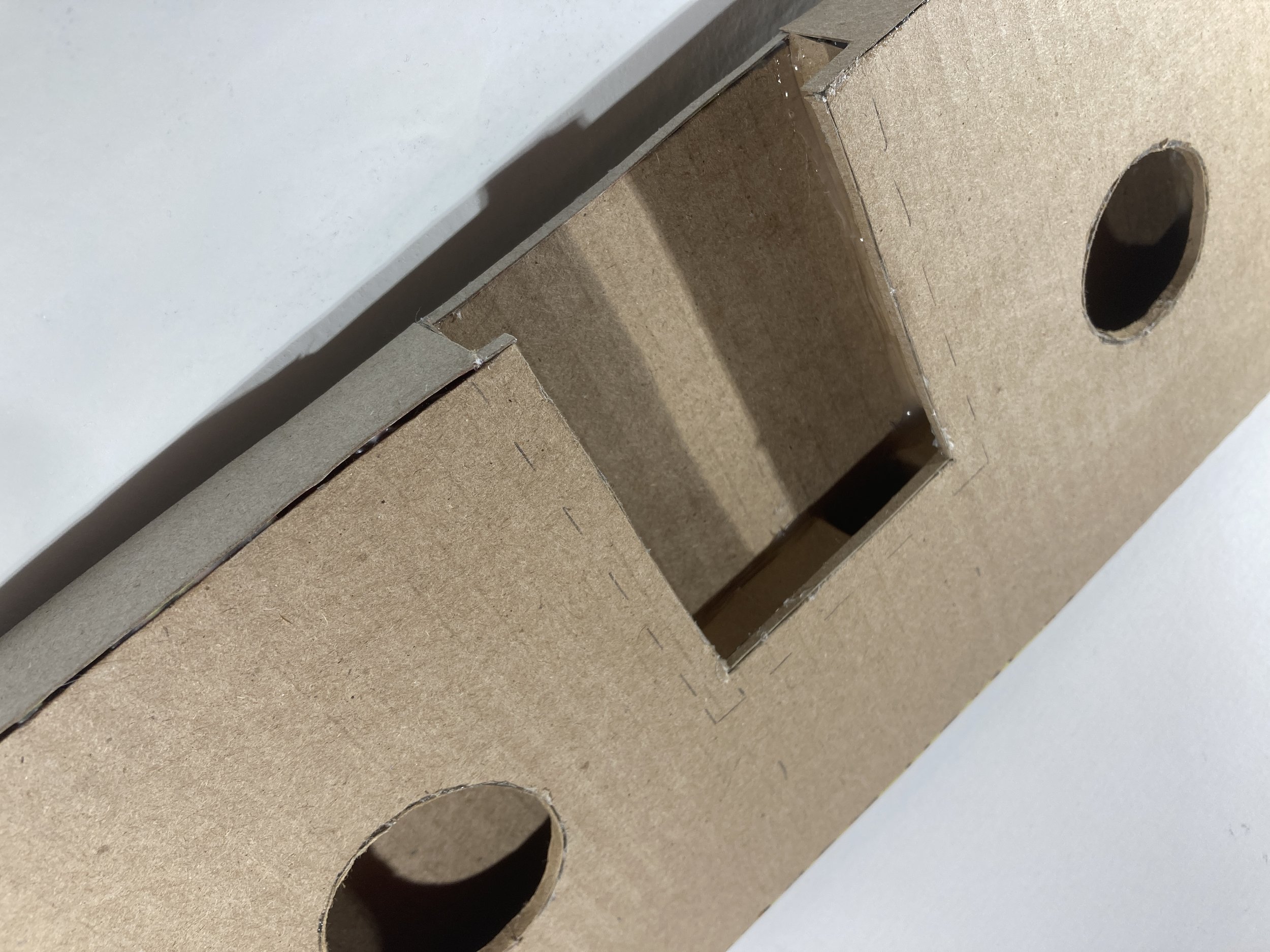
By all accounts, the cardboard “sound amplifier” I made for my phone is useless. It didn’t really make anything louder, and now that I have a new phone (that is larger, so it doesn’t fit) it truly seems like a waste of space.. And yet I feel there was absolutely something gained from making it.
I saw a really cool Instructable that made a cell phone amplifier out of scrap wood, so of course I had to try making it out of cardboard. I know it didn’t really end up working, but I got to practice my new method of adding edges to the previously rough-looking ends of the boxes, and of course, my knife skills.
Even when I realized shortly after starting that all the gaps in the boxes would probably just absorb the sound rather than amplify it, I still saw the project through to completion. Was it useless? No. It was an experience. And experiences are never useless, as there is always something to be gained from each and every one. If not a new functioning amplifier, then a little bit more skill with the materials that will surely come in handy for future projects.
Maybe you prefer drawing, or metalworking, or woodworking, or like me, enjoy making stuff from cardboard. A really great way to branch out is to choose an instructable (or random project) made in a different medium, and try making it in your own. Honestly, it’s something I’ve done twice now, and have loved it both times. (The first time was a park bench in case you were wondering). Maybe give it a shot!
How to have a Productive Break
Either it’s just me, or you too have a hobby that you think might be able to go somewhere.
For me, it’s art.
Either it’s just me, or you too have a hobby that you think might be able to go somewhere.
For me, it’s art.
As a teenager, I of course feel the restrictions of “oh, I’m not an adult yet, so what could I possibly do?” far too often. Then I see people like @couture.to.the.max on instagram and I think “what am I doing??”. Max is an odd one out in the way that his mother is the acclaimed cardboard artist @realsherrimadison whom I already admire because of her outstanding art. This famously led to Max wanting to be a fashion designer at an outrageously young age, his mom making a mannequin for him out of cardboard, and him going on to become a (currently) 7 year old couture design prodigy, and making waves in the entire fashion industry.
How does this relate to productivity? Well… uhh… anyways, art has always been a pastime of mine, and yes I’ve sold art, but I’ve never truly considered it as a possible career. Now that I am a junior and looking at Art Degrees as a possibility for college, I realize my art could possibly lead to being more than a pastime.
Now how this relates to breaks… well… over breaks there is a lot of downtime. There is the constant urge to sit down and binge a TV show or scroll through YouTube until you pass out from exhaustion, only to wake up to a similar sense of non-urgency to complete anything the next massively unproductive day. Hence my encouragement of structure.
To have productive downtime is the same as to have productive uptime. What I mean by that is you need to establish goals. Whether that is to post a new art piece every day over break, spending as little as 30 minutes of your 10 hour day on it, that’s alright. With that post you could reach three new accounts, of those three accounts, one could follow your account and suggest an idea in a future suggestion box you post. That idea could springboard into a series of 6 posts, each reaching a dozen new accounts and of those dozens, 20ish new followers (or more, these are just numbers that would be substantial to me at the moment). The act of posting something was part of the grander scheme of growing a social media presence with your art, and therefore networking more, therefore growing more potential customers, therefore growing a business you may not have even begun yet.
Just think what three posts could do.
Now of course there is going to be plenty of brain-dead time over your breaks. (At least there always ends up plenty in mine however hard I try to maintain a productive state). Motivation is not endless, I get it. However the point is that with just a little structure in a massively unproductive amount of downtime, a hobby can transform into a little bit more than it was before.
The Word of the Day is Patience
…at least that’s what I said the day I went to the University of Indianapolis’ “Riveting” Workshop at which I learned the wonderful new skill of joining metal sheets. However, I’m finding patience to be an extremely common need in art in an even broader sense.
…at least that’s what I said the day I went to the University of Indianapolis’ “Riveting” Workshop at which I learned the wonderful new skill of joining metal sheets. However, I’m finding patience to be an extremely common need in art in an even broader sense.
When you’re scrolling through Instagram art, you see finalized pieces, some staged process pics, or sometimes even a nice little sped-up version of the whole process. Some of these pieces take months to create, and all you see is the finished piece on this glorious post you decide is “something I could never do”. Wrong. Patience and practice can take you so much farther than you ever wait to realize.
Crayons are a wonderful medium, but their associated connotations are all wrong. The scribbilistic style of children’s art does not give justice the glorious application of wax art that is possible when used in a delicate and purposeful manner. Similar in a sense is the use of colored pencils. Due to the widespread and early introduction of these mediums to most artists, the materials are associated with art of beginners, not within their own right as an art supply. My conclusion is such that any medium is only able to reach its fullest potential with time.
Blending of colors when using the waxiness of crayons and colored pencil, or the ink of markers and pens takes layers. And layers take time. And time takes immense patience to endure.
Some of my favorite art pieces on sites like Instagram are those completed with one medium. Of course I love multimedia art, but the simplicity of a ballpoint pen piece just gets to me. The incredible use of sometimes only three standard colors to create these incredible portraits is inspiring not just because it shows what patience and practice can do in such a magnificent manner, but it shows that any medium can have incredible results. A crayon piece done well can be just as incredible as an expensive copic piece, or far better depending on how practiced the artist’s copic skills are (mine are lacking).
The point is, patience is evident in so many areas of life, but especially art, that is if you choose to indulge yourself in the creative process. To achieve the insanely detailed results you can see in abundance on any social media platform ever, you have to put the equivalently inexplainable amount of effort into it.
(I’ll likely revisit this conversation soonish, I just needed to get something out there. Feedback is appreciated)
Old Vehicles into Park Benches
If I were to create a TV show, it would probably be called something along the lines of “Junkyard Dreams” and feature me, along with a bunch of creative friends, turning stuff from a trash heap into art. (Oh boy, now I might just have to make that a reality).
One such “dream” is turning an old vehicle into a park bench.
Just imagine: There’s a rusty old minivan with no wheels and missing seats. The airbag is gone and the glovebox is missing entirely. The radio definitely doesn’t work, and the doors and windows were taken off years ago. I’d say that’s a perfect opportunity for a park bench.
If I were to create a TV show, it would probably be called something along the lines of “Junkyard Dreams” and feature me, along with a bunch of creative friends, turning stuff from a trash heap into art. (Oh boy, now I might just have to make that a reality).
One such “dream” is turning an old vehicle into a park bench.
Just imagine: There’s a rusty old minivan with no wheels and missing seats. The airbag is gone and the glovebox is missing entirely. The radio definitely doesn’t work, and the doors and windows were taken off years ago. I’d say that’s a perfect opportunity for a park bench.
I would first clean out the van, ripping up any carpet or cloth that has the potential to rot if it hadn’t already. Then I would go about cleaning the rust off however one goes about that. I would paint it and make sure to weather-proof it in any way possible. Since the normal seats would be no longer, I would install two rows of bench-style seats facing each other in the van, with a recylced table in the middle (maybe a repurposed tire well…). That would serve as the perfect footrest for the tired individual, the perfect surface for avid card players, or even the perfect spot to crash and work on homework for a teen.
Personally I think it’s a great idea.
Next time you pass your park, picture one of the benches as a repurposed SUV, and maybe you’ll agree.
Overdoing it
Sometimes inspiration strikes in the most unnecessary moments.
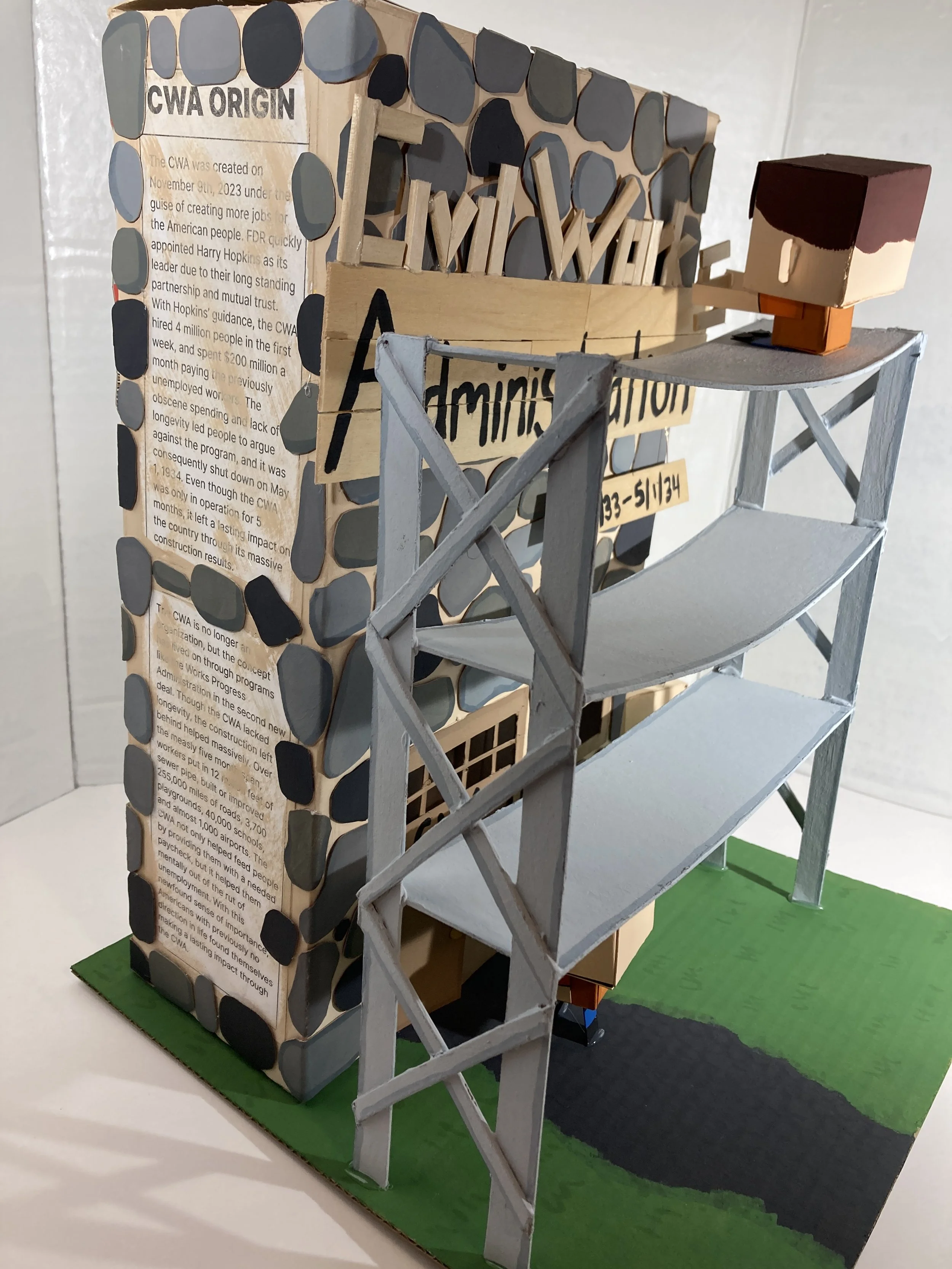
One such moment would be a United States History project in which the task is to create a cereal box advertising one of Roosevelt’s New Deal Programs.
Not only did I have an amazing idea of how I would advertise the CWA (Civil Works Administration), but I had the audacity to challenge a similarly creative friend to see who could create the better box. I won in the end… but not without ridiculous amounts of effort on my part.
Sometimes inspiration strikes in the most unnecessary moments.
One such moment would be a United States History project in which the task is to create a cereal box advertising one of Roosevelt’s New Deal Programs.
Not only did I have an amazing idea of how I would advertise the CWA (Civil Works Administration), but I had the audacity to challenge a similarly creative friend to see who could create the better box. I won in the end… but not without ridiculous amounts of effort on my part.


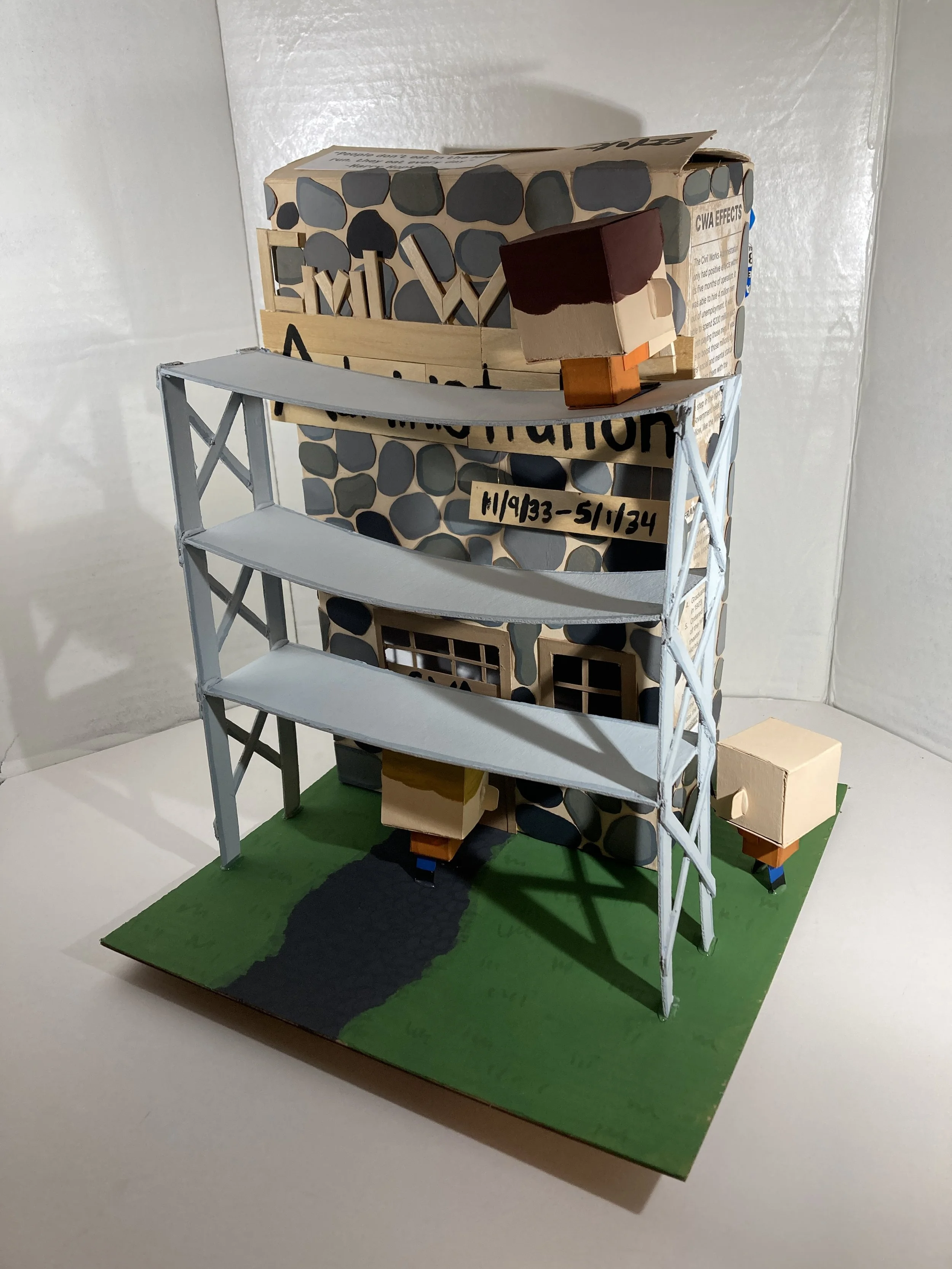

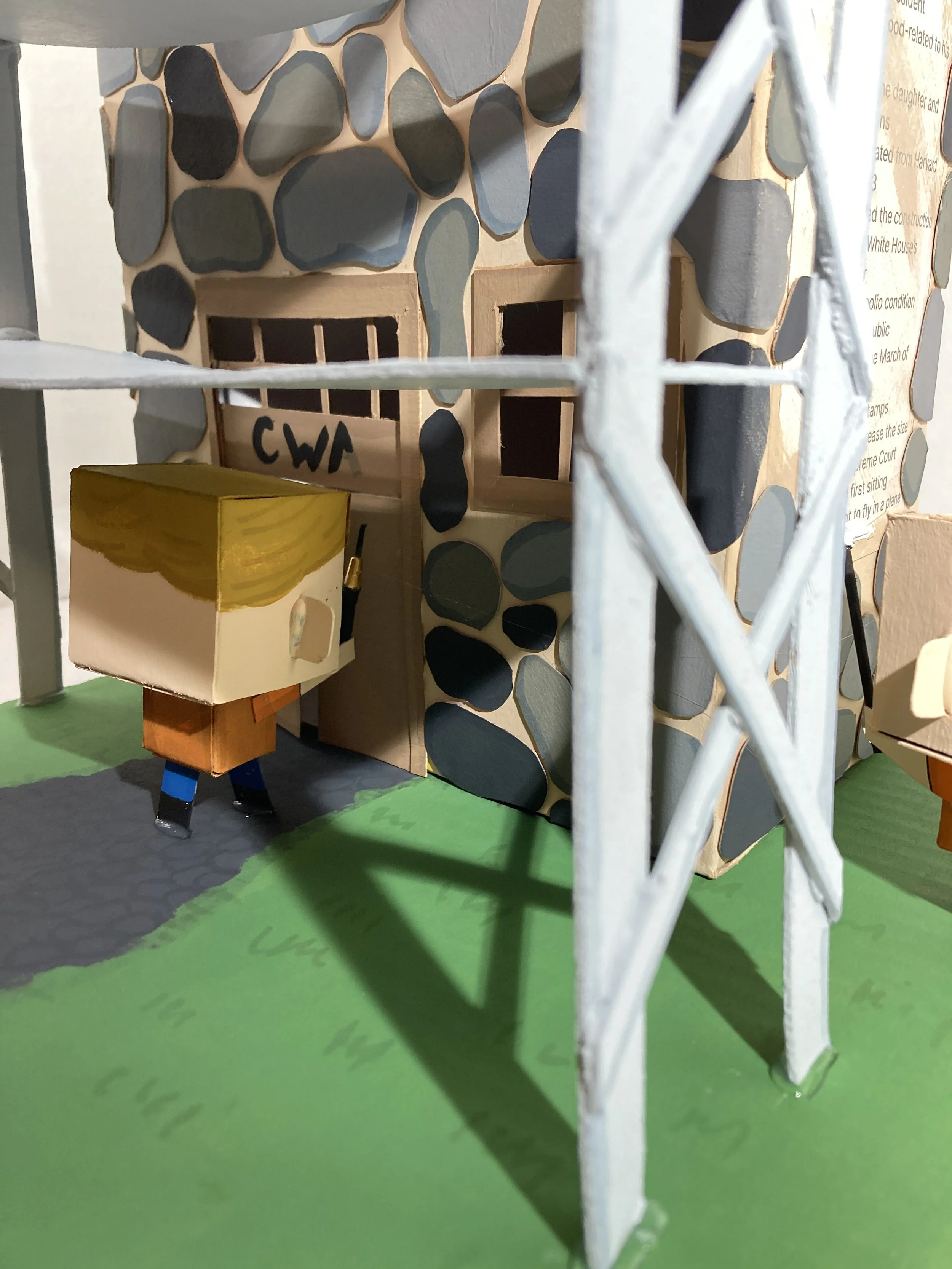
Firstly, I painted one of the hundreds of cereal boxes I have in my possession a light beige. Secondly, I formatted and printed the information required from the project rubric. Thirdly, and definitely the most time-consuming(ly), I made dozens and dozens of little “rocks”, painting them various shades of gray, adding shadows with markers, and meticulously attaching them to the box with hot glue. Fourthly, I made three little “dudes” to be “working on building” the box. One to put up the last letter on a painstakingly-cut sign, one to paint the final letter on the doorframe, and a third to do something with some sort of squeegee (honestly I’m not sure what the bald dude is holding).
Not only did I receive an outstanding grade for the assignment, but my teacher even wrote me a note saying “You are an encouragement and inspiration to me.” and I’m almost certain my project will be used as an example in years to come.
To go above and beyond on a project like this is completely unnecessary, but to be as proud of a result as I am of this is worth the effort. (I’m not saying I’ll willingly cut and paint cardboard rocks for another six hours of my life-this was quite enough-but it turned out fantastically).
Consider going above and beyond on something as trivial as a school project, or maybe do a boring chore with extra excitement, and it may just give you the courage to go above and beyond when it really matters too!

How to sketch a sculpture
In a sculpture class my sophomore year of high school, I was introduced to the material that is foam core (I think that’s its official name). Foam core is a sort of thin-ish sheet of foam with paper glued on either side, making it firm. To work with it you must have very sharp knives, else the foam will tear away in chunks when cut. You also must be very cognizant of the way you are holding the knife, as with the depth of foam core, holding it at an angle will affect the edge.

In a sculpture class my sophomore year of high school, I was introduced to the material that is foam core (I think that’s its official name). Foam core is a sort of thin-ish sheet of foam with paper glued on either side, making it firm. To work with it you must have very sharp knives, else the foam will tear away in chunks when cut. You also must be very cognizant of the way you are holding the knife, as with the depth of foam core, holding it at an angle will affect the edge.
My first project using foam core was inspired by a Dr. Seuss drawing of a house. Something as crazy as…

The Reference Photo
…can be a bit intense to look at and say, “I know exactly how I’m going to replicate this".” It’s just so all-over-the-place.
So I sketched it using cardboard.
With my hot glue gun in one hand, and my scissors in the other, I had no trouble mashing together pieces until it resembled something I liked. Similarly to sketching a portrait, the point of a sketch is not to be perfect, but to eventually get to a product you can finalize and add detail to without wasting time. In a previous post I mentioned the importance of proportions, and how they are part of the sketching phase. Well, in sculpture it also applies, and while not many people will “sketch” their sculptures beforehand in 3d using something like cardboard, they may need to adjust their design just as much as they go along.
With my mini cardboard model, I was able to jump straight into the unfamiliar medium of foam core with plenty of confidence, and ended up with a result I was quite happy with (until I painted it, but that’s just because my painting skills were sub-par).
If you’re ever uncomfortable or unsure how to approach a new medium, try approaching it with one of your favorite, or previously well-acquainted mediums in a similar way first, and then jump into the new one.

Proportional Importance
Now why, you may wonder, would this boy write about proportions in art when he clearly doesn’t know anything about them? That’s where you would be mistaken. Just because I choose to dismiss standard proportions in most of my art does not mean I am unaware of them.
Let me preface this by saying I am no master of proportions. This is simply a compilation of my observations and recent experiences with proportions and their relevance in art.
If you have seen any of my Instagram’s work, you will know it mostly consists of blocky, somewhat cute, cardboard figurines. Their proportions are, more often than not, lacking in accuracy and extremely skewed to the side of artistic liberty.
If you have also seen a relatively recent blog post about my interest in caricature art (which I sadly have not had time to pursue), then you would also question the validity of my following thoughts, as caricature art is incredibly skewed to the side of artistic liberty over realism.
Now why, you may wonder, would this boy write about proportions in art when he clearly doesn’t know anything about them? That’s where you would be mistaken. Just because I choose to dismiss standard proportions in most of my art does not mean I am unaware of them.
Bobble-head toys are funny. Why are they funny? Because they have big heads. My cardboard figurines are not particularly trying to be funny, but rather have a charm similar to that of a bobble-head. The blowing-up of one’s head proportionally can lighten the mood of even some of the darkest characters. Proportions, in fact, are used in bobble-heads, they simply are not accurate for the reason of humor and simplicity.
Similarly, there is caricature art. Caricatures humorously mock those being drawn by exaggerating their most noticeable features. If somebody has a round nose, you know there’s going to be a giant circle in the middle of the caricature mocking it. But the mocking is funny, and the disregarded proportions aid the humor of the drawing. Since it is often the person recieving the drawing who is being drawn, it is taken as light, banter-like humor between them and their close family and friends.
Proportions in realistic drawings are what it really comes down to.
If you want a drawing to be realistic, the proportions have to be spot-on. If you’re trying to draw a nice portrait, you want to make sure the nose isn’t too crooked, or the head too large, as it would often send the wrong message.
Artists love using circles and lines to get their proportions right. The trick is to not become attached to your “sketch” and to be willing to erase it and alter it until it resembles preciselt what you are attempting to draw in a proportionatly accurate manner. “Eye-balling something” is when you look at it and roughly sketch the shape of it. Artists need to do this when drawing things like monuments, landscapes, portraits, and anything in which there is a physical reference being observed for the piece.

Above is a sketch. There were lines used not only to get the basic layout of the picture (of which there was a photographic reference), but also to get the proper proportions for the faces and bodies. I used circles for the heads, lines for where shoulders would go, and boxes for glasses. Yes, this is the end of my sketch, but they start out incredibly rudimentary, often with little resemblance to the finished piece.
Some artists have the ability to do an inch of their drawing at a time, and finalize it as they go. Most artists, however, benefit from sketching out, extremely roughly, the entire drawing so as to get their proportions right, and finish it by adding waves of detail afterwards.
(The following pictures are less-so focused on proportions as on the process and “waves” of details added during each “phase”.)


I sketched the entire drawing. Then I inked the entire drawing. Then I added inked, stylized shading lines to the entire drawing. Then I erased the graphite from underneath the ink. Then I colored the entire thing with colored pencils (a layering process in itself). And finally, I added marker to really make the colors pop.
All of it was laid atop the proportions of my sketch.
The sunk-cost fallacy applies to art a hundred times over. You can think, after sketching for what feels like eternity, that you “deserve” to just move on to the next step. When you step back at the end though, with everything inked, shaded, colored, and completed… you will notice the proportions are off if you didn’t put the effort in up front.
Proportions can make or break every piece. Whether the used for comedic effect, such as in figurines and caricature art, or for portrait and landscape work in which they need to be accurate, proportions will be there. Make them the best you can.
Looking for a particular post?
-
2023
48
- Jan 12, 2023 Hamsters Jan 12, 2023
- Jan 12, 2023 Art Museum Sketching Jan 12, 2023
- Jan 12, 2023 Frogs for a Good Cause Jan 12, 2023
- Jan 12, 2023 Art in Trigonometry Jan 12, 2023
- Jan 12, 2023 Free Caricaturist Jan 12, 2023
- Jan 12, 2023 Disney Mashup w/ @k.steely_the_artist Jan 12, 2023
- Jan 12, 2023 Art Studio in a Van Jan 12, 2023
- Jan 12, 2023 There’s a House in my Boot! Jan 12, 2023
- Jan 12, 2023 Minecraft Dungeons was a Spark Jan 12, 2023
- Jan 12, 2023 [Insert Straw Pun Here] Jan 12, 2023
- Jan 12, 2023 Oh Christmas Tree Oh Christmas Tree Jan 12, 2023
- Jan 12, 2023 Why Sketchbooks are the Greatest Thing Ever Jan 12, 2023
- Jan 12, 2023 How to make the Perfect Christmas gift Jan 12, 2023
- Jan 12, 2023 I drew a house Jan 12, 2023
- Jan 12, 2023 I designed my own Rodeo Stampede Animals Jan 12, 2023
- Jan 12, 2023 MiPads Jan 12, 2023
- Jan 12, 2023 2d or 3d Art? Which do I prefer? Jan 12, 2023
- Jan 15, 2023 Utilizing Other Peoples’ Energy Jan 15, 2023
- Jan 16, 2023 Goodwill Builds (ft. Waffle Blanket) Jan 16, 2023
- Jan 19, 2023 I spy with my artistic eye… Jan 19, 2023
- Feb 4, 2023 Art Teacher Simulator Feb 4, 2023
- Feb 15, 2023 Proportional Importance Feb 15, 2023
- Feb 23, 2023 How to sketch a sculpture Feb 23, 2023
- Feb 27, 2023 Overdoing it Feb 27, 2023
- Feb 28, 2023 Old Vehicles into Park Benches Feb 28, 2023
- Mar 27, 2023 The Word of the Day is Patience Mar 27, 2023
- Apr 5, 2023 How to have a Productive Break Apr 5, 2023
- Apr 5, 2023 Define Useless… Apr 5, 2023
- Apr 25, 2023 My Kind of American Football Apr 25, 2023
- Apr 26, 2023 Behind the Business (Cards) Apr 26, 2023
- May 7, 2023 Preserved Through Planning May 7, 2023
- May 26, 2023 The significance of June 25th May 26, 2023
- May 28, 2023 The Heads or Tails Machine May 28, 2023
- May 30, 2023 The Legend that is Harry Smiles May 30, 2023
- Jun 7, 2023 Thoughts about My First Ever Workshop Jun 7, 2023
- Jul 2, 2023 Now THAT’S how you run an Art Camp Jul 2, 2023
- Jul 10, 2023 Duck Architecture is SO COOL Jul 10, 2023
- Jul 22, 2023 Blank Space: The Game you 100% Make Up Jul 22, 2023
- Jul 29, 2023 The Tipping Point (by Malcolm Gladwell) Jul 29, 2023
- Aug 13, 2023 Creativity > Efficiency Aug 13, 2023
- Aug 30, 2023 I want a taco truck Aug 30, 2023
- Sep 15, 2023 “It’s Not Her.” Sep 15, 2023
- Sep 27, 2023 The Biggest Decision of my Life (so far) Sep 27, 2023
- Sep 30, 2023 A post about Purpose Sep 30, 2023
- Oct 11, 2023 The Idea Box Oct 11, 2023
- Oct 22, 2023 A Tentative Return to Social Media Oct 22, 2023
- Nov 15, 2023 Artistic “Style” Nov 15, 2023
- Dec 23, 2023 An Audacity Evaluation Dec 23, 2023
-
2024
17
- Jan 13, 2024 The Value of Walking Away Jan 13, 2024
- Feb 18, 2024 “The Thought Box” Event Idea Feb 18, 2024
- Feb 24, 2024 The Scholarship Essays Feb 24, 2024
- Mar 2, 2024 “Simple Pictures are Best” Mar 2, 2024
- Mar 9, 2024 Downloading a Virus to make a Cardboard Deck Box Mar 9, 2024
- Apr 14, 2024 The Deck Box Initiative Apr 14, 2024
- May 29, 2024 Trying Everything (why this website is poorly maintained and I'm okay with that) May 29, 2024
- Aug 26, 2024 (In)Finite Enthusiasm Aug 26, 2024
- Oct 4, 2024 I called it! (unsurprisingly) Oct 4, 2024
- Oct 25, 2024 Meaning in Materials and Autobiographical Art Oct 25, 2024
- Oct 31, 2024 On Adaptability and Switching Majors Oct 31, 2024
- Nov 16, 2024 What Francisco de Goya, Nick Cave, and Nathan Foley have in common. Nov 16, 2024
- Nov 16, 2024 Art and “the Media” Nov 16, 2024
- Dec 5, 2024 SPACESHIP (Visualizing Childlike Wonder and Creativity) Dec 5, 2024
- Dec 8, 2024 A Checklist Conclusion (Part 1) Dec 8, 2024
- Dec 25, 2024 A Checklist Conclusion (Part 2) Dec 25, 2024
- Dec 26, 2024 My mom said I should write about the ewok child. Dec 26, 2024
-
2025
15
- Jan 29, 2025 Blastoff in 3… 2… Jan 29, 2025
- Feb 2, 2025 “So you’re the Cardboard Guy?” Feb 2, 2025
- Feb 4, 2025 “Are you happy with that?” Feb 4, 2025
- Feb 13, 2025 Asking More Questions Than the Students… Feb 13, 2025
- Mar 11, 2025 Prioritizing Creativity Mar 11, 2025
- Mar 25, 2025 Brainstorming some Improvements Mar 25, 2025
- Apr 5, 2025 The Pilot Episode Apr 5, 2025
- Apr 25, 2025 Emphasizing Impermanence Apr 25, 2025
- May 22, 2025 Artistic Autonomy May 22, 2025
- Aug 4, 2025 Ideas? Meet your Makers. Aug 4, 2025
- Aug 5, 2025 En Masse Aug 5, 2025
- Aug 12, 2025 Observation, Creation, Communication Aug 12, 2025
- Sep 23, 2025 Communication is an Art Form Sep 23, 2025
- Nov 13, 2025 Islands in an Ocean of Words Nov 13, 2025
- Dec 9, 2025 Enjoy the Waffling Dec 9, 2025
-
2026
11
- Jan 6, 2026 “Cardboard” in 300 words Jan 6, 2026
- Jan 6, 2026 Choosing Cardboard Jan 6, 2026
- Jan 16, 2026 Buried Under the Weight of a Thousand Shoulds Jan 16, 2026
- Feb 22, 2026 You Can't Throw Away Experience Feb 22, 2026
- Mar 22, 2026 Embellish Everything Mar 22, 2026
- May 2, 2026 Start it Up! May 2, 2026
- May 3, 2026 Lesson Plans, Volume 1 May 3, 2026
- May 7, 2026 Explanation Clarification May 7, 2026
- May 25, 2026 First Bite Conversations May 25, 2026
- Jul 7, 2026 What silence says… Jul 7, 2026
- Jul 23, 2026 Like a Smiling Headless Chicken Jul 23, 2026