
blog
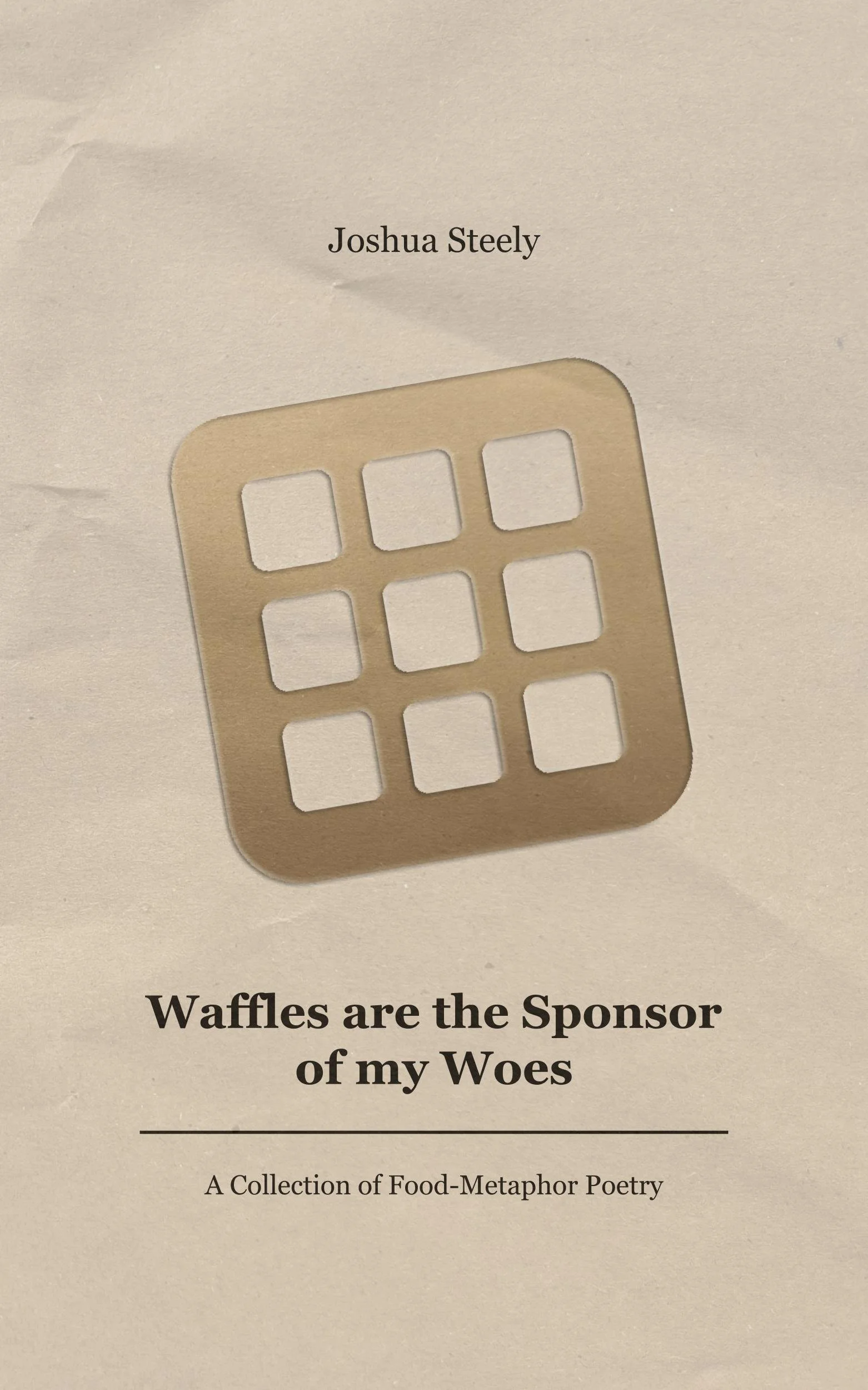
"Waffles are the Sponsor of my Woes"
OUT NOW ON AMAZON
"Waffles are the Sponsor of my Woes" OUT NOW ON AMAZON
"This cooked." –Michael Howe
Joshua Steely's heart is served up on a silver platter in his debut poetry collection, Waffles are the Sponsor of my Woes. Steely's food-metaphor-based poems explore themes of Hope, Rejection, Desperation, Rage & Regret, Resignation, and Sadness as if steps for the recipe of a hopeless romantic. With chocolatey tears and stained shirts, readers can experience the feeling of grasping at straws that so inspired many of the poems within.
While Waffles are the Sponsor of my Woes is written from the perspective and experiences of a 16-19 year old boy, the emotions evoked by emptied gourds and sweet cinnamon rolls are for everyone. Is a diet from love the answer? Gorging on it until there's nothing left? Steely offers spoonful after spoonful, but each taste leaves only a desire for more...
"Waffles are the Sponsor of my Woes"
OUT NOW ON AMAZON
"Waffles are the Sponsor of my Woes" OUT NOW ON AMAZON
Why a blog?
I’ve always loved sharing my ideas with whoever will listen (or is unlucky enough to be within earshot). Most of them go nowhere after that, but a couple end up worthwhile! This site is a way for me to share my ideas with people beyond earshot, and doubles as writing practice!
I hope one day somebody may be inspired by what I’ve shared and go on to do things greater than I could have ever dreamed of. I couldn’t exactly take credit, but if I’m even a slight influence towards something greater, that’s a win.
Enjoy the Waffling
Yesterday I saw something inspiring. Or, more intriguingly, I didn't see something, and that absence itself was what was inspiring.
Sam Blakely is a graduating student of IWU's MLLC, who presented his senior capstone project over a collection of poetry using an experimental form he dubbed "Silent! Verse".
I am a HUGE fan of this form, not only because he paraphrased Syndrome from the Incredibles when presenting it (we'll get to that shortly) but also because…
Yesterday I saw something inspiring. Or, more intriguingly, I didn't see something, and that absence itself was what was inspiring.
Sam Blakely is a graduating student of IWU's MLLC, who presented his senior capstone project over a collection of poetry using an experimental form he dubbed "Silent! Verse".
I am a HUGE fan of this form, not only because he paraphrased Syndrome from the Incredibles when presenting it (we'll get to that shortly) but also because it powerfully isolates the reader by rendering the poems practically impossible to read aloud to the same effect as they visually lay on a page. Here's Syndrome:
"And when everyone's super… [insert evil cackle] no one will be"
-Syndrome (The Incredibles, 2004)
When Blakely said it however, it was less fantastical and more realistic, along the lines of, "when everyone's talking, no one is" which is arguably so much more thought provoking.
Finally! Something that addresses the overabundance of people addressing social injustices. With the onslaught of new media, and algorithms encouraging audacity, often only the loudest people are heard. But then enough people parrot those voices to the beat of a massive subwoofer called society and any chance of opposition is drowned out.
By using unconventional punctuation, line, and placement variations, Blakely adds pause to the process of reading poetry. One of his poems, for example, showed insanity on a page–well, four pages more precisely: The first page has a poem stretched across the surface of the paper in a strange manner. Then, the second page appears differently, and that visual change may lead readers to experience a false hope of content variation. But the second page reads just the same as the first. And the third follows suit, with the same poem in a new tie. And the fourth after that. The pages stack on top of each other experientially, building up and tearing down a false hope of sense.
You can probably tell why I like this concept so much.
Most of the other poems Blakely shared in his presentation focused instead on variations in line and spacing. He used " " to construct pauses, and;
different orientationsofwords to
either con–
fuse or engage
readers in interesting ways.
Now, if you were to try to read these poems aloud–then you may confuse both yourself and your listeners. That. right. there. is the method Blakely has employed to isolate a reader. These are not poems meant to be read aloud, they are instead poems to be individually digested–like bubble gum you don't share, except it's punctuation you're chewing. Sure, you can respond to the poem aloud, but it itself cannot be shouted to add to the already thunderous wave of opinion crashing through every screen.
Instead of adding to the ocean, Silent! Verse plays in the sand. It draws pictures using the placements of words, and with those pictures tells a story not even musical rhymes can. But rather, using gaps to say silence–punctuation to interrupt + or add: x=y but y does x?
The only other form of poetry I've seen that visually approaches the art, rather than rhythmically or otherwise musically (with rhyme or song) is when words are arranged into a picture. But that's cheating! Or at least, is employing imagery formed by words as pixels, not as the magnificent symbol they hold as words. At least, not in the same way that they are embodied in Silent! Verse.
If I was to pick up painting again, I would want it to be with words. And Silent! Verse enables that.
I hope to add at least one poem in Blakely's form to my in-progress poetry book "Waffles Are The Sponsor Of My Woes" (abbreviated to Waffles). The form, however, seems to be in direct contradiction to how I have written most, if not all, of my poetry. I have written it with the expectation for it to be shared aloud. I write them to roll off the tongue, sing-songy, even Dr. Seuss-esque at times.
"Waffles Are The Sponsor Of My Woes" is a collection of food metaphors about love, meant to be shared with a grin and a giggle–though few are solely happy in nature. The sweet syrup of subtle metaphor masks the misery beneath the words.
For example, a haiku:
sugary facade
dissolving against your tongue
leaving nothing left
or fast-paced flavors jumble as they rush down your throat:
"cookbook"
Words are my feelings
my butter and bread
words are the only things
up in my head
jumbled and bruising
some downright confusing
I seem to be losing
all parts of my mind
to this foray of letters
of phrases of rhyme
the only thing left
is a matter of time
until you all look
and I am a cook
writing a book
to just watch it burn.
or a longer, more intense metaphor is found in a
"flapjack"
Pour out the sweet batter
on a hot griddle.
If the temperature's right
it'll soon start to sizzle.
Have your spatula ready!
so it doesn't burn.
The first flip is tricky!
it's something you earn.
If you get that first flip
now you see a new side.
What will you do
if its smile is wide?
I'd let it sit
while I take in the view–
but the other side blackens
if that's what you do…
Oh shoot! you remember.
so you flip it right quick.
You'd added some butter,
so it doesn't stick.
But now you're stuck
with a face dark as coal.
Distance and anger
were never the goal.
What do you do?
When this all is new?
Pretend you don't see it?
Smother it with a goo?
Something thick, something sweet,
like fluffy whipped topping.
But if you knew better
all you'd be is dropping
Me right in the trash,
one side black as ash.
Because flip all you want
but that side you don't see
still ruins a flapjack
and both sides are me.
Waffles is dedicated to the color red, and may be released in the next couple years. I'm currently up to 34 poems (plus a handful of haikus), but would like to get it to at least a hundred before entering the ruthless editing phase (during which it may be culled back to 75-80). I've been at it for less than a year, however, (as I started it during the SP2025 semester in Dr. Linda Manganello's Interpersonal Communications Class–yes, during her class, it's okay, she knows.) so it shouldn't take more than two more years, ideally.
Because Waffles is intended to be read aloud, I will produce (alongside the physical book) audio tracks for each of the poems, which will be available to listen to somewhere on this website as a supplement to the book. I'm not sure how a publisher would feel about that, but I plan to do it regardless, because the emotion and inflection and pacing behind most of the poems is what makes them work. And, I just love reading out loud!
Lastly, while I've already established and permitted my additions of communications-focused writing to this "art blog" in the somewhat recent post "Communication is an Art Form", poetry is even closer than Communication Studies to the typical "art"
so enjoy the waffling.
Islands in an Ocean of Words
Similar to the formation of volcanic islands, the initial formation of an interpersonal island looks impressively disruptive. We think of communication as something that "just happens" and most people not studying it as intently as I (Joshua Steely, a Sophomore Human Communications Major) are often led to believe there is little reason to change "how they talk" or interact with others. That's just "how they are". Anything further can be regarded as "manipulative" or "ill-intended" because it doesn't seem to follow this natural flow of human communication. But we all learn how to interact from somewhere, and after pausing to consider these somewheres, most people would quickly admit their imperfections. Were your parents perfect communicators? Your teachers? Your friends or lovers? Seldom do they come close. Therefore the unnaturalness of observing our communication and ways to improve is crucial for our betterment. Sometimes you need an explosion.
This Essay was written starting September 19th, 2025 and brought to this point and recorded on November 13th, 2025.
Surely there are too many essays out there that start with the phrase "communication is everywhere" so I'll save you the trouble of redundancy by metacommunicating it. Truly everything subscribes to the axiom "One cannot not communicate" credited to Paul Watzlawick. In this metaphorical ocean of words and meanings, we can't help but feel like we're incessantly waterboarded by misinterpretations, mixed messaging, and blatantly wrong assumptions (in hindsight, that is). I propose that the best route to genuine interpersonal understanding is by means of an intentionally isolated conversational landscape: an island, of sorts. These islands are removed from the day-to-day torrent of communication by their location, focus, and openness. They're not just another dinghy to "chat" or "catch up" in, but instead an intentional, secluded setting that leads to truly meaningful dialogue.
Volcanic Disruption
Similar to the formation of volcanic islands, the initial formation of an interpersonal island looks impressively disruptive. We think of communication as something that "just happens" and most people not studying it as intently as I (Joshua Steely, a Sophomore Human Communications Major) are often led to believe there is little reason to change "how they talk" or interact with others. That's just "how they are". Anything further can be regarded as "manipulative" or "ill-intended" because it doesn't seem to follow this natural flow of human communication. But we all learn how to interact from somewhere, and after pausing to consider these somewheres, most people would quickly admit their imperfections. Were your parents perfect communicators? Your teachers? Your friends or lovers? Seldom do they come close. Therefore the unnaturalness of observing our communication and ways to improve is crucial for our betterment. Sometimes you need an explosion.
I'm no geologist, but I'm pretty sure the famous volcano builds up pressure before it spews magma to the surface in a violent eruption. Just like the desire of humans to develop close relationships, all pressure eventually needs a release. Humans long for a closeness that we can derive from communication, but the contexts in which we can have close conversations are dwindling. Education and entertainment are moving online, and despite technology making things ever-more efficient, schedules are somehow getting busier and busier. When did you last sit down and just talk with a friend? Not to catch up, but to really talk? If it's been a while, the pressure and desire for closeness may be building up inside of you, looking for a release.
If a release of volcanic debris falls onto an existing landscape, it can shift it from lively to desolate. A blackened pile of ash coating what used to be the thriving city of Pompeii. I'm not talking about that kind of release. If you try to alter most existing communication environments with the concepts of islands, it will muddy them and detract from their own values. Those landscapes are beautiful as they are. Fun, joking, sarcastic conversations that result in nothing new learned and maybe even nothing new said are still valuable. Don't fully abandon this mainland of often messy communication. But keep your speedboat in tip-top shape. I only recommend the creation of an island as a vacation escape from unseriousness for a short while. You have to go back to the mainland for your supplies even after a couple hours. Your release (the explosion) should attempt to create an island, not settle on the existing terrain.
Establishing Islands
So what is an interpersonal island, and how do you construct one? To give you some examples, I've included two from my own life, and one that I've brainstormed for future use. My website, "Van Talks", and the "Kitchen Island", despite my best attempt, are certainly not universally applicable. So, following these examples I hope to identify consistent traits that can transfer over into your own circumstances. The 3 traits I've chosen are mutual, distraction-free, and established. With these three in mind, I hope you can give interpersonal islands a shot!
Island Examples
www.jsteelycr8.com.
Starting off simple, my "art blog" holds some examples of an island, yet without as much of the interpersonal parts. It is, after all, quite one-sided (barring the spelling errors my Mom emails me about after reading each post… thanks Mom). The value I've found in the site is its direct opposition to an app like Instagram. My site instead feels far more secluded from the infinitely intermingled content of social media. Sure, there are potentially 2.4 billion Instagram accounts (Dixon 2025), and an estimated nearly 2 billion websites (see www.internetlivestats.com; Armstrong 2021) but I have, in my own way, separated my output from social media in order to curate an island of communication. Now, this is not to say that my website comes close to the importance of conversational islands, but it is still relevant to the metaphor. As an artist, I am asked for pictures of my work, but often in the form of "what's your Instagram?" or "what's your social media?" Instead of a generic @, I get to answer them with a business card stamped on the inside of a cereal box. It creates a recognizable island by being a disruption to their normalcy found in handles. Instead of a jumble of characters, they are handed a physical thing, not even containing the key to their digital platform, but instead a link to a more informed site. They are handed a visitor's pass to my island.
This is to say, we ought to hand out passes to face-to-face communication islands. By constructing an area to host genuine conversation and inviting others into them with the prefaced expectation of thoughtful and open communication, we will reap the benefits of deepened relationships and greater self-understanding. But these passes need to be surprising, like a cardboard business card with a website as a 16–now 19–year old. The disturbance holds the potential to send out social ripples. It is a worthwhile rock tossed in a pond. Enough rocks and an island will form. Enough disturbance and a norm is established.
Van Talks.
Fittingly for the ocean metaphor, my current vehicle is a chunky silver minivan named Bruce, after the shark in Finding Nemo (2003). Recently, I've even embraced the name further by adding a shark fin on top and a bumper sticker that reads "Fish are Friends, Not Food". My very first interpersonal island was a dark blue, almost purple '06 Dodge Caravan I drove in high school. In it, I hosted what were dubbed "van talks" which became a form of intentionally secure deep conversation. At one point I attempted a podcast episode or two, but their primary use was getting to know friends at a deeper level than school waving-interactions¹ would allow. A vehicle has the benefit of natural seclusion and–now that I'm in college being constantly bombarded with social opportunities–can offer a welcome escape. In high school this escape was less necessary, as I had my own room, but far more optimal for sensitive conversation than within my thin-walled house. I had one friend in later high school that told me a van talk we had was the most meaningful conversation they had ever had. These were quality conversations, even for how comparatively little I knew about Human Communications back then.
What made van talks so good was my early introduction to concepts such as circular listening² from books like Malcolm Gladwell's Talking to Strangers and Outliers, paired with Charles Duhigg's similarly journalistic-styled Supercommunicators. With these incredible tools, I was able to host genuinely constructive conversations, unlike so much junior high and high school dialogue I experienced in and around school. It was my first great opportunity to practice listening skills after absorbing Gladwell's "the person that talks the most enjoys a conversation the most". Before reading that I was quite the talker. After reading that I consciously dialed it back and started to listen (though those who know me as the talker I still am are astounded I've "dialed it back"). People benefit from the ability to talk and be heard, but also to have the same opportunity to listen. I would reciprocate, not just take in, these deep life-evaluating topics. Through van talks, I became increasingly secure in my past, because I was so thoroughly reflecting on it with close friends. Van talks are a prime example of an interpersonal island.
It is worth noting just how disruptive these meaningful conversations were to the high school norm. When does a school friend consciously seek out an organized opportunity for deeper conversation? The first time each friend was invited to the van for a van talk, I had to outline the rules and expectations. It was a new experience for them! I wanted to establish upfront the unfamiliarity, and set an expectation of embracing it. I explained to each of them the function of circular listening, and they seemed eager to participate in this unusually intimate dialogue. The strangeness was soon welcomed, but nonetheless remained strange in their broader ocean of communication.
The Kitchen Island.
My Minivans have had quite the run in establishing secure relationships through close dialogue, but one day if I am a family man, I certainly won't be having every conversation in a van. So I propose a new use for the marble slab in the middle of a kitchen: a designated interpersonal island. What if, instead of chasing family members around the house trying to hold a serious conversation, there was a designated space for serious, focused discussion? It would have the potential to limit inattention and multi-tasking, and allow for a place with consistently constructive back-and-forth.
How this would function is such: if ever I wanted to have a conversation (with my hypothetical wife or children) I would ask them to chat at the island. They would be able to come and sit, knowing that whatever was to be discussed would benefit from their undivided attention. These topics could range anywhere from how the kids were doing in school to the current financial situation, to whatever real adults worry about (I'm not quite there yet). Here's the important part: if the person is unable to give their attention, they leave the island.
But then what about the conversation? you may ask. Well what about it? If both parties are not open to hearing the other, what good is trying to have a conversation anyways? If the other person gets angry, the rooted state of the island allows them to leave, cool off, and come back when ready. If I'm sitting at the island, then that alone could signify I'd like to have an important conversation. There is so much precedent that could be set in having a designated space for focused conversation that it could save countless hours of bickering or lost attention. In the stools you know that the conversation is important, and if you are not in the mindset that allows for such a conversation, you leave.
I'm struggling to put down the words that express the emotions so closely connected to the potential of a designated conversation area. It would be so helpful! I hope one day to put the idea into practice.
Three Common Factors
Mutuality.
Mutuality (or Equality) is crucial for establishing an equal playing ground. Something that prevents balanced dialogue (the goal of these islands) is a power differential. Therefore these meeting places cannot be in which one party has the upper hand. It must be neutral ground. My van only applied when I was parked in a place my partner could exit conveniently at any time. If I drove somewhere that they would need a ride back from, the power was in my hands enough to cause an imbalance. I chose the word mutuality over equality to emphasize the necessary agreement to co-opt a conversation before power differential even becomes relevant. Only if both parties are actually willing to attempt a constructive conversation will the island have any value. This requires a mutual understanding of the intentionality behind creating this kind of space.
Distraction-Free.
It is critical that interruptions are minimized. Any time something is let through the meticulously developed intimacy, a repair job is necessary to return to the same depth. A single text in the middle of a story can grind it to a halt faster than a sudden flat tire. It's not gradual–it's instant derailment. It's like getting chucked off the boat. It's like a bolt of lightning. It's bad. There is now so much research on how hurtful cell phones can be to conversation that I don't even have one best source to choose from. But phones aren't the only distractions, which is why I have an entire section later dedicated to "the sharks circling" the island, waiting for a chance to bite. Do your best in any potentially productive space to limit these shark attacks.
Established.
The first conversation in a space, especially with unfamiliar partners, will most often be a largely reflective conversation, building rapport. Only after the space has been utilized multiple times can it be practical in a pinch. Only once it is established can it be referred to, as my "van talks" similarly began to gain precedent. Be especially careful in the first few uses of an island, as setting the wrong precedent may be difficult to correct later down the line. But once you have the right ones set, and have mutually agreed upon the boundaries of the space, it can be of immense use.
Islandic Biomes
Before we get to the sharks I've identified four conversation types ("biomes" if you will) that will benefit from stranded conversation. That is, conversation that takes place on these interpersonal islands, secluded and intimate in a way that allows for truly constructive dialogue. These four types are reflective, circumstantial, relational, and predictive. I will touch on each shortly, but they all share some of the same benefits. When stranded, these conversations are all far more effective than if addressed in the deafening, battering waves of oceanic conversation. That is, conversation that takes place in the ocean of endless communication, with countless inputs all being thrust upon you at once–distractions stealing your attention and interruptions halting progress. Imagine trying to tell a close friend about grieving the loss of a loved one in the middle of a concert or a bustling mall. Imagine opening up your heart to someone as their phone starts to ring and they turn away saying, "I have to take this". Interpersonal islands are what allow conversations to move past the fleeting and into the influential.
You may be starting to think that these islands are just a matter of attention. In that case though, a preacher in his pulpit or a teacher at her podium would be on a church or classroom island. But alas, their stage is a mere boat's deck, still tossed by waves of distraction. Only in isolated conversation can real focus be attained. That's not to say value is unable to be gained from their messages–after all, I'd rather be on a boat than among the sharks–but the rocking is far from the security of dry ground.
Before I get too carried away in metaphor, recognize this: I am aiming for an understanding of when and where the best conversations can occur, and how I can structure my life to have more of them. I thrive in an engaging dialogue, whether or not I agree with the other person–honestly more often than not I prefer disagreements because they lead to more difficult conversational gymnastics as I try to navigate a way to mutual understanding. But this is self-indulgent as one who enjoys communication theory and practice. For the sake of others, I want to make this quality of conversation more accessible, which is why I'm trying to formulate a method to practically develop these islands in your own life. I know that not everyone has a minivan or a viable place in their home, but I hope with these tips and some creativity, anybody can form one for their own circumstances. Now I'd like to dive into each of these "biomes" and keep expanding my self-entertaining metaphor. There is plenty of overlap between the four, but I think the distinctions are still worth exploring.
The "Reflective" Biome
I begin with reflection because I think it is easily the most accessible of the four biomes. Think of it as a tropical jungle filled to the brim with opportunities for exploration. You're bound to get lost in it, and come out the other end having only explored a fraction. But also, just as a jungle is home to plenty of poisonous plants and potential beasts, so is the past filled with touchy subjects and yet-to-be-uncovered realizations. They were there before you got there, but how you conversationally interact with them has dangerous potential.
To make the metaphor concrete, I'll pull from generalized examples. Parental influences, childhood friends, experiences in school, traditions, and literally anything that has already happened can be the basis of a reflective conversation. Anything that involves history allows for conclusions to be drawn from, because a conclusion happened to the event. Of course, if it is part of your own life, that conclusion has not come yet, but chapters may have been finished (even if they are revisited or lost later). These chapters can be the topic of self-explorative or explanatory conversations, trying to establish why you are the way that you are and how you are unique from or similar to your conversational partner.
The benefits from reflective conversation are plentiful, and reflection continues into every conversation, as it is the foundation of our understanding. We quite literally cannot know something we have not previously come in contact with. First time encounters with newness instantly become the past. By the time you try to reflect on the present, it's suddenly the past! The omnipresence of history is extra tangible in meaningful dialogue, as explanations are constantly being derived from personal experiences or previously learned knowledge. Any new ideas are built upon the foundation of reflection. Additionally, reflective comparison is how most friends "get to know each other" in the first place before they experience things together and are able to have relationally reflective conversation. "Oh, you were in a choir? Me too!" unlocks a whole range of comparison dialogues and allows for precedented jokes regarding choral music making. Saying to that one friend who you know was in a choir "I'm a soprano at heart" will make a whole lot more sense than if you said it trying to joke with a musically ignorant friend. Reflection builds foundations in relationships and sets the groundwork for the other three types of conversation.
The "Circumstantial" Biome
Now, this is as in-the-moment of a conversation as you can get. A circumstantial discussion is based on what you and/or your conversational partner is in the midst of. It's when you're trying to figure out what in the world is going on in your life right now. Inevitably, the circumstantial discussion pulls from both reflective observation of recent events or past patterns, and predictive outcomes. It's the act of exploring new connections to past events and imagining potential outcomes. These can be wildly creative in both positive and negative lights (see: "catastrophizing").
The "Relational" Biome
Anything pertaining to shared experiences, past, present, and future, is a relational conversation. Whether discussing how to improve a friendship, or to end a relationship, extensively personal topics such as deeply-rooted desires and values tend to be relevant. These are not just conversations with established loved ones, however, as these risky value-sharing discussions are how close relationships are initially formed as well. To get close with anybody, you most often start with a shared experience. Even if you meet at a random coffee shop in a random city, your shared experience was being at that same coffee shop at that same time. Relational conversation has the unique power of becoming shared reflective conversation. Inside jokes? Those only work because you shared the experience and can now reference it together.
The "Predictive" Biome
Off in the distance is a tiny dot. You're sure it's another island, but you're on this island, discussing what may be on that one. You may never make it there, but the discussion of the possibility is a predictive conversation. This is typically the most imaginative conversation and is closely tied with circumstantial conversations, but needn't relate to anything currently occurring. These are admittedly the kinds of conversations I most often have with myself (in my head) as I imagine my own future. Entrepreneurs and visionaries often rely professionally on mastering this kind of conversation, trying to provide security in the uncertainty of tomorrow. While sometimes these conversations can seem frivolous or pointless, they are like a child's imagination: something we ought not to live without.
The Sharks Circling
Up until now it's as though I've assumed you and your conversational partner will simply refrain from making mistakes. That's not at all the case. Emotions, for example, are a fickle thing that all-too-often spoil opportunities for constructive conversation. Anger and sadness overwhelm a person so physically, that sometimes choking back rage or tears leaves one at a loss for words. It's little use babbling under a waterfall if you're trying to come up with a plan for your taxes. Overwhelming emotions are just one of the metaphorical "sharks" attempting to detract from the productive conversation on an island. The few I list also include defensiveness, the infamous cell phone, and children (though I know nothing from the side of a parent). With each shark, I attempt to offer a solution that allows for continued conversation, but often the best option is a break. Just cool down and come back to the discussion at a later time and/or date with a cooler head.
Emotions
If the opportunity of a break or the necessary self-awareness to know one needs a break is not present, then emotions are the most frequent offender for ruining a productive conversation. Boiling anger disrupts listening abilities, and sinking sadness can pull away from a moment. Emotional flares are unpreventable and even acceptable, but must be dealt with constructively. Perhaps the sadness informs that you really do have a problem with something the other said, and it needs to be explored delicately. Maybe an anger flare-up tells you that you aren't in a good state to be attempting constructive talk right now, so you need to go cool down for a bit. Emotions are often the notifications that ding in our mind instead of our pocket, and our response is up to us. Ignorance may lead to more dings (especially if it's your mom asking where you've been) but over-dwelling can distract from what's in front of you. Emotions are to be acknowledged, then appropriately responded to. Failing to do so will surely jeopardize productivity.
Escape Routes
Leaving the island needs to always be an option. As I mentioned from my own experience, if it's a van, the driver needs to be parked next to the partner's house or own vehicle. If it's the kitchen table, the partner needs to be able to get up without being followed. Escape needs to be an option because believe it or not, not everyone can voice a level-headed opinion in the heat of an important dialogue. Sometimes the ability to step away is what makes or breaks a conversation because it reduces outbursts, and redirects what could be seen as forced isolation into optional intention.
Defensiveness is what results from lacking an escape route, and if you've ever tried to converse with a defensive person, you know you might as well stop. You can say the same thing a hundred times in a hundred tones with increasing volume, but if the person across from you already shut you down in their head it won't matter. They need a break, and to come back to the conversation when they are able to listen. If your partner is never able to listen, then I'm sorry–you simply won't have productive conversations as I'm idealizing.
Notifications
I touched on this earlier: phones are bad. If the screen is up or the ringer on, any valuable conversation can be chucked aside if a light or noise activates. Even in the seclusion of my van, phones were always a risk of distraction. Some people do not treat technology as I do, and would have their phones on vibrate or even fully on. Limiting notification-producers is a must. Similarly, limiting the option to satisfy an urge to pick up a phone and check for notifications is important. It's best to leave phones out of the space.
Children
Trying to disrupt a social norm with intentionally secluded conversations as mature adults is one thing, but trying it with children is surely a different beast. My only prediction is that if it is modelled well for them, they will be able to do it well, and if it is modelled poorly, they will lack the unlearned skill. The best thing parents can do to teach their kids constructive conversation is to practice it in front of them. Instead of having every conversation behind closed doors, try to make the interpersonal island in the kitchen or dining room–a place where the kids can observe a civil dialogue and respectfully participate. It is important to explain to them the value of focus and respect in these conversations, else they may quickly turn sour.
What I cannot yet begin to understand however, is the extent at which children can bring up the three major sharks (emotion, the ability to leave, and distraction). Perhaps if you actually have children you are screaming at this essay, accusing its principles as inapplicable to your chaotic life. However I will counteractively play the "user error" card, and implore you to try harder. Perhaps you consider your children to be actual animals shredding every fiber of your peace, or they are too young to be left alone long enough for this long, uninterrupted conversation, or more likely they will find ways to interrupt it more effectively than even your phone can. Anyway, I am certain there are workarounds to appease the children or better yet, invite them into the conversation so they may learn and grow alongside you. I worked at a summer camp recently, and you'd be surprised how much 12 year olds can teach you about life.
Time
Sadly, the passage of time is the ultimate, inevitable conversation limiter. We run out of energy and willpower as the day progresses, and can't keep talking forever. You need breaks! But you worked so hard to get to this point of vulnerability! You worked so hard even to read this essay written by a kid about trying to have effective conversations, to the point where now you're too tired to even say goodnight to your dog! While I am far from bold enough to make generalized assumptions of your individual time availability, I know it is finite. I just hope that its finitude does not prevent you from trying to have constructive, life-giving conversations. I think it's worth it.
¹ I define "waving-interactions" as short passings, most prevalent for me in school settings. In a waving-interaction, the two parties have far too little time to do more than allude to a deeper subject. If it is more than the ever-present college campus wave coupled with a "Hey [insert name here]!" and isn't about classes or shared connections, these brief interactions only allow for a couple meaningful sentences before duty or schedule calls a party elsewhere. If a deeper conversation, or at the very least a meal, is never shared with these "waving-friends" then only the name truly may relevantly persist in the relationship. Little meaning but a consistently friendly smile can be further derived.
² Circular Listening is the method of active listening that results in mirrored statements leading with "I hear you saying" followed by an attempt at accurately repeating what a partner just said. This helps the partner feel heard, and gives them an opportunity to correct any miscommunications. It is often extremely helpful in more serious dialogues, where learning nuances in understanding is the whole goal.
References
Armstrong, M. (2021, August 6). How Many Websites Are There? Statista. https://www.statista.com/chart/19058/number-of-websites-online/?srsltid=AfmBOoqcproTckiCNyQE2G-NCyr4Dz9DLAJ9fy-7vjJAZTIXdJWYcnOU
Dixon, S. (2025, June 25). Instagram users worldwide 2019-2028. Statista. https://www.statista.com/forecasts/1138856/instagram-users-in-the-world
Duhigg, C. (2024). Supercommunicators. Random House.
Gladwell, M. (2008). Outliers. Little, Brown and Company.
Gladwell, M. (2019). Talking to Strangers. Little, Brown and Company.
internetlivestats (accessed 2025, September 19). Total number of Websites. https://www.internetlivestats.com/watch/websites/
Steely, J. (2025). The Art and Thoughts of Joshua Steely. jsteelycr8. https://www.jsteelycr8.com/
Unkrich, L., & Stanton, A. (2003). Finding Nemo. Buena Vista Pictures.
Communication is an Art Form
Maybe you've noticed a lull in posts. So have I. I'm not pleased with it for one major reason: I'm still writing a bunch! I'm just not writing a bunch about art. And I've framed this blog in such a way that I consider it to be an "art blog" and not a general "whatever" blog. That's mainly to refrain from it ever becoming an outlet for gossip or personal details/rants. I don't think the switch I'm wanting to make will violate that. I want to start posting my writing about Communications.
Maybe you've noticed a lull in posts. So have I. I'm not pleased with it for one major reason: I'm still writing a bunch! I'm just not writing a bunch about art. And I've framed this blog in such a way that I consider it to be an "art blog" and not a general "whatever" blog. That's mainly to refrain from it ever becoming an outlet for gossip or personal details/rants. I don't think the switch I'm wanting to make will violate that. I want to start posting my writing about Communications.
If you didn't already know, I'm a Sophomore Human Communications Major at Indiana Wesleyan University (that much is available on my public LinkedIn profile, so it doesn't count as private information). That means I LOVE communication studies. I actually want to go into Human Resources (HR), which is one of those "really?" kind of dream jobs, but everything I love about organizational communication and conflict resolution can be found in an HR position!
Really, I had the idea of shifting this blog over to include communications once I was 11 pages deep into a paper I was writing for fun alongside the actual, required homework I'm assigned regarding similar topics. I suppose I enjoy writing about more than art, and I think it's worthy to be shared. So instead of changing my website's mantra–an "art blog"–I'm just broadening the perspective of what qualifies as "art". I'm saying words count. Here's why:
Practice
As I consider this more and more, communication and art overlap SO much. They are both things that the common person assumes is a "gift" or "talent" but is instead so thoroughly based in conscious practice and improvement. If you don't actively seek understanding of new words, your vocabulary will not grow. In the same way, if you do not seek new methods of art, your range will not grow. Again, if you don't practice using communication tools and strategies, you will not improve. In the same way, if you do not practice drawing or sculpture, you will not improve. Practice makes all the difference in both disciplines. It's not about a natural inclination–though that may give you an initial boost and inspiration to grow–instead, both communication and art are intensely improvable skills. To improve requires practice.
Makes
Communication and art are both creative and constructive disciplines. They can both make up your social identity and allow for self-discovery. The only reason any art works is because it communicates through shape or color or texture or motion (etc.) as it was created to do so. This isn't as niche as people often think it is. A kid drawing something in crayon, for example, is communicating to his parents a multitude of things: perhaps an aptitude for art, an interest in dinosaurs, or a love for his family. If a child entrusts the parent with safeguarding the artwork, maybe he thinks it will be appreciated and his hard work will be validated. Or maybe if he shoves the paper in their direction he's communicating distaste or disapproval of the creation. Every aspect of art is communication from the art to the artist and the artist to the audience. The landscape painter Laurén Gerig agreed with me that no place (and therefore any painting she creates) can be separated from the interactions she has had with people there or surrounding the time of its creation. Human communication therefore informs the vast majority of any art. Only a little bit of it comes from that which we actually observe. Those things we observe only derived any meaning in the first place from communication we have had about them. Impressionism is an extreme example of intensely personal art, inspired by intimate moments, but even Abstractionism can effectively communicate an artist's emotion. Sometimes a white painting is all you need to portray an emptiness, loneliness, or lack of purpose. Sometimes a yellow triangle is all you need to communicate danger. Two lines to reference the Crucifixion.
All this color and shape theory exists for art, and meanwhile there is a whole communications world regarding "Semiotics", which is the study of symbols and their interpretation. Art is symbols. Words are symbols. There is little difference between you drawing a stick figure and me writing the word "stick figure" (except for potential language barriers). They somehow still communicate the same thing.
Moments
This next bit may risk some reiteration of the creativity in both art and communications, but I think it's worth additionally noting the storytelling power in each. I was talking with a friend the other day and he told me the reason he loves art so much is because he can find stories both in the work and around the work. He can look at a landscape and notice the curves of the hill, but also notice the figure on the hill and wonder who that was to the artist who painted it. Art can capture visual moments, but words can describe them. Recall your favorite work of fiction. Often mine include rich, immensely intricate detail of setting and characters. If you look up "Face Quotes" on Goodreads, for example, the top one is “He had the look of one who had drunk the cup of life and found a dead beetle at the bottom.” (P.G. Wodehouse). An artist could paint that and show viewers one image, but words have the magic of offering a moment up to so much more visual interpretation. No one reader imagines the same image–the same moment, if you will. They could only then share their interpretation through visual communication like painting or drawing or attempt to edit another's through their own description.
I hope these three similarities (though I'm sure I could've found more) are enough to excuse myself for posting henceforth more works about communication that may not include direct reference to visual arts. You see, I titled this post regarding communication as an art form, but as I wrote it, I've determined it's the other way around.
Art is a Communication Form.
Observation, Creation, Communication
"That was a lovely introduction," I started, regarding the words my connection said to the group before I got up to address them, "I'd love to get to know all of you–just a little bit–via a show of hands for just a couple of questions." a couple of nods.
"First, do any of you like art?" and every hand raised.
"Okay, fantastic. Do any of you play an instrument?" A few hands…
"Yeah… instruments actually have nothing to do with this but that's good to know!" a couple chuckles and some smiles. Great start.
"And the last question, are any of you interested in art lessons for your kids?" Only a couple hands went up. That's good to know.
"Alright, that's okay!" and then I went on to explain two things, starting with what people can gain from art and ending with Crate logistics. This first portion I've boiled down to three concepts (though I know from experience there is a WORLD you can learn from art and design). The three are as follow:
The three lessons from art.Yesterday I had the privilege of speaking to a group of parents in a homeschool co-op about the Crate. Specifically, about the opportunity for them to purchase art lessons for their kids.
I had a few takers, but that honestly wasn't my goal. The goal was to have the experience of talking to an actual group of potential buyers about something I'm selling. Families are a key market segment of the Crate, so getting that chance was amazing. I'm very grateful for the connections that made it possible.
Going into it I knew this: That there would be 14 families-worth of parents and that they were all in a homeschool group. That was it.
So this clearly wasn't my typical competition-style pitch. I wasn't here to give them the whole overview or any of the feasibility plan information. I wasn't even seeking an investment, only the odd interest.
So first I wanted to see where they stood with art in general:
"That was a lovely introduction," I started, regarding the words my connection said to the group before I got up to address them, "I'd love to get to know all of you–just a little bit–via a show of hands for just a couple of questions." a couple of nods.
"First, do any of you like art?" and every hand raised.
"Okay, fantastic. Do any of you play an instrument?" A few hands…
"Yeah… instruments actually have nothing to do with this but that's good to know!" a couple chuckles and some smiles. Great start.
"And the last question, are any of you interested in art lessons for your kids?" Only a couple hands went up. That's good to know.
"Alright, that's okay!" and then I went on to explain two things, starting with what people can gain from art and ending with Crate logistics. This first portion I've boiled down to three concepts (though I know from experience there is a WORLD you can learn from art and design). The three are as follow:
Observation
This is most noticeable in empirical work. That is, the work where you say, are looking at an apple and drawing in intimate detail what you notice about that apple. Observational skills involve breaking down complex objects into simple shapes, and noticing the little details.
Creation
This involves the tactile. Any tool skills or techniques or even just knowing how to use a ruler are all part of "creation". Yes, there are the aspects of creation like brainstorming that can make it entirely complicated, but it's first and foremost the skills you need for the process work.
and Communication
This is the one I'm typically most excited about (as a Human Communications major). It's the fact that art has the ability to transcend language barriers using globally understood color and shape language. If anybody sees something pointy or bright red, it can mean danger. If someone sees something round and light blue, it typically seems safe. The power of communication that visual arts holds is something I've hardly scratched the surface of, but look forward to learning more about.
After telling them that these three concepts transfer over to other life skills–trying to explain the viability of art lessons–I then explained the Crate's client onboarding process (which probably took too long) and the CRATE acronym. I think I actually took twice (if not three times) as long as I should have (I was told 5 minutes but the clock definitely went farther than that since I'd last looked…) but they were all smiling. That means either they enjoyed it and it was worthwhile…
or that these parents were good actors.
En Masse
This summer I had the privilege of working for 7 weeks at a little church camp called Camp Challenge in Bedford, Indiana. It offers 5 day overnight camps for 1st graders up through highschoolers, with attendances ranging from 50-120 in a week. As a member of the summer staff, I resided in a cabin with 8-12 of the campers each week and guided them through the planned activities and discussions (alongside co-counselors). Luckily for this blog, there was some art! Not a lot, but enough for me to mention it. But of course, alongside mentioning the art projects I think it's worth noting how different age groups interacted with both me and each other.
I wish I had taken better notes, but the hectic schedule kept me on my toes both physically and mentally, so here is my attempt at coherent thought.
Group Management in Art and Activities
This summer I had the privilege of working for 7 weeks at a little church camp called Camp Challenge in Bedford, Indiana. It offers 5 day overnight camps for 1st graders up through highschoolers, with attendances ranging from 50-120 campers each week. As a member of the summer staff, I resided in a cabin with 8-12 of these campers and guided them through the planned activities and discussions (alongside co-counselors). Luckily for this blog, there was a little bit of art! Not a lot, but enough for me to mention it. Alongside mentioning the art projects I think it's also worth noting how different age groups interacted with both me and each other.
I wish I had taken better notes, but the hectic schedule kept me on my toes both physically and mentally, so here is my best attempt at coherent thought.
Minions! Tonight we steal THE MOON!!
The summer started off with a BANG, featuring the 1st through 3rd grade bunch we call "Young Explorers". I found this especially cool, because I had never been to Camp Challenge before either! So there I was for the two day camp leading these first-timers around and experiencing it with them for my own first time! They certainly had energy, but I was able to match it for the brief two days.
The only activity involving art was short but sweet. We only had a half-hour to create a "Cabin Flag" on a decent-sized piece of canvas. We grabbed some markers and headed to the cabin.
For better context, this was a group of eight 6-8 year-olds: they don't have an attention span. But somehow I still felt confident that we could create a cohesive piece (with a good amount of help).
I've heard that this age group struggles to form mental pictures. Hence the "Look at this Dragon" blobs they create. It's obviously a dragon…
So as I taught my Cardboard Club to do this past Spring, I started with Brainstorming. (The YOU PLAN acronym)
In this phase it's important to say that there are NO wrong ideas. And by that I mean anything can be used to work towards generating that first step. (Of course some things do not belong in certain contexts, and that was acknowledged if necessary, but wasn’t really a problem)
I went around the room and asked them to just throw out ideas. They had clearly seldom done that before, so we had some strange or vague responses, but eventually we got "American Flag" and "The Moon" and then someone referenced Despicable Me.
"Minions! Tonight, we steal… THE MOON!" they declared,
and the idea was planted.
I squatted down to the flag, grabbed a marker and wrote "Mahuron Minions" in bold (our cabin was named Mahuron) and then drew a minion from memory. Then told them to draw their own minions on the flag.
What happened next was beautiful.
In the mere 15-20 minutes, everybody who wanted to contribute, contributed. One of them sat out and one drew a moon and an american flag instead of a minion, but everyone felt very included. AND the flag looked really good. I was impressed, and I think my co-counselors were a little impressed too, though I had prepped them by saying "guys, I teach art to kids as a job".
I loved it.
What I noticed was that because I had drawn my minion with one eye, so had everyone else. But they had been creative in other ways! One made a disco minion, some added the little levitation potion bottles (from the first movie) and others just made theirs have a slightly different hairstyle. This age group copied what I put in front of them, and tweaked it slightly as they saw fit. But they didn't stray that far. Nobody added a second eye, or made an extra buff minion. They took the template I had drawn and then changed things like color and outfits, but not structure.
8 is Great!
I've found that eight is a really good number for collaborative arts. Everyone can pair up, and the pairs can pair up, and they can all fit at a table and learn each other's names within a half hour.
When the groups start to get any larger than that, even to 10 or 11, then side discussions happen way too quickly and the group is harder to control. You won't have the same focus with a larger group.
There are ways around this, but with different results. As in, it's not impossible for a larger group of say, two dozen kids to accomplish a project together or individually. The problem is, they won't be able to work on the same project at the same time (unless this thing is MASSIVE and allows for 48 hands on it at a time). In most cases, a few voices will be heard, and everybody else's will be too quiet. With 8 or fewer, it's far clearer who is talking most and who should be asked to provide their input.
Think of a classroom art setting you may have experienced. Yes, there are 20+ kids in there, but you only really see the work of the three or four people sitting at your table, and you only really give your input there (unless you're like me, and liked to walk around and comment on other peoples' projects). If all twenty were sitting at the same table, the table would be like that of a lunchroom (long) table where you are only talking to the five, maybe six kids closest to you (your left, right, and three across).
That's why 8 is great. Because everyone can sit at the same table and collaborate together. 3 on each side and two on the ends. Or pairs, or two groups of four.
It's one cohesive table, not too much to handle.
At camp I found that the larger the group was, the less instruction the person in charge was able to give before kids lost focus–particularly in the crafts context. The kids would get antsy rather quickly to start painting their sled or whatever the project was. All the instructor could say was, "Okay guys, paint this" and then distribute paint, because it just took so much effort to get a larger group quiet enough to receive instruction.
It's different talking over 20 voices as opposed to 4 (realistically all 8 members are never talking all at once)
I suppose the reason I'm so drawn to the smaller groups is because I can then actually provide input and help each one when needed. I'm not stretched too thin as I am in a larger group. That being said, large group workshops are possible to do well. They just must be structured differently. How exactly, I'm not certain yet, but I can tell you right now that it needs far more logistics and better prepared materials than a smaller group does. Passing out 8 pallets of paint isn't a huge problem. Refilling 30 palettes of white is a full-time job.
There really weren't many instances where we made art at camp. On several occasions people made friendship bracelets and drew with chalk, and the staff made some fun mailboxes during training week, but art wasn't hugely prevalent. So, to wrap up this post I just have an observation I would like to share with any future camp directors—a sort of plea ripped from the void of my camper-induced insanity:
please don't give wet bandanas to middle school boys.

Ideas? Meet your Makers.
This past Saturday (August 2nd) I had the privilege of pitching The Crate of Curious Things at StartED Up's 2nd Annual State Fair Innovate WithIN Alumni Showcase & Pitch Competition. It's always a blast to share the joy I have in the idea, and the progress I've made towards making it more and more of a reality.
The exciting news is exactly how real it's becoming!
This past Saturday (August 2nd) I had the privilege of pitching The Crate of Curious Things at StartED Up's 2nd Annual State Fair Innovate WithIN Alumni Showcase & Pitch Competition. It's always a blast to share the joy I have in the idea, and the progress I've made towards making it more and more of a reality.
The exciting news is exactly how real it's becoming!
As anybody up to date with my goings-on would know, this Spring I led my first ever "Cardboard Club" and early this summer I taught my first ever private lesson! In terms of practice, those two are key events in preparing for more official CRATE events, which include Lessons, Clubs, and the third and scariest thing: Workshops.
These "Group Workshops" are programming options for recreational, educational, and even corporate settings. That means the Crate could be leading art projects in Elementary Schools with children, or offices with 40+ year old staff members, or even retirement communities with 80+ year olds. It's intimidating, having only taught 8-14 year olds, to plan for such a variety of engagement and levels of projects. With kids, I know that I know more about the material than they do. With adults, I need to try and bring something they haven't heard before, and engage with what they have already. With grandparents, I need to figure out what level of patience and care is needed in a strangely different-yet-similar way to that of the Elementary groups.
All the lessons, workshops, and clubs however, struggle to have me as excited as the new idea that I pitched for the Crate at the State Fair:
"We want to connect kids with Artists who can make their dreams come true"
I said, and then explained the idea of "Dream Project Collaborations"
In the pitch, I storytell about Andy, a boy with an idea for a bubble-equipped alarm clock. This is something he can't quite make himself, and his parents are in no position to help with, either art-wise or money-wise. So they help how they can: by emailing the Crate with the idea. The Crate then connects the idea to some artists and schedules a time for Andy to come and work on the idea with them, making the alarm clock as a reminder to meet impractical creativity with joy.
Some of the major logistics issues with this are as follows:
We want to reach the ideas of kids who can't come to lessons, workshops, or clubs– how do we do that? Perhaps by reaching their schools, and through the schools reaching the parents, who will then reach out to the Crate with the idea and a time their kid can contribute.
Money? It's not going to be possible to find every material we use for free (though we hope to find most of them for free) and it's also going to be difficult to always have volunteers to help with the ideas. So these ideas need to be crowdfunded or (as Tyler Mantel recommended at the fair inspired by Bombas' business model) by including the cost as an upcharge in the lessons, workshops, or clubs we already offer. Something like, "by paying extra for your kid's private lessons, you are funding an idea of a kid who can't afford lessons". Perhaps it's an optional upcharge on all three in varying degrees. That way there would be less complexity in balancing not-for-profit and for-profit business aspects.
Space? The Crate still does not have its own location, and won't for quite a while (realistically) so it needs to plan these collaborations within existing spaces. That introduces so many liability complications that I don't have the experience to truly grasp yet. But I do know I can't just have a parent drop a kid off at a random artist's garage and expect that to be okay.
The Crate's "end goal" is to have a location–around the size of an old Walgreens in which we have 7 resident artist spaces (one themed for every color of ROYGBIV) and a large makerspace-style layout for our workshops and membership access (as ideated early on). However, I can't currently afford that–so it may be a ways off–and I want the dream collaborations to occur now, alongside the mobile lessons, workshops, and clubs that avoid the location necessity by taking place at the client's own place.
After two weeks of prepping for the pitch: designing and ordering brochures and apparel; getting the website's MVP (minimum viable product) up and acceptable (crateofcuriousthings.org); rehearsing the presentation; planning the booth; and more, you would think I'm ready for a break.
But oh boy, the Crate is only just getting started.
//That's the end of the blog post, but below are additional materials including the brochures and pitch script from the fair (numbered according to the slides)Artistic Autonomy
How much instruction is too much?
"How do these bricks look?" she asked for the 5th time. "Gosh I don't know, probably exactly like the last four groups you painted, which I said looked great!" I wanted to retort. But THAT, ladies and gentlemen, would've been rude of me. So I think I said something like, "I'm sure they're just as good as the first side–I trust your artistic ability."
On the drive back from that project I had to pause and think. How much help is too much? and how little is too little? I don't think I have an answer yet, but here are some ramblings.
How much instruction is too much?
"How do these bricks look?" she asked for the 5th time. "Gosh I don't know, probably exactly like the last four groups you painted, which I said looked great!" I wanted to retort. But THAT, ladies and gentlemen, would've been rude of me. So I think I said something like, "I'm sure they're just as good as the first side–I trust your artistic ability."
On the drive back from that project I had to pause and think. How much help is too much? and how little is too little? I don't think I have an answer yet, but here are some ramblings.
When do you stop Brainstorming?
For this particular project, I was helping a friend's little sister with her school cardboard car derby box. Y'know, the one where the little kids pick up a box and try (then fail) to run in a straight line? That box. I thought, "I do this [cardboard art instruction] as a job! Surely I can help with this project–no sweat." But boy, was I in for a ride.
If it had just been the one sister, maybe the brainstorming process would've been simple. I know how to listen to the ideas of kids and try and work with what they give me instead of stepping on their toes with my own big ideas. I know how to do the balancing act of asking them details about what they are picturing and helping them pick ones that will work.
But there were three more sisters and a Mom, all with ideas for this car. And the poor little one making the car was of the age where she can't quite picture things in her head yet, so she jumped from offered idea to offered idea until I almost broke down. "Just PICK ONE!" I wanted to scream. But screaming is never an option–the options were the problem.
When should you stop brainstorming? is a great question. You could keep going forever, thinking of more and more possibilities, trying and failing to run your idea bed dry, but thinking more will never make more happen. There comes a point where you just need to start.
What I found–in reflection–was stressing me out was that we weren't starting. And the little one wanted to paint! She would ask "can I paint yet?" and the box had quite literally nothing added to it, and no decisions had been made. So we needed to make a decision and go with it.
What if You Take the "Wrong" First Step?
That first decision is a tricky one. What if it fails?
Well you're in luck, because if it fails, you have one way you know won't work that you didn't before. You know what to try and improve, and one final result you aren't happy with. There's a famous Thomas Edison quote that goes, "I have not failed. I've just found 10,000 ways that won't work." and that is the attitude you should take if that first step "fails".
You just succeeded in making something you don't like. So what?
Sticky notes were created because of a "failed" adhesive. It was meant to be stronger, but alas, the adhesive was perfect! for something not initially intended. Nothing is useless, it just too often isn't placed in the right context.
For the car, we didn't take the wrong first step when we finally took one. We started painting with a plan and went with it. The key words there being, "we started."
How Much Instruction is Too Much?
Both the sister's repeated affirmation seeking, "is this good?" and the initial idea generation process have me wondering how much help can you give before it starts to hinder? How little is too little? At NMPL, patrons are often provided templates for crafts and activities instead of a blank sheet of paper and a prompt. This makes sense, as they are often not doing the activities for a creative problem-solving experience, but instead to pass the time with something relaxing. Creating everything from scratch isn't particularly relaxing, I suppose. Complete freedom often paralyzes sane individuals (while I start rattling off the most random ideas with ease), but I want to know at what point they are contributing the most creativity before it just becomes a task.
For example, Legos. They come with instructions, and when you follow the instructions they function as a puzzle with an answer key. On their own, they open doors to infinite creativity with some practical (physical) boundaries.
When drawing, you could start with a circle, or a square, or any number of shapes, and then add to it from your mind until something takes shape. Or you could practice empirical drawing, where you have a reference and mimic it in your work. Whether pulling from your mind's catalog, or a catalog in front of you, the limits are only in the supplies and your ability unless you place more boundaries on the project.
I feel like I'm rambling, trying to grasp for a point. I think the point could be "just do it," but that's taken. Let's break it down:
Okay. So you have an idea. That idea (to become anything real) needs to be acted upon. So eventually, you take that first step. There are boundaries, but they are unique to each project. How much help is too much? Well I guess that's included in the boundaries portion.
Maybe the challenge is that you have no outside help. Maybe you can only ask three questions. Maybe the instructor gives you a prompt and that's it. Maybe they apply their skills in a way you tell them to. There's no one answer, but instead a sort of graph with the amount of help correlating to the creative freedom of the helped. On one end, there is so much structure to the project that it feels only like a chore–there is no personal choice, you are only completing a task. While on the other side there is no help at all–you must create everything from what is in front of you and within you and your mind already. In between are the blurry parts, where instructors could step in, or ask guiding questions, or provide feedback without physically helping. Any of those nuances could lead to degrees of creative freedom and influenced results.
Anyways, I guess it's a good thing I prefaced as a did because
I really don't have one answer.

Emphasizing Impermanence
Instead of dwelling on the past, I want to encourage moving on, particularly with art.
Well it's over.
The first year of college just concluded and I'm headed into summer. Time remains infinitely weird.
Back in August 2024 when I was starting the school year, I was a triple major with Human Communications, Studio Arts, and Honors Humanities. Fast forward a couple weeks and I had two majors and a minor: Human Com, Honors, and Business Administration. Then, before Christmas I was down to the Com and Honors majors. Where did the art go?
Well actually, the art didn't go anywhere. I created almost as much as I would've in any art class.
After that runway show in December I was given an incredible opportunity with Wonderspace, leading a series of 6 Cardboard Club workshops in February and March, helping with two of their large Saturday PLAYdates. It was amazing, and I learned so much. But time moves on.
So, instead of dwelling on the past, I want to encourage moving on, particularly with art.

For the April PLAYdate I spent ten hours building a cardboard boat that got played with hard for 4 and quickly destroyed. For context, after only an hour the mast had depleted to only one sail; at one point I looked up and a kid had grabbed the mast with two hands and was violently rocking it back and forth, and at another point a kid straight up stood on the nose that was only glued on.
So at the end of the afternoon, I took the mast and beat the sides in to flatten what was left of it.

The whole thing was constructed and deconstructed in less than a week, and I loved it.
This is one of the reasons I love cardboard.
I've never been one to hold onto my artwork. I'd always rather build something to give away, or that has a practical instead of decorational use. Even though I had a few years where I made over a hundred detailed, highly decorative cereal box figurines, I haven't kept a single one this long. I hung on to a couple, but even those made their way into the recycle eventually.
Cardboard is almost an artist's memento mori. Nothing really lasts–especially not cardboard. It successfully reminds me that the joy of art is in the process, either alone or collaboratively, and then sharing the results.
An old teacher of one of the art faculty was visiting the other week, and while I didn't get a long conversation with him, Mark Potter heard a bit about Cardboard Club. His one question was along the lines of, "What skills do they learn?" to which I rambled, "well, we focus on four tools: rulers, scissors, knives, and glue guns, but the benefit of repeated meetings is that they can work on teamwork and more life lessons besides how to make cool stuff." He was interested to hear if they took their completed works home, proud of something they made in the hour and a half. I let him know that "nope. They don't really make anything that's able to be taken home. We often work collaboratively, so there isn't really any one thing for a member to take."
It turns out that Mark had been talking to another student about why they had so many "menial tasks" assigned to them in their art classes. The point he tried to make to them was that these activities are skill builders– not finalized projects. Instead of being the biggest and best, these activities are perhaps only practice to refine skills for later use. Who knows when they will be necessary, but they likely will, and only after completing project after project will the skills be refined enough to be reliable.
Cardboard is almost purely a skill-building material because of its impermanence.
Try to make something last in the hands of a child that is only made of cardboard. From what happened to the boat I made… I doubt yours would fare much better. Kids simply have no spacial awareness when it comes to fragility, and they have no regard for artistic efforts. They really don't care how much time and effort you put into something–they just care if it looks cool.
When I was younger I drew a cover on a notebook that said "living the simpler life." Even in elementary school I was a fan of tiny homes and minimalistic living. But then I started hoarding art supplies. Piling and piling it up until it took two full van trips to transport it to school.
Only recently did I reduce and refine my collection. Now I know what is my preferred marker, preferred knife, and preferred pencil. I've thoroughly reduced the clutter by removing the excess supplies and upgrading my storage, and now I'm proud to say it all fits in a single van trip.
What I didn't remove, and that were far less impermanent, are the "tools". This includes anything from a jigsaw to a cricut to a pair of scissors. They are the larger ticket items that you can't just go out and repurchase willy-nilly. They are things you share with others when they don't have one. They are not things you just get rid of.
My paint, I decided, was not something I wanted to hold on to. I don't like painting, and I prefer the look of the shades of brown cardboard in my sculptures. Just because I used them a lot before, doesn't mean I have to use them a lot in the future, and I absolutely don't have to hold onto every color of Walmart's Apple Barrel paints anymore. The painting era can be over. Happily. But the experience stays with me. The tool of painting knowledge remains.
The other night Wonderspace had their volunteer sendoff and brought paint-by-numbers. I surprised at least one of my peers with a more than half-decent painting (of course ignoring the numbers and mixing some colors) proving the impermanence of a paint collection hardly changes its equipping of my metaphorical tool belt.
If I can use cardboard to prioritize improving skills like problem-solving over building just visually cool stuff, then teaching workshops to more kids will be a breeze. I won't have to worry about the product, only about the intentionality they have. Besides, their projects will end up in the recycling soon.
It's the experience that won't.
The Pilot Episode
That's a wrap on the first ever 6 Cardboard Club meetings! I'm exhausted. Drained. And yet so energized and renewed. I'm ready for Fall.
The whole experience felt similar to my workshops with NMPL in that it was preparing me for something greater. Yes, I put all that I knew into each series of workshops, but now I know so much more because of them. This post is an attempt to recap my progress and look to the near future.
That's a wrap on the first ever 6 Cardboard Club meetings! I'm exhausted. Drained. And yet so energized and renewed. I'm ready for Fall.
The whole experience felt similar to my workshops with NMPL in that it was preparing me for something greater. Yes, I put all that I knew into each series of workshops, but now I know so much more because of them. This post is an attempt to recap my progress and look to the near future.
Thank you, WonderSpace
Thank you thank you thank you!
The freedom! oh, the completely unwarranted freedom you all provided… I couldn't have been more blessed.
First, the fact I even found out you existed is happenstance, and the fact you had the budget to bring on some Cardboard fanatic to share his excitement is wild. Gosh, you hardly knew me! and you handed over a group of kids that signed your waivers and let me give them knives! I will never get over that. The generosity is outrageous.
The things I learned can never fully be portrayed through words, but that didn't stop me from trying. I wrote 5 blog posts with a lot of words trying to explain that which I learned: "Blastoff in 3…2…" was a post marvelling at the coincidence of how I got connected with WonderSpace in the first place and babbling excitedly about innocent plans; "So you're the Cardboard Guy?" was a reflection on the first Saturday PLAYdate I went to that I built some cardboard rocket ships for, and feels like AGES ago even though it's been a mere two months; "Are you happy with that?" was what I said a lot at the first Cardboard Club meeting–one that I had PLENTY to reflect on; "Asking More Questions Than the Students…" was what I noticed myself doing in the second meeting, so I wrote about it; "Brainstorming Some Improvements" was a recap of meetings 3, 4 and 5 because I hadn't paused to write about each individually; and finally this post. Though I predict I'll be referencing WonderSpace for years to come.
Of course I have to also thank Ms. Burnworth and the North Manchester Public Library (Jeanna and Sarah) for their generosity even prior to Wonderspace, allowing me to teach workshops in their classroom and library respectively. I'm flabbergasted that they allowed me such responsibility.
My imposter syndrome flared up recently,
telling me I'm not even a real artist because I changed my major to just Human Communications. But looking at the facts I don't think I'm allowed to deny it. Degree or not, I'm teaching people art–guiding them through activities I planned and people I can only call crazy allowed me to lead. Then why do I still feel like a fraud?
Upsettingly, the same feeling revolves around most aspects of my life. The art aspect is just most visibly significant because of my plans for this fall. I want to start an art education-related business and I can.
What is my life if not one big blessing? I can do these things, so why wouldn't I? Even if it feels fake?
The CRATE spiel
For a Public Relations Lab, I was prompted to create a One-Liner and brief organizational overview for the Crate, a business idea I've been refining for a couple years now. Here they are:
" The Crate of Curious Things is a Collaborative, Recreational, Artistic Thrifting Experience, or CRATE for short—which brings accessible upcycling art workshops to schools, libraries, retirement homes, and other community centers for the purpose of joy.
" The CRATE operates on a number of levels. If you're a school and you want to host a class, that's going to be called a Cr8 Workshop, and last for around 2 hours. It will have a primary art principle, say, depth, and then an environmental concept that ties into it—for example, rabbit holes. They would connect in a way that informs the workshop, and provides the students with both a visual and practical concept of the world. Cr8 Workshops are typically one-off, often hosted annually at each venue. For those that wish to host more frequent workshops, I have a group called "Cardboard Club" which is when workshop series of 3-6 workshops can take place. These groups meet weekly, most often, and have similar guiding principles, but they can stack, and involve teamwork and character growth with the extra time I have to get to know each of them and they get to know each other. One-off workshops and Cardboard Club series are the Crate's primary features, do you have any questions about those?
Perfect. What I've found is that some of the kids want to take it a step further and attend one-on-one art lessons. And that's why I have "Studio O," a service that provides personalized instruction in the convenience of client's homes. Eventually, the Crate will connect to and vet other artists with varying specializations to also teach lessons. All these interactions with creators lead to a whole lot of ideas and things to talk about, which is why I have a personal blog and the monthly podcast "The Crate of Curious Thoughts" on which I can bring other creatives to talk about their projects and unique approaches to creativity. For your convenience, everything I just talked about is viewable and bookable through our website, crateofcuriousthings.org.
Basically, the CRATE is a way that I can get people to make art with me. I just frame it in a way that benefits them, instead of just telling them truthfully that making an entire business is easier than making friends.
Jokes aside though, everyone is looking for programming that checks the environmental, artsy, and inclusive boxes that the Crate can check. It may not be at the level that some more established artist's workshops are at, but that just makes it even friendlier to the beginners I'm trying to reach.
It starts this August.
This April, I'm collecting my existing endorsements and marketing materials to build a website. With the MVP, I'll reach back out to the ISBDC for help forming an LLC. Then beginning in May, I'll be reaching out to my various contacts to schedule workshops for the Fall (using the website as credibility). Before June hits, I'm off to a summer camp! where I'll be working with 6-18 year olds for two months as a part of the summer staff team. I think the experience will be enormously enlightening on how different age groups function and how my workshops can best fit their point in life (one thing I learned from WonderSpace is that age matters. Sure, maturity can differ extraordinarily within the age, but the baseline expectation goes up.) For example, I know what age is on the brink of being safe to give knives to: 10+, but anyone can and will cut themselves some way or another.
Of course the camp will also pay me. And this money will allow me to get the final supplies I need to start materialistically prepared. Sadly, starting businesses isn't free, so this is an important factor. Mainly the website is a cost I can't just use pocket change for, since it needs to be able to field the funds from clients and business features such as those cost a bit more.
The workshops and activities I have led so far have all built on each other to give me enough experience to feel confident reaching out to strangers to guide them through art projects. I still don't think "art teacher" is the right title for myself, but "enthusiastic facilitator" doesn't sound as professional (even if that's all they're getting). I've pushed myself emotionally and physically to maintain a level of energy around the students, and am aware of what it feels like to overwork myself. I'm more confident in my ability to prepare for these, and have really just had a lot more experience doing it, so comfort comes along with that confidence. I don't have to overthink every aspect anymore, because I've already experienced several. When introducing kids to craft knives, I know now to have adults monitoring hand placement and how the kids hold the knives–correcting as they cut cardboard (not themselves). I know how long some activities take to teach in contrast to how fast I can complete them on my own. I've learned how to interact with the kids' projects without taking over. And I know some questions to ask, and how to encourage curiosity and problem solving.
They taught me a lot in preparation for the big show to come… which will launch in August with Episode 1.
Stay tuned.
Brainstorming some Improvements
I've been thoroughly unable to write down my thoughts about the 4th, 5th, and now 6th Cardboard Club Meetings for weeks now. Whether other things came up, or I sat down to write, only to meet frozen fingers, nothing has been typed until now. I'm almost happy I waited (even though it's been driving me insane) because now I have plenty to talk about…
I've been thoroughly unable to write down my thoughts about the 3rd, 4th, and now 5th Cardboard Club Meetings for weeks now. Whether other things came up, or I sat down to write, only to meet frozen fingers, nothing has been typed until now. I'm almost happy I waited (even though it's been driving me insane) because now I have plenty to talk about.
Cubes and Crayons
Trying to teach 8-14 year-olds geometry is HARD. The Cubes and Crayons workshop increased my respect for math teachers SO much. It was just… difficult to get boys excited about the 11 different nets for a cube. I brought in some foldable cardboard nets that they enjoyed interacting with, but then asked them to think beyond their years, and come up with the remaining 6 unique geometric nets. They couldn't. To be fair, I don't even think I could have either.
This is why teachers start with the easy stuff. As I found through that workshop, the ordering of information needs to make sense. I messed it up a second time by throwing in 20 minutes of "How to fold a zine" which, looking back, didn't make sense to be included in the context of the workshop AT ALL. After that, I threw another impossible challenge at them, trying to get teams of two to have one person describing a 3D shape, and another building it. While some of these shapes I hadn't even talked about yet…
If I write any more about the Cubes and Crayons workshop, I think I'll start breaking things. It's fair to say I, the teacher, learned far more from that meeting than the members did. It was poorly structured on my part due to not assessing and properly adapting to their current skill levels. I threw too much at them, so it bounced back and smacked me upside the head. Hence my delay in writing about it. I was hoping the gut feeling of disgust at my idiocy would dissipate, but alas… it definitely didn't.
Brainstorming
The 4th meeting went a bit better. This time I showed them a bunch of fancy pencils and erasers, had a massive paper covering the table that they could doodle on, and then an acronym to explain.
It wasn't overly-complicated like the Cubes and Crayons meeting.
I'm actually quite fond of my "YOU PLAN" acronym for Brainstorming. It seems quite nifty in explaining the eventually subconscious steps you should take when developing a larger idea.
I explain it decently well on the handout [attached] but the idea is: you recognize your own ideas, other ideas, and then really understand what your goal is; then you prototype and learn from the prototype, adjusting it and defining your next steps with the project.
The kids didn't even know what an acronym was. So I again overestimated their level–but this time it was quickly explainable. There were reference points and business' acronyms they knew to compare it to.
Then I had them try to apply the acronym, and it went alright. One guy brainstormed a tower project, one brainstormed a miniature chair gallery show, and another brainstormed a tshirt (which got surprisingly complicated!) It was a smaller group, but that allowed for a lot of one-on-one dialogue, which is certainly helpful in learning something cognitive like acronym application.
More TShirts
Cardboard Club is idealized to be this group of kids who can learn and grow together to create awesome things out of cardboard that do more than look cool. They are supposed to learn character growth and teamwork principles that they can apply to other areas of their life. They are supposed to create things that will benefit more than just themselves, and may better their community. Cardboard Club is meant to be bigger than a once-a-week class.
So of course we need tshirts.
To tackle this necessity, for the fifth meeting I brought in my Cricut and Laptop, alongside some larger sheets of cardboard and some pencils. Members were traced onto the cardboard, and then cut out model shirts and drew up some designs. Then using the designs I showed them how to create them on Cricut Design Space, then sent a couple to be cut out of paper so they could see it in action. I promised that their designs would be made a reality by their next meeting, so they can wear them for a photoshoot.
The shirts will be cool. I got over the failure of the geometry lesson. Hopefully kids will stop getting sick, going on vacations, and joining rugby teams because I want them at my cardboard club meetings.
All is well.
On another note, I used pliers to eat Chickfila recently, and it's got me thinking about improvements. (just kidding- literally anything else has prompted me to think of improvements)
Even thinking of improvements has me thinking of how to improve thinking of improvements, because if you focus on it too much, you won't acknowledge the improvements you have made, and then you'll burn out. I don't want to burn out.
The end of the semester in college is a lot, but it's manageable. Using tools like lists and calendars and actually staying on task can make it a breeze. But slack on those lists and that calendar for even a little bit, and you've lost optimization. But don't take it too far, because not scheduling breaks will tire yourself out before even half of the list is done (learned that the hard way). You can't go all-in, one-track-minded, on the concept of "consistency". The entire point is that it's an ongoing, never-ending path (called life). To maintain that analogy, there are stumbles along the way–sticks you absolutely HAVE to pick up and those few that actually have poison ivy on them–and there will be glorious sights to see. "Improvement" is therefore not always picking up the pace and doing things faster (because then you're more likely to stumble AND miss the glorious sights) but it is instead to pace yourself, and enjoy everything along the way.
A mentor of mine told me recently that he had experiences of a lifetime in his twenties before he got married, and he rightfully misses them. But he won't ever remember them as fondly as he recalls his daughter doing something stupid and all the time they "waste" together because now he consciously enjoys the time. His 20s were impressive, but he was always "looking towards the next big thing" and never stopping to enjoy it. Unsurprisingly, he told me to "enjoy the moments as they happen."
Because no moment happens twice.
Looking for a particular post?
-
2023
48
- Jan 12, 2023 Hamsters Jan 12, 2023
- Jan 12, 2023 Art Museum Sketching Jan 12, 2023
- Jan 12, 2023 Frogs for a Good Cause Jan 12, 2023
- Jan 12, 2023 Art in Trigonometry Jan 12, 2023
- Jan 12, 2023 Free Caricaturist Jan 12, 2023
- Jan 12, 2023 Disney Mashup w/ @k.steely_the_artist Jan 12, 2023
- Jan 12, 2023 Art Studio in a Van Jan 12, 2023
- Jan 12, 2023 There’s a House in my Boot! Jan 12, 2023
- Jan 12, 2023 Minecraft Dungeons was a Spark Jan 12, 2023
- Jan 12, 2023 [Insert Straw Pun Here] Jan 12, 2023
- Jan 12, 2023 Oh Christmas Tree Oh Christmas Tree Jan 12, 2023
- Jan 12, 2023 Why Sketchbooks are the Greatest Thing Ever Jan 12, 2023
- Jan 12, 2023 How to make the Perfect Christmas gift Jan 12, 2023
- Jan 12, 2023 I drew a house Jan 12, 2023
- Jan 12, 2023 I designed my own Rodeo Stampede Animals Jan 12, 2023
- Jan 12, 2023 MiPads Jan 12, 2023
- Jan 12, 2023 2d or 3d Art? Which do I prefer? Jan 12, 2023
- Jan 15, 2023 Utilizing Other Peoples’ Energy Jan 15, 2023
- Jan 16, 2023 Goodwill Builds (ft. Waffle Blanket) Jan 16, 2023
- Jan 19, 2023 I spy with my artistic eye… Jan 19, 2023
- Feb 4, 2023 Art Teacher Simulator Feb 4, 2023
- Feb 15, 2023 Proportional Importance Feb 15, 2023
- Feb 23, 2023 How to sketch a sculpture Feb 23, 2023
- Feb 27, 2023 Overdoing it Feb 27, 2023
- Feb 28, 2023 Old Vehicles into Park Benches Feb 28, 2023
- Mar 27, 2023 The Word of the Day is Patience Mar 27, 2023
- Apr 5, 2023 How to have a Productive Break Apr 5, 2023
- Apr 5, 2023 Define Useless… Apr 5, 2023
- Apr 25, 2023 My Kind of American Football Apr 25, 2023
- Apr 26, 2023 Behind the Business (Cards) Apr 26, 2023
- May 7, 2023 Preserved Through Planning May 7, 2023
- May 26, 2023 The significance of June 25th May 26, 2023
- May 28, 2023 The Heads or Tails Machine May 28, 2023
- May 30, 2023 The Legend that is Harry Smiles May 30, 2023
- Jun 7, 2023 Thoughts about My First Ever Workshop Jun 7, 2023
- Jul 2, 2023 Now THAT’S how you run an Art Camp Jul 2, 2023
- Jul 10, 2023 Duck Architecture is SO COOL Jul 10, 2023
- Jul 22, 2023 Blank Space: The Game you 100% Make Up Jul 22, 2023
- Jul 29, 2023 The Tipping Point (by Malcolm Gladwell) Jul 29, 2023
- Aug 13, 2023 Creativity > Efficiency Aug 13, 2023
- Aug 30, 2023 I want a taco truck Aug 30, 2023
- Sep 15, 2023 “It’s Not Her.” Sep 15, 2023
- Sep 27, 2023 The Biggest Decision of my Life (so far) Sep 27, 2023
- Sep 30, 2023 A post about Purpose Sep 30, 2023
- Oct 11, 2023 The Idea Box Oct 11, 2023
- Oct 22, 2023 A Tentative Return to Social Media Oct 22, 2023
- Nov 15, 2023 Artistic “Style” Nov 15, 2023
- Dec 23, 2023 An Audacity Evaluation Dec 23, 2023
-
2024
17
- Jan 13, 2024 The Value of Walking Away Jan 13, 2024
- Feb 18, 2024 “The Thought Box” Event Idea Feb 18, 2024
- Feb 24, 2024 The Scholarship Essays Feb 24, 2024
- Mar 2, 2024 “Simple Pictures are Best” Mar 2, 2024
- Mar 9, 2024 Downloading a Virus to make a Cardboard Deck Box Mar 9, 2024
- Apr 14, 2024 The Deck Box Initiative Apr 14, 2024
- May 29, 2024 Trying Everything (why this website is poorly maintained and I'm okay with that) May 29, 2024
- Aug 26, 2024 (In)Finite Enthusiasm Aug 26, 2024
- Oct 4, 2024 I called it! (unsurprisingly) Oct 4, 2024
- Oct 25, 2024 Meaning in Materials and Autobiographical Art Oct 25, 2024
- Oct 31, 2024 On Adaptability and Switching Majors Oct 31, 2024
- Nov 16, 2024 What Francisco de Goya, Nick Cave, and Nathan Foley have in common. Nov 16, 2024
- Nov 16, 2024 Art and “the Media” Nov 16, 2024
- Dec 5, 2024 SPACESHIP (Visualizing Childlike Wonder and Creativity) Dec 5, 2024
- Dec 8, 2024 A Checklist Conclusion (Part 1) Dec 8, 2024
- Dec 25, 2024 A Checklist Conclusion (Part 2) Dec 25, 2024
- Dec 26, 2024 My mom said I should write about the ewok child. Dec 26, 2024
-
2025
15
- Jan 29, 2025 Blastoff in 3… 2… Jan 29, 2025
- Feb 2, 2025 “So you’re the Cardboard Guy?” Feb 2, 2025
- Feb 4, 2025 “Are you happy with that?” Feb 4, 2025
- Feb 13, 2025 Asking More Questions Than the Students… Feb 13, 2025
- Mar 11, 2025 Prioritizing Creativity Mar 11, 2025
- Mar 25, 2025 Brainstorming some Improvements Mar 25, 2025
- Apr 5, 2025 The Pilot Episode Apr 5, 2025
- Apr 25, 2025 Emphasizing Impermanence Apr 25, 2025
- May 22, 2025 Artistic Autonomy May 22, 2025
- Aug 4, 2025 Ideas? Meet your Makers. Aug 4, 2025
- Aug 5, 2025 En Masse Aug 5, 2025
- Aug 12, 2025 Observation, Creation, Communication Aug 12, 2025
- Sep 23, 2025 Communication is an Art Form Sep 23, 2025
- Nov 13, 2025 Islands in an Ocean of Words Nov 13, 2025
- Dec 9, 2025 Enjoy the Waffling Dec 9, 2025
-
2026
11
- Jan 6, 2026 “Cardboard” in 300 words Jan 6, 2026
- Jan 6, 2026 Choosing Cardboard Jan 6, 2026
- Jan 16, 2026 Buried Under the Weight of a Thousand Shoulds Jan 16, 2026
- Feb 22, 2026 You Can't Throw Away Experience Feb 22, 2026
- Mar 22, 2026 Embellish Everything Mar 22, 2026
- May 2, 2026 Start it Up! May 2, 2026
- May 3, 2026 Lesson Plans, Volume 1 May 3, 2026
- May 7, 2026 Explanation Clarification May 7, 2026
- May 25, 2026 First Bite Conversations May 25, 2026
- Jul 7, 2026 What silence says… Jul 7, 2026
- Jul 23, 2026 Like a Smiling Headless Chicken Jul 23, 2026