
blog
Why a blog?
I’ve always loved sharing my ideas with whoever will listen (or is unlucky enough to be within earshot). Most of them go nowhere after that, but a couple end up worthwhile! This site is a way for me to share my ideas with people beyond earshot, and doubles as writing practice!
I hope one day somebody may be inspired by what I’ve shared and go on to do things greater than I could have ever dreamed of. I couldn’t exactly take credit, but if I’m even a slight influence towards something greater, that’s a win.
The Scholarship Essays
Recently I’ve been writing for several scholarship applications, and I’ve seen a trend in the prompt questions. It goes something like, “Why do you want to go to college? What are you going to gain from it? How is a post-highschool education going to further your career?”
And it’s a good question.
Maybe less so for future Doctors and Lawyers and Engineers because their answers are obvious: “I’m going because it’s required for my career to have an education beyond high school.” For an artist the question is really fun.
Recently I’ve been writing for several scholarship applications, and I’ve seen a trend in the prompt questions. It goes something like, “Why do you want to go to college? What are you going to gain from it? How is a post-highschool education going to further your career?”
And it’s a good question.
Maybe less so for future Doctors and Lawyers and Engineers because their answers are obvious: “I’m going because it’s required for my career to have an education beyond high school.” For an artist the question is really fun.
It’s fun because I say “Well, I don’t actually need college. It could easily be viewed as a waste of time in my profession of choice.”
Art Majors have a 7.3% dropout rate. And hey, if those people really want to be artists even after they dropout, they can be. Formal education is not at all required for art, and that’s why this question intrigues me. An education can help, sure, but only if you learn things that you are actually going to apply. If I was going into welding art, a workshop on paper-making isn’t going to help me. (For me, paper-making is actually applicable because of my paper-based medium, but it was just an example) Some students may just pick the wrong classes and get discouraged that way. Art is quite difficult to limit to those with access to a higher education.
Here are a few of the prompts I responded to with my answers:
Why is education after high school important?
Formal education in the field I intend to enter is not important. To be an artist that succeeds is to have a market, and a way to fill that market with a certain type of art, well. No formal education required. I still plan to attend a university after college to study studio arts, but not necessarily to learn about art. I will grow tenfold as an artist not because I'm at a place of higher education, but because there is an atmosphere of growth around me with students like myself growing and learning with me. I will grow because I will be exerting an awfully large amount of effort into my work as an art major, and that effort itself will initiate the growth. College is a structure, and a structure I as an infant to the world of adulthood, need. Without the structure I would surely crumble and fall chasing my dreams. With the structure I will be built up to greater and greater things.
How will you use an education after high school to achieve your career goals and contribute to your community?
Schooling when it comes to art is quite unlike other fields. To become an engineer you must thoroughly understand all required math, and to become a doctor you absolutely need to understand the human body and the procedures you are performing. Schooling is necessary for engineering and medical fields. An artist however, just creates. The title is so broad that literally anybody can fit it. No formal education required. Sure, it helps to have certain certifications for jobs, and portfolios and resumes and the standard things. But it isn't required. An artist does whatever they feel like doing, and they do it well and with their whole soul. Whatever an artist decides to do, there only needs to be a market and a pathway to that market set for them to succeed. What I want to accomplish through my education is an improvement of my soul. If an artist produces outwardly what is within them, then I want what is within me to be the best it can be. I plan to be not only a part of the art department at my school of choice, but also a part of their honors program. Their honors program asks questions like "What is Beauty?" and "What is the Good Life?" and through it, the students tackle the hard questions that often go unanswered in people's souls. I will be learning art as an art major, of course- I will be learning new processes, and making new connections, and figuring out what works for my own creative process and what doesn't. But I will also be learning how to collaborate. How to work with my peers in creating true meaning through art. Meaning that mirrors an improved soul. Through my education I hope to improve as an artist, but synonymously, as a person- as an individual. Art education isn't required to be an incredible artist, so through my art education I instead hope to become an incredible person.
What would you like to study or train for after high school? How did you get interested in this field? Tell about any jobs, internships, or volunteering you have done in your area of interest. What motivates you to enter this field (such as, good salary, fascination, concern for people, etc.).
I want to be an artist because I love art, have loved art, and always will love art. Really, that's all there is to it, but I guess I'll explain.
Artists don't really decide if they're good at art. They instead, get told they're good at art. The elementary teacher peeks over a shoulder and sees the student is actually getting it. They actually understand how blue and green makes purple, and how to color outside the lines. Their coil pots are lopsided and their portraits are picasso. (Funny how it's the opposite, because art just as well may be described either way.) Who are they to think they can determine what is good? If the child says it's a dragon, then it's a dragon. Whether it really looks like one is irrelevant. My dragons looked like dragons though, so I knew I was an artist. Now I know I was just lucky.
I've been extremely lucky in more than one regard. Namely, my access to supplies and teachers and learning experiences. I've had the elementary, middle, and high school art teachers to tell me the best way to shade a sphere. I've had the pencils and knives at home to cut my cardboard. I know where to go for help. Not everyone gets that. Not everyone gets a part-time job at their local library at which they get to lead a half dozen workshops teaching cereal box crafts to kids. Not everyone gets to teach a high school intro art class for a week. Not everyone has an art blog by sixteen to share their ideas with the world. I've been extremely lucky. And I want to be extremely creative.
I want to keep making art because I love it, not because everyone says I'm good at it. I want to attend university for studio arts not necessarily to learn more about how everyone else thinks art should be made, but rather to learn what is not being done. I want to look at a process they teach me and try to turn it on its head and do that instead. With my one crazy, wonderful life, I want to love art.
It’s funny how these scholarship prompts-generally-are asking questions as if the teens the questions are targeting have a single clue what their life is going to be like. We don’t. I know I’m going to be hit by a metaphorical brick wall going 60 on a freeway one day and I’m going to have to change my course entirely. That’s life.
But I do enjoy these little dreams called essays. These figments of imagination and planning and interpretations of my life through my eyes. When I answer, I don’t really know what I’m saying, and if I did it’d be impossible to completely portray it in a few hundred words. What I can do is paint a partial picture of what I think happened, or what I think I believe, or what I think may happen, and show this snippet to the scholarship people
and hope I get some money out of it.
“The Thought Box” Event Idea
I can’t for the life of me remember what the events (that already exist) are called when a group of people gather, often for a business-induced workshop, and come up with ideas for a day. Plenty of incredible ideas come out of this, and have led to some of the big-name companies of today. I know that much.
I’d like to do that with a big group of teenagers and cardboard, and call it “The Thought Box”.
I can’t for the life of me remember what the events (that already exist) are called when a group of people gather, often for a business-induced workshop, and come up with ideas for a day. Plenty of incredible ideas come out of this, and have led to some of the big-name companies of today. I know that much.
I’d like to do that with a big group of teenagers and cardboard, and call it “The Thought Box”.
It could be competitive, but even more likely it would be collaborative (or both!) Teams of teenagers coming together with box cutters and hot glue, competing to solve a proposed problem with cardboard. As the event grows, and teams are eliminated, new tools (laser cutters, cricuts, various adhesives) would be introduced as available… (typing this out I realize there are several directions the idea could go. Here are a few)
The Game Show
would perhaps be the most fun, but also the most exclusive and perhaps not most beneficial. Creativity is not always best shown under pressure, especially in teenagers. But to capture the attention of viewers, a show would need to have that anxiety of a time crunch, and the emotion of elimination. It’d be doable. But is it the best choice?
The School Event
would be possible due to the accessibility of cardboard and the tools needed to work with it. Communities could easily fill entire gyms of a school solid with cardboard if asked, and most everbody has knives and glues and tapes. Schools could structure such an event to encourage class colaboration, and could use it in a format similar to homecoming, with grades competing, or just with individual classrooms. With groups of engineering and art students inevitably taking a hold of the competition, leadership dynamics and lessons will emerge that may be beneficial to further learning experiences.
The Summer Camp
…to quote Napoleon: “Summer camps, summer camps, summer camps.” Camps would be able to bring like minded groups of individuals together for the experience of creating in a collaborative atmosphere nonstop for a week or so. The naturally competitive air of cabins would be heightened by the actual competition. The possibility of a light-bulb idea in the middle of the night, and excitedly waking up cabin mates to share and the implement the idea on projects would be unique to the camp experience.
The idea is only an idea so far,
but it sure could be a cool reality.

The Value of Walking Away
…not from this website. Don’t worry. I’m talking about the value of walking away from an art project.The sunk cost fallacy applies to art… more than I’ve ever wanted to let it because I am absolutely a completionist. If I start a project, I want nothing more than to check another “completed” box.
…not from this website. Don’t worry. I’m talking about the value of walking away from an art project.
The sunk cost fallacy applies to art… more than I’ve ever wanted to let it because I am absolutely a completionist. If I start a project, I want nothing more than to check another “completed” box.
The troubles arise when the project is either larger than expected, or I lose interest part of the way through. Luckily, I have a couple examples I overcame the “larger than expected” issue:
I started a mural on my bedroom wall in July of 2023 after around a month trying to figure out the best design for it. I’m glad I waited for the right idea because I love how it turned out… but it was a much larger project than expected. It’s worth noting that, before the mural (and the 100 head project) the only project that took me more than a day or two was the 64 cube pixel art I made in a little under a week. (School projects don’t count because of the divided opportunities to work on them). Suddenly, I had a project that was starting to last months, and I didn’t know how to react. Every time I looked at the unfinished wall, I felt a pit in my stomach, and a little voice tell me “Why haven’t you finished that yet?” which would often send me into a spiral of despair and self-doubt towards my success as a young artist (extreme, but true.)
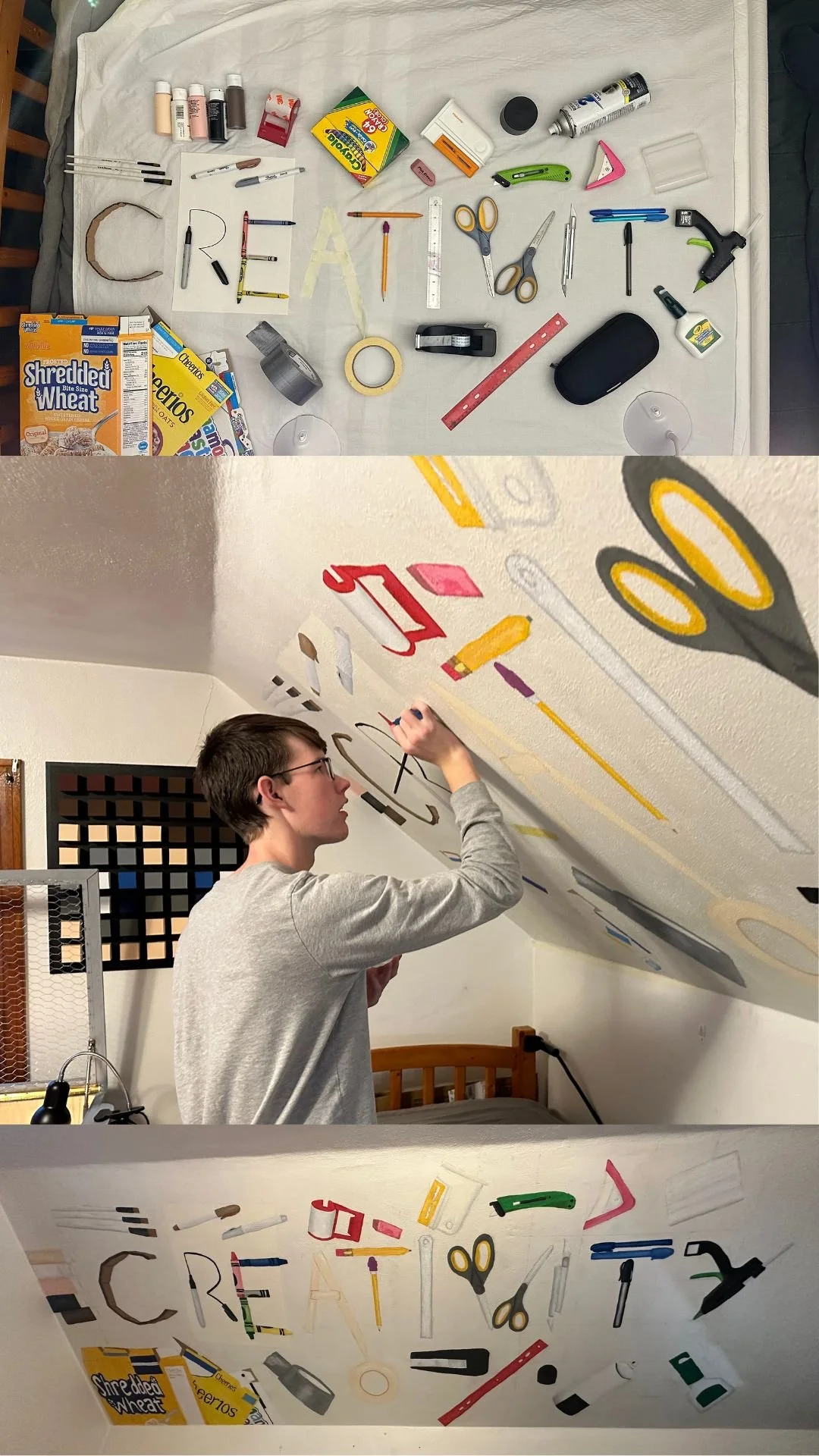
I finished it… eventually. It took several pushes, but I’m happy now with the result. Every time I look at it, I can hardly remember the wall without it.
(Same with the 100 heads… which took a little less time since I was really excited to get them out into the world, and the “pushes” to get them done were more frequent.)
I finished those large projects, and now am able to take on some bigger projects with the assurance from their success. What I have also learned though is: that motivation for large works can’t be momentary.
I mean, these two projects weren’t started on a whim. There were months leading up to each of them where I wanted to do something like it, but hadn’t quite come up with what. The planning phases were robust, and spanned far more than a few days. (For the heads, I had even done a smaller distribution of a dozen or so in my school before thinking of the hundred travelling ones. And for the mural, I sat on the idea for weeks before deciding what I would paint.) And of course, I continued to complete smaller projects while these were looming in the background. Sticking to one piece is simply unrealistic. Artists can say they have “worked on this piece for six years” because it’s on-and-off work, not constant, every day for six years. They work on other things and live their life inbetween sessions.
All this to say I know now that: I can’t make stuff without consistent justification behind it. Here’s a different example:
I recently (a month or so ago) started another decently large project: Turning a plastic crate into a Thneed factory. I’ve been documenting it through my Instagram, and a few people really enjoy seeing progress. But that enjoyment isn’t enough for me to feel motivated towards the project. So now, every time I see it I (similarly to the 100 heads and Mural,) somehow shame myself for not working on it, and send myself down a spiral into which I don’t make any art. (NOT what we want.)

I’m at a point today where what I really want to do is draw what I’ve built so far, and then finalize a cool illustration. I don’t want to finish the large sculpture. This is my one life, so why waste time doing something I don’t want to, that I don’t have to?
I have all the justification I need to scrap hours of work to pursue something I want to do more.
An Audacity Evaluation
When I started this blog post, I had recently been tasked with writing an “Original Oratory” speech for a class, and I chose the topic: “Audacity”.
This post was initially going to contain my process of brainstorming for that speech, but the semester is now over and I’ve both written and performed the speech. So instead, here is the speech, and afterwards, some relevant thoughts and takeaways.
When I started this blog post, I had recently been tasked with writing an “Original Oratory” speech for a class, and I chose the topic: “Audacity”.
This post was initially going to contain my process of brainstorming for that speech, but the semester is now over and I’ve both written and performed the speech. So instead, here is the speech, and afterwards, some relevant thoughts and takeaways.
“I dare you to commit a crime..
But before you do, let me clarify:
I don’t want you to participate in any illegal activities. I want you to do something you feel is socially illegal. Like, compliment someone you wouldn’t normally associate with, say no to an activity so you can catch up on schoolwork, be respectful and attentive during an extremely boring convocation, or, my personal favorite: wear out-of-the-ordinary clothes like neon and sweater vests.
As some unknown, probably important person said: “Audacity is the key to greatness. Without it you’re just… average.” Don’t go commiting crimes, but do go doing things others won’t. It’s how you can make a difference.
With that said, I think audacity is the skill of standing out. It’s not that people learn it, but more often that we lose it as aging brings on the pressures of social lives. We all know of children that have the audacity to draw a scribble with a crayon and call it a “dinosaur” and then go around showing it to everyone like it’s olympic gold. They aren’t ashamed of their hard work, and love to share it.
We lose that audacity when we learn that things are “wrong”. Someone… at some point… tells you that your scribble doesn’t look anything like a dinosaur. They tell you your hard work isn’t as hard worked as someone else’s. You find out that someone will always be better than you at… whatever, and it devastates you. We learn to hold back because all of a sudden we care more about other people’s approval than we do our own enjoyment.
First and foremost in our older lives is that loss of social audacity. Often it’s for the better, preventing us from making unnecessary scenes in public places, and saying things we may later regret. But the lack also crushes creativity. It stops us from doing new things- things that could improve the world. Because we are too scared to fail. We’re too scared someone might laugh. If comedians can admired for anything- it’s just that. They make careers out of their social audacity.
However, you can be socially audacious and still a quiet person. Audacity doesn’t always correlate with loudness. What it does mean though, is that a sure belief will overcome any fear of being the center of attention. For example: if an audacious person wants to stand for something, like how amazing cardboard is, or how great the game bananagrams is, or how cargo pants are the superior pants, they will stand for it, and be unashamed of doing so. Think: each audacious person is running their own ad campaign instead of buying into any of mass media’s.
I would love to meet Robert Rauschenberg. Or rather, I would love to meet anybody who has the audacity to become famous for a blank canvas. So many people have such strong feelings against what seems like an utter lack of effort. But Robert was bold enough not to care. He created a piece of art that looked like he didn’t do anything. He accepted the criticism and moved on. He thumbed his nose at convention, per say, by challenging the saying “art is in the eye of the beholder” by making the whole piece up to the beholder.
Audacity in art is apparent in hundreds of ways. Namely, literally any unique art style, since the artist couldn’t possibly know if it would be marketable until trying. Think: Dr. Seuss, Pablo Picasso, Salvador Dali. Most well-known artists aren’t well-known because their work fit the standard well, but because it stood out well.
That’s what you have to do: try, and be willing to fail. But NOT willing to give up. The artists were told they would fail. Plenty of times. But did they?
I have a challenge for you: don’t look around at other peoples’ reactions before formulating your own. Don’t let someone tell you your dinosaur isn’t a dinosaur. If you stand out enough, people around you will start to accept that as simply who you are. They’ll start to admire, instead of criticize, your dinosaur because unlike their’s, at least your dinosaur is happy.
There will always be comments. But twisting hate into love is a skill to be mastered. Next time somebody says something less-than-nice to you, say “thank you” right back with a smile in a genuinely nice tone (it doesn’t work with sarcasm or anger). Trust me when I say, even if they don’t change right away, the response will make them think. It may just help them realize how much better compliments are than their usual duche remarks.
Audacity is more than just speech though, it’s also about actions. Having a positive attitude all the time isn’t normal. But it should be. When doing anything, we should do it with a positive attitude. This means: not grumbling about assignments, taking down the laundry with joy, and happily listening to music while doing the dishes. Likewise, instead of cussing out rivals, we should compliment them on their achievements. If we as society put as much energy into loving others as we now do hating others, the change would surpass imagination.
I think we should start with the audacity to wear neon for fun. If someone comments on it, tell them a clean joke, compliment them, make them smile.
We need to stop thinking about other people’s opinions, and start thinking about the positive change we can make on the world if we just go ahead and do it. Audaciously.”
Why I can be Audacious
Events of my childhood led me to understand very early on that I have it good. I am the lucky one. With two loving parents, a full stomach, blessed mind, creative joy, and (I like to think) a decent sense of humor, I really am free of worry. This freedom allows me to stand out.
While some may seek the approval of peers or parents, I know my parents support me no matter what, and my peers will grow past their judgemental ways. Because of my safety net at home, I am able to explore creative endeavors most children and teens wouldn’t risk social wrath attempting. I wrote books, made merchandise, and started a craft club in fifth grade themed around my stuffed animal “Moosey”, and continued it in sixth grade until I moved away for seventh. I moved to a school without double-advanced math, so I was thrust in with the grade above, setting me out as the “smart math kid”, but really I was just a bit more priveledged. I accepted the title, and worked with it. As I’ve had on repeat in my head: “it is what it is”. That title separated me enough to not worry about fitting in- it wasn’t even an option.
By now, I’m really not sure what my peers refer to me as- I’ve tried so many different things. I joined FFA, Science Olympiad, Swimming, Tennis and Girl’s Tennis Managing, Theater, Choir, Academic Super Bowl, Spelling Bowl, the School Art and Writing Publication, and Key Club (and that’s just with my school). I also work at a library and started my own art blog (shocker). Personality-wise I joke at everything and still focus enough to have a perfectionist’s mindset. I’ll correct a teacher but keep a secret, I’ll drive you home but won’t go to the football game, I’ll sing “Let it Go” at the top of my lungs, but prefer to watch the rest of the movie in silence. I’m social but avoid social life. (I have no conclusion for this paragraph because I too am unaware of an singularly accurate descriptor.)
Social Audacity…
…basically means to not give a- (let me reword:) It means to not care what others think. Not to mind if their morals align differently, and to still stand by yours no matter the circumstances. It means to refrain from giving in to social pressures, and to not be afraid of standing out.
In my speech I refer to a crayon-scribbled dinosaur. When we are kids it is so easy to be proud of our hard work. We draw that dinosaur lickety-split and show it off “like it’s olympic gold”, proud as all get-out. But at some point, someone tells us our dinosaur looks weird, should be drawn with a different color, or should be “like this”… and we’re stupid enough to listen to that. Too often people stop trying to improve their dinosaur or be content with their dinosaur, and they start to resent their own dinosaur because of other people’s influence.
To extend the metaphor, people have “dinosaurs” for all kinds of things. Their looks, their actions, and their hobbies, to name a few. Because this is an art blog though, I’m going to address the artsy dinosaur.
The Artsy Dinosaur
While trying not to rant about social media and how it alone kills more dinosaurs than any other source (I can think of)… I’ll say a little about my recent experiences.
I like to think I protect my uniqueness with a firm hand. I hand out business cards without remorse, recently finished releasing a hundred cardboard heads with QR codes into the world, and try to share even my less-than-perfect creations with others somehow. But doubt is still consistent. I mention social media because on the platforms there are incredible artists. and I mean incredible artists. I know I’m capable of a lot, and if I worked as hard as each of them had I could probably do it too… but I can never be as good as all of them at everything. I’ll never do flawless realism graphite and stippling pen work and automaton creations and woodworking and pottery and quilting and crocheting and drawing and metalworking and glass working and and and and and. Never. I can’t do everything. All I can work on is my own dinosaur. Whether it sticks with cardboard, or expands to other sculpture or design or art mediums, is up to the future. There’s no way of knowing what I’ll become. But the attitude I maintain through it all is up to me.
The audacity of my dinosaur is up to me.
Artistic “Style”
All established artists seem to have a distinct “style”… and I really don’t.I understand it’s something developed over time, but like most things, it probably helps to take a break and evaluate the progress so far every once in a while:
All established artists seem to have a distinct “style”… and I really don’t.
I understand it’s something developed over time, but like most things, it probably helps to take a break and evaluate the progress so far every once in a while. Here’s my break:
Moosey
My first point of reference in my art is Moosey: A character based off of my stuffed animal that starred in my later elementary and early middle school years. The details included in the character reflected my age, and were easily replicatable and recognizable for the merchandise I made along with the books.
The takeaway is: the character was based off of my stuffed animal. Any adversaries or partners that joined him in the books… were also stuffed animals of mine. And anything we made in the club tended to be based off of either Moosey or just moose in general.
The Cereal Box Figurines
Again, this large stint of art reflected the resources I had available. I had (and still have) plenty of cereal boxes, and no difficulty obtaining walmart acrylics and brushes. I knew how to make cubes, so I based the figurines off of that, and developed a system that maintained a resemblance throughout each one.
But did I ever make anything completely original? Hardly. Most every piece was either based off of a character from some fandom, a skin from a game, or a person and their outfit in real life. The artistic problem solving was in the way I made them, by simplifying details into the often more basic shapes and fewer colors, but the characters were seldom unique.
Drawing from References
I admire people who can draw purely from memory. I have yet to master that skill. Nearly everything I draw is from a reference.
I saw something on Instagram the other day that inspired me though- it was a man who took a stick and used it like a quill pen. My immediate thought was: “What if he drew the tree the stick came from… with the stick?” Which sent me down the path of “is there something I could take from a house and use it to draw the house?” “What else is there similarly?” Perhaps there is another layer to be added to reference usage that would make the art that much more meaningful.
The thing is… I enjoy drawing from references. When I play Minecraft, everything I tend to build is a translation of something else. For example, I have built pixel-by-pixel animals, one such being the turtle from Minecraft. I just picked blocks that resembled the colors and built it big enough to live inside its shell. I built the Colosseum and bits of Rome to-scale using Google Earth as a constant reference. I built the Library of Congress based on images. I built Cragievar castle. Did I ever really make a unique base? Nope. Because I rather preferred the translation process instead.
I would love to improve my portraiture, and perhaps dabble in caricatures. I love observing the things around me with the close eye of an artist, and look for the beauty in everyday things. Direction may help, but I’m still yet to find my art “style”.
With time though, it might just find me.
A Tentative Return to Social Media
I’m quite hesitant to return to social media due to the exact reasons I left it. However,I feel with my renewed purpose and new sense of direction, I may be able to more effectively utilize social media to meet that purpose instead of initiate a mind-numbing scroll every time I open the app.
I’m quite hesitant to return to social media due to the exact reasons I left it. However,
I feel with my renewed purpose and new sense of direction, I may be able to more effectively utilize social media to meet that purpose instead of initiate a mind-numbing scroll every time I open the app.
I consider jsteelycr8.com to be a hub for all the going-ons of my art career. It is a comforting central point that I can return to and update at any given time, pruning off or grafting on new branches including YouTube, Twitch, Instagram, Patreon, Fiverr, Etsy (maybe, who knows), or countless others, even those yet to be created in my life thus far. With this central point I can maintain a sort of focus, and therefore make all the branches grow in similar ways. But the branches also serve a vital purpose: to connect new people to the main stalk.
You see, websites are great because of their consitency. You type in the same link (or click the same bookmark) each time, and the website shows you its newest version. Social media sites however, are ever-changing, adding new content and following trends out of control of the user. I can control this website… it just doesn’t advertise itself well (past my business cards and head hunt experiment). This is where social media can pitch in. It will be able to share the things I am putting on my website in ways that people (who don’t frequent my website to see it) see it.
In other words: My opinion on Social Media has not changed. I still believe it to often hinder, rather than encourage young artists because of the incredible work posted by professionals on the site. It too often makes art seem daunting because the viewers don’t see the thousands of hours put into the craft prior to a creator’s sucess. Professionals already did the practice- so we don’t get to see the extreme growth very often. Art should bring an artist joy no matter their skill level and amount of practice. This is why a website is great for me: I can compare inwardly to my thoughts and work, and I can showcase my personal improvement, instead of doubt my abilities.
I can use Social Media to share my joy and creativity, rather than compare myself to others’.
The Idea Box
I highly doubt this concept is new, but it doesn’t have to be for me to use it and make something cool out of it.
What is an “Idea Box”? It’s a box. With ideas. inside on bits of paper.
I highly doubt this concept is new, but it doesn’t have to be for me to use it and make something cool out of it.
What is an “Idea Box”?
It’s a box. With ideas. inside on bits of paper.
More importantly though, it’s a decision-making tool. Here’s my issue it solves:
I have so many random ideas that I write down, that other people suggest, that I see and want to try, and I have so little time. I want to try out all of them. But I can’t. So sometimes I just settle with doing none of them. And that’s no fun. So now I put them in the Idea Box and hope to draw the best one. Even then, it seemed like a waste to spend all my time on these wacky ideas that may never see the light of day. If nobody else sees them, are they really worth anything?
And that is why I am pleased to announce:
I started a YouTube Channel!
Yay. Woo. So unique.
Look, I know everybody and their Mom has a YouTube channel, but are they me? Nope. So therefore, my channel will be inherently unique.
I’m beginning by basing the video style off of the average Adam Savage video in which there is little to no editing, and the majority of the video is him talking to the camera. It’s the kind of video you aren’t engrossed in for the special effects or fast edits, but rather one you put on while doing a mundane task, and can listen to somebody enthusiastically ramble about their new discoveries/old experiences/general ideas and thoughts, and glance over for context at times.
Besides all the dozens of other ideas I have for videos to post, there will be an “Idea Box” series in which I simply take out an idea from a box (I can get creative with seasonal boxes, et. cetera), beit my own, somebody I know’s, or a commenter’s, and I make that idea. I can go through the process of workshopping all the way to finalizing it, however I decide to do so. They will be consistently creative episodes that make their own little show because of their similar roots.
I can’t hesitate…
…when I’m thinking of making a video. Or else I’ll never make it.
The weight of social pressure is immense. If I pause to consider how bad my video editing skills are, and how so many people could do what I’m doing a million times better: I’ll be too scared to try.
This is why I am glad I decided on my purpose. Every time I am scared to record something, I can just restate my purpose to myself and press record. How can I share my God-given joy and creativity with everybody if I don’t try YouTube?
I hope you stick along for the ride as I continue to explore videography and attempt to improve each video,
because boy will this ride be fun.
A post about Purpose
It is human nature to pursue purpose. People dedicate their lives to different things, and do those things well because of intention behind their actions. For example: a person has to have something beyond motivation to choose running as a sport, and be competitive in it.
Our cross country team has a motto this year, and that motto is one word:
“Purpose”
It is human nature to pursue purpose. People dedicate their lives to different things, and do those things well because of intention behind their actions. For example: a person has to have something beyond motivation to choose running as a sport, and be competitive in it.
Our cross country team has a motto this year, and that motto is one word:
“Purpose”
The one word asks exactly what we all look for: the “why?”. In this case: “Why are those crazy cross country members running on a Saturday morning?” In other cases: Why are we competing in a sport? Why are we working overtime? Why are we choosing choice a over choice b? Some of them come with answers, but those answers lead to more questions: Why would we study for a math test? (For the grade, most likely) Why do we want the grade? (To get into a better college and graduate with less debt) Why are we going to college? (To learn) Why are we learning? (To grow) Why are we growing? (To succeed) Why do we want to succeed? (Because it feels a whole lot better than failing.)
Why am I writing this blog post right now? To share.
And that’s what I’ve decided my purpose to be:
My goal is to share my God-given joy and creativity with everybody.
and a purpose really is a goal. a goal for a life.
Life is full of goals, but purpose is a goal full of life.
I would be able to fall asleep feeling accomplished each night if I could point to a moment (or moments) in that day I worked towards my goal. I value joy and creativity above almost anything, so when I share it with others, I share the value God has given me, with them.
Purpose in Art
Great examples of purpose in art are students’ AP portfolios. Primarily because they each have a “guiding question” (a.k.a. a purpose) driving the collection of works. My AP portfolio’s guiding question this year is along the lines of: “How can I twist fairy tales to show how messed up our world really is?” And I have proceeded to make works displaying sadly true depictions and statistics of teen suicide, child trafficking, and drug overdosage with Rapunzel, Little Red Riding Hood, and Princess Aurora from Sleeping Beauty as the victims (to name a few).
Just as guiding questions streamline portfolios, so does purpose streamline lives.
Moving Forward…
…is the only way we really can move in time, isn’t it.
I’ve taken a new step forward: I’ve recorded a video of myself talking, and posted it.
I was scared even thinking of posting a video on YouTube, and sharing my joy and creativity that way. There are so many nuances to YouTube, and so many rules, and so much editing, and so much software and troubleshooting and and and then I pressed record.
I told myself, “this is a benchmark. It has to be bad so I can improve.” and I went for it.
Too often I try and jump right in and perform perfectly. I’ve been able to do that nearly my whole academic career thanks to an incredible, high-functioning mind. But there are so many more things I can’t be perfect at from the getgo. SO many things. And filming myself is one of those.
So this first video has no editing. No script. No planning. except for a newly discovered purpose and oh, so much excitement to share. Excitement to share my thought.
and while it may still change some day, I can be content now because
I’ve finally defined my purpose.
The Biggest Decision of my Life (so far)
The thought of college (as a high school senior) is one of immense weight and pressure. The source of the pressure is hardly whether or not to attend college, as I fully expect to, but rather where to attend college.
…will be College.
The thought of college (as a high school senior) is one of immense weight and pressure. The source of the pressure is hardly whether or not to attend college, as I fully expect to, but rather where to attend college.
I have formed two options:
Option 1 is Indiana Wesleyan University: with its campus close, but not too close to home; one I am very familiar with from my art camp experiences there; with amazing art+design division staff. I would be studying Studio Arts and Human Communications.
Option 2 is Western Michigan University: an out-of-state, large campus with countless opportunities, and a gorgeous city with a new environment to explore and thrive in. I have an idea for a podcast that would be incredible if I were to attend WMU, and the surroundings would surely spark countless more ideas. I would be studying Paper Engineering.
This blog post is not intended to convince myself through emotion why I should attend IWU, but to add a level of logic and clarity that emotion prevents.
Indiana Wesleyan is a Christian school, so I would be able to grow my faith and thrive in a Christ-centered environment.
Western Michigan is a secular school, so it would be easy to fall into the traps and temptations inevitably surrounding me.
Indiana Wesleyan is a small school, with about 2,200 undergrads enrolled.
Western Michigan is a big school, with about 14,400 undergrads enrolled.
Both IWU and WMU do not allow tortoises without ESA approval. Which I do not apply for.
While there are obviously factors, my predicament stems not from which campus is better, or which has more preferable people; those things are easily subjective and bound to change based on circumstance. Rather, it stems from the fundamental question of: Can I make a living with art?
I understand that less than 30% of college graduates end up working in the field of their degree. I would probably be in the 70% percent who don't if I earned a degree in engineering. I would likely pursue art anyways. The difference being, I would not have had four years to explore and expand my craft in a safe environment such as university. And I would have a backup degree in engineering.
But back to the question:
Can I make a living with Art?
We all have one life to live. And for some reason, senior year has me expecting I can plan mine all out before I even hit eighteen.
A YouTuber by the name of TangoTek's take on the purpose of life is, "Do everything you can to be happy with the time you have." (All I need to add on is "Love the lord your God with all your heart, soul, and mind. And love your neighbor as yourself." and it's exactly as I would have it.)
There's no telling what will happen in the coming years. While it is far from ideal, there's a possibility I don't live past college. What would my investment in a future have been worth then? if I didn't enjoy the years leading up to a future that never came?
While there are plenty of comfortable artists out there, it is well-known as an instable career. For a person like myself who is immensely habitual, and yet enjoys spontaneity to its fullest, the idea is beyond attractive.
Because of my entrepreneurial experience and creativity, I'm quite sure I would be able to make things work as an artist. And I'd enjoy the ride the whole way. Not the ride to finish a lucrative degree in engineering so I can live a comfortable life. Instead, the bumpy and unsure, but passionate and adventurous, life of an artist.
Things I have truly enjoyed in my life are both service activities (being a part of Key Club, etc.), and creating things. Being "smart", being "competitive", and being "employable" have all meant less to me than serving others and creating new connections, new ideas, and new things out of cardboard.
So if I am choosing based on what I really love: I choose art and communications.
If I pursue them at a university level, perhaps I will gain what I am currently lacking to make art a successful career. (And yes, I know success is also subjective). With the gained knowledge, I can at least know where to look for any next steps.
But first I need to take the next step that’s right in front of me. Is it the right step to study art? The right step to study engineering? I feel more inclined to one than the other… is inclination the most important? or is financial comfort?
I know I would be able to enjoy every day as an artist, so if it falls to a question of passion or stability…
I choose passion.
“It’s Not Her.”
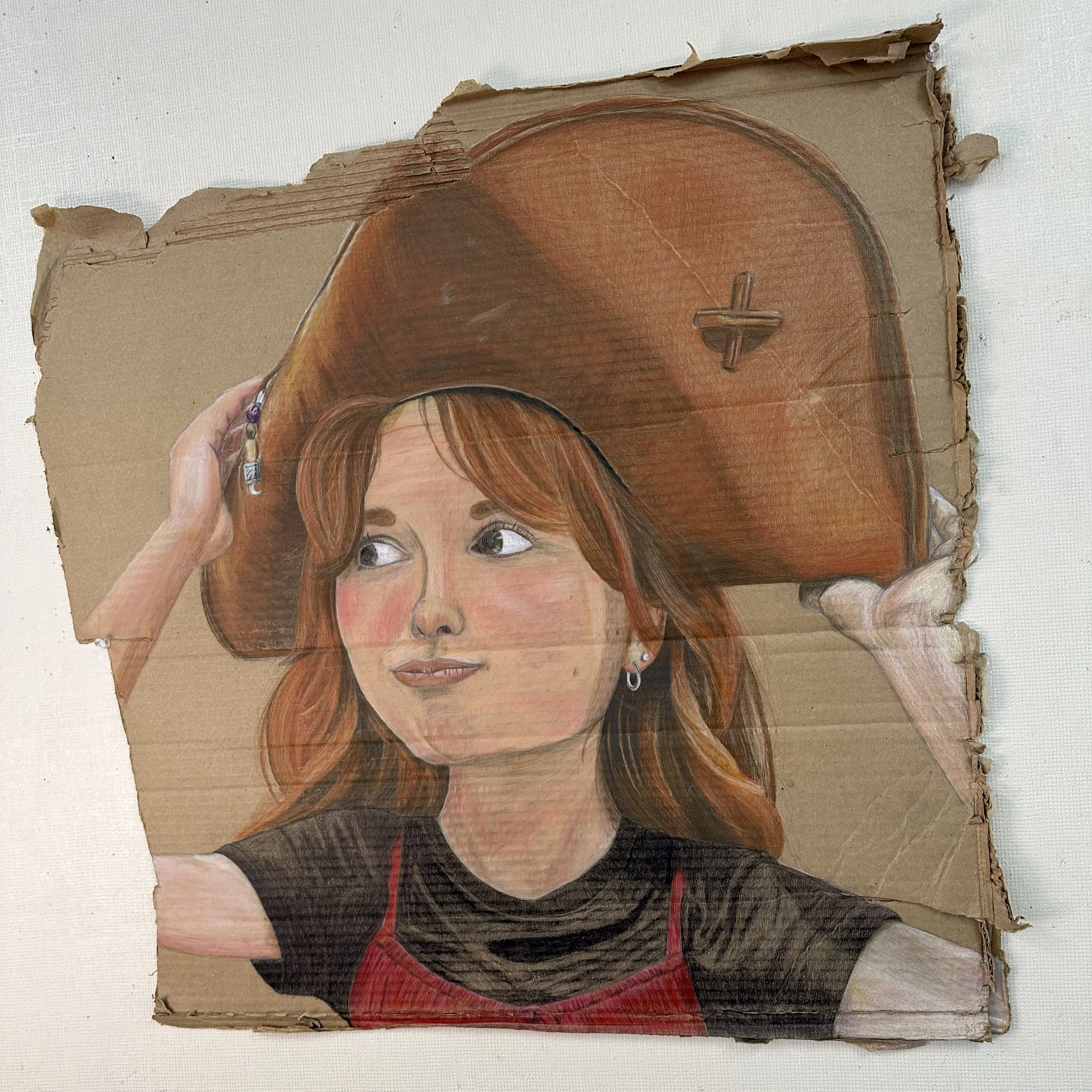
…is a heartbreaking thing to hear after spending so long on a portrait piece. And it’s even worse to know its truth.
…is a heartbreaking thing to hear after spending so long on a portrait piece. And it’s even worse to know its truth.
The one that Isn't Her
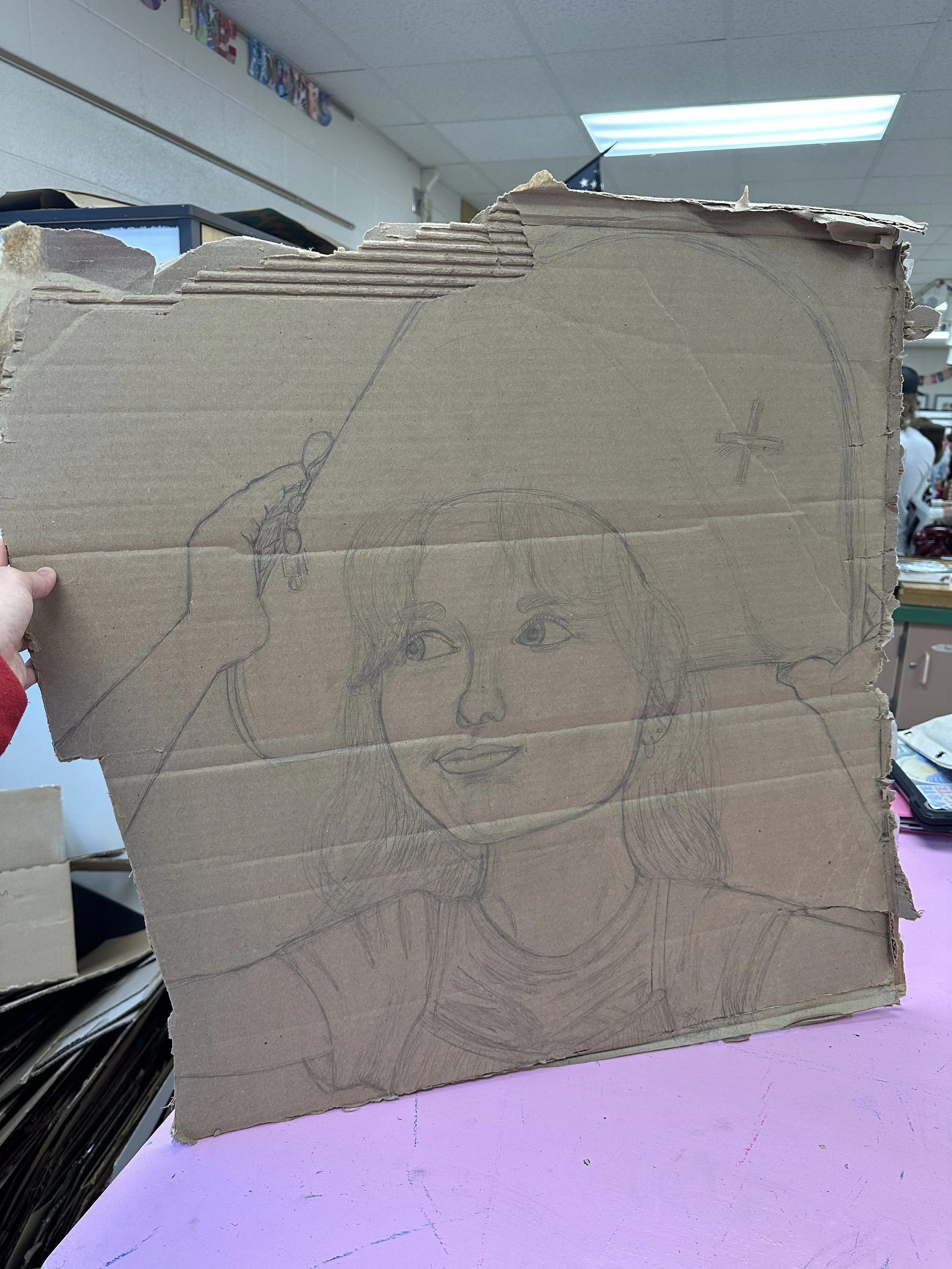


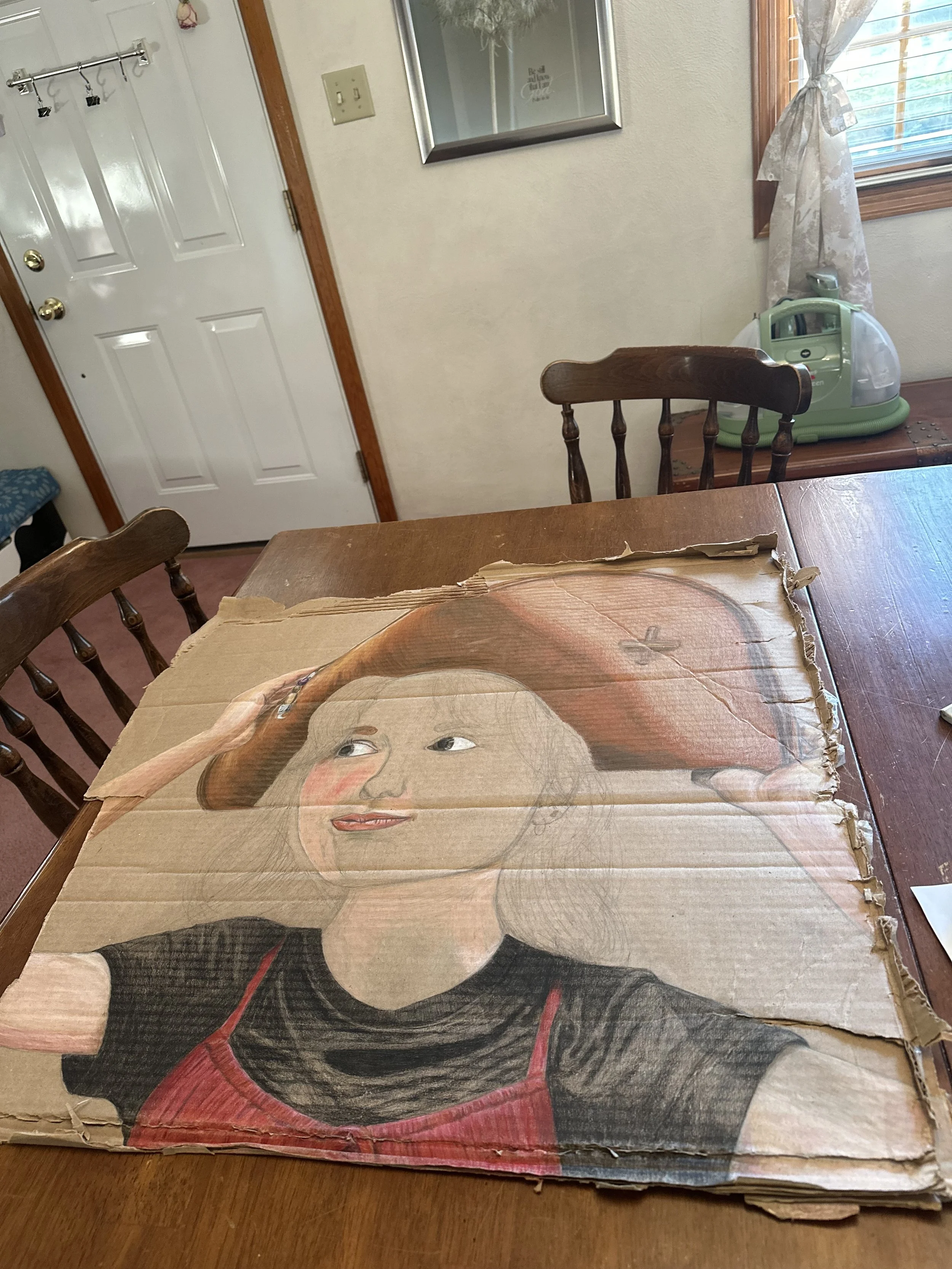


Luckily, just because a final piece is inaccurate to the reference image, it can still look great.

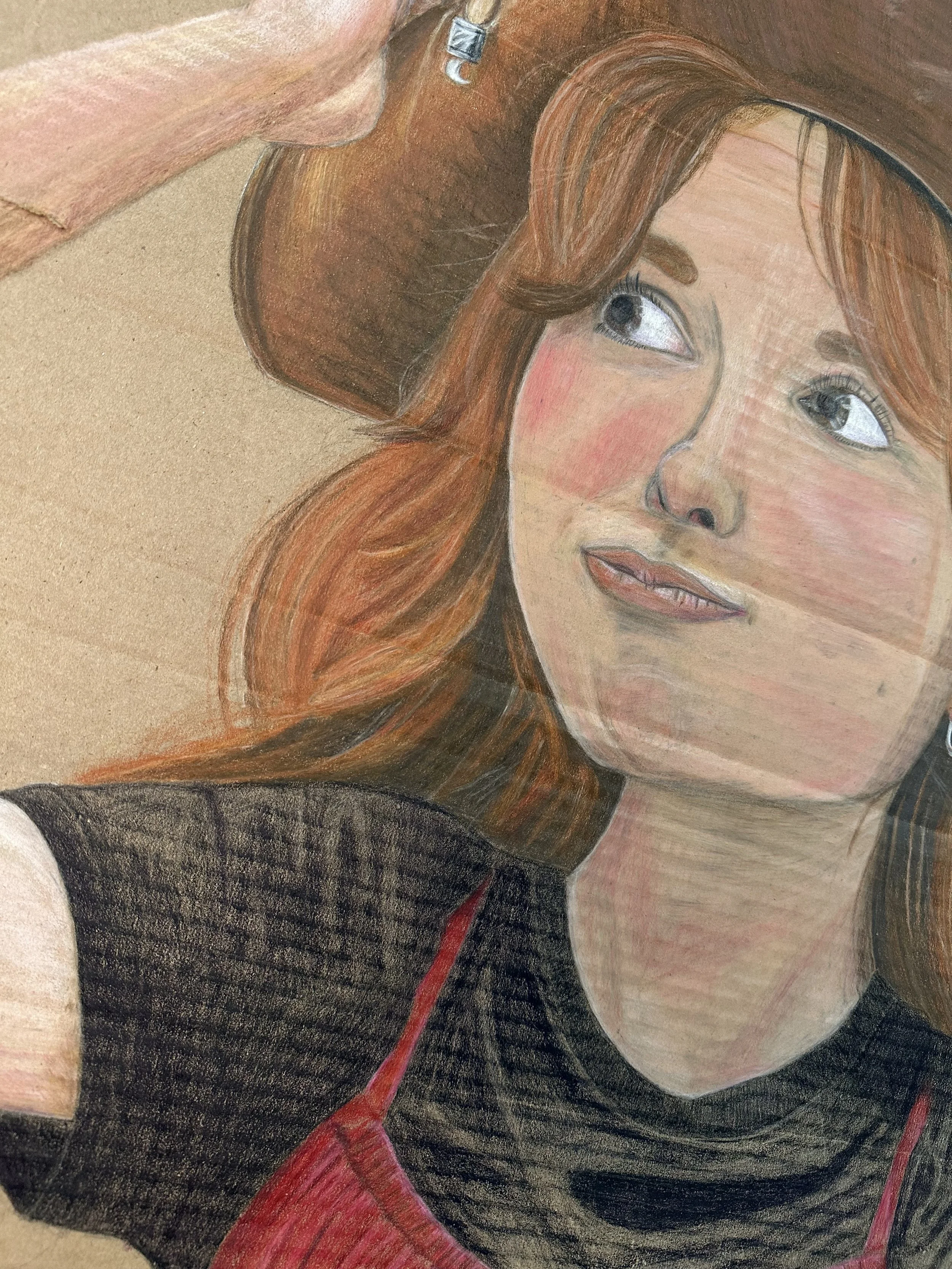
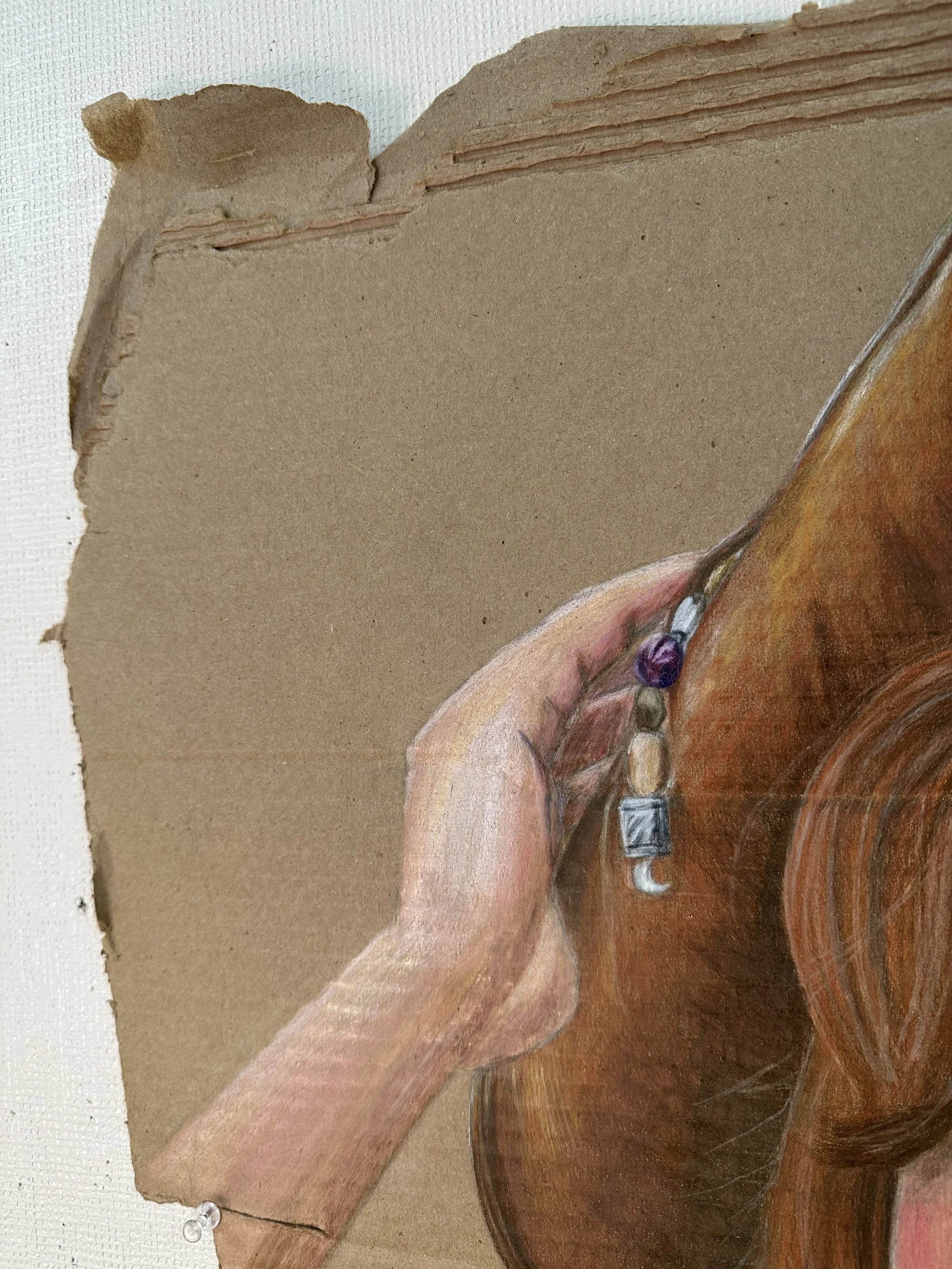
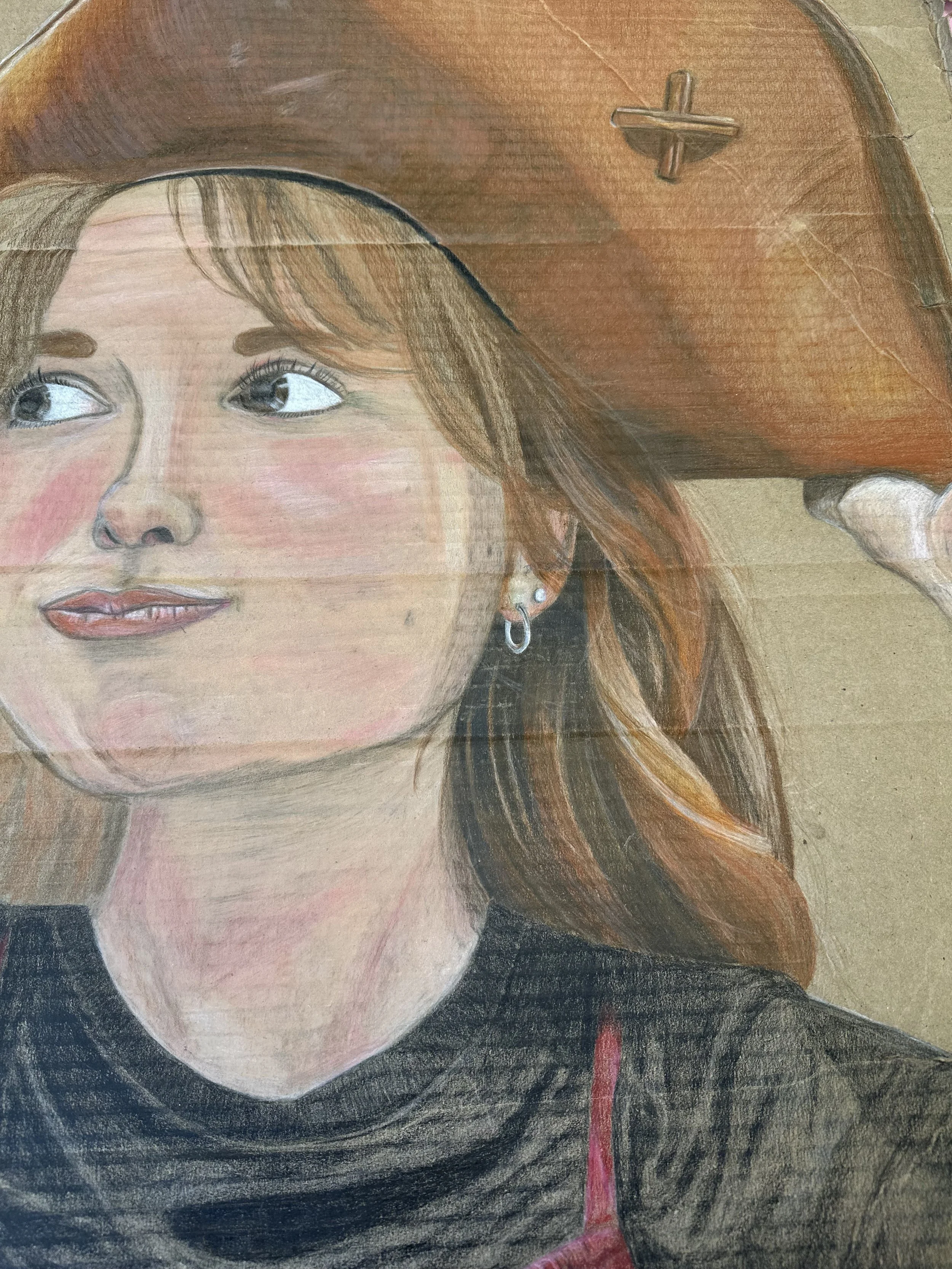


This was a spontaneous portrait. (Which is crazy to say, what with how perfectly the picture fits on the random piece of cardboard I plucked off the dusty floor of the school’s art room).
I was in class, and burnt out from my portfolio series after completing two, and starting two more, pieces within the first few weeks of school. So I just… started a portrait. And it ended up taking from that Thursday, September 7th, until this Friday, September 15th. Non. stop. Sunday alone I colored that thing for seven or eight hours. It was a blast.
But I wanted it to look exactly like the picture, and I failed to do so.
I hope to improve.
Portrait drawing is Hard
Portraits are infamous for their difficulty to freehand. Hence, commonly being aided by transfer and tracing techniques to get proper proportions. (I have a newfound respect for the portrait artists of old. I'm lookin' at you, Da Vinci. *not you, Picasso.)
But most things are difficult, if you don't first learn the fundamentals. (Take Calculus without first taking any Algebra, and you'll agree). Proportions are the fundamentals of portraits. However, (my mind especially) wants to draw the nicest line it can, and then wonders why the portrait is inaccurate. Well (obviously) it's because human faces are full of imperfections. That's what generates uniqueness. I would have to perfect the imperfections by ignoring my desire to draw a fun line, and to observe what is really there in front of me.
Ways to practice include: still life drawing… and obviously more portrait drawing. and really, just drawing things how they are, not how you want them to be.
Here’s where I put a small disclaimer: This is all very situational.
That jab at Picasso was because his work doesn't apply to accuracy. But that doesn't mean his portraits aren't art, or don't represent the details of faces in a different way. He drew them how he wanted them to look.
I explored caricature art as a possible hobby for a bit, and it is far from accurate portraits. But it does resemble the people another way: exaggeration. They draw them how they think is humorously accurate.
So I give you this: There are the exaggeration of features, and the subtleties of accuracy, and both are used to draw portraits. Either is a fine choice…
(but I want accuracy).
How Drawing People brings you Closer to them.
My aunt recently shared with me a podcast episode from "People I (mostly) Admire" titled episode "110. Drawing from Life (and Death)" with artist Wendy MacNaughton, discussing her book "How to say goodbye".
It was one of, if not the best, podcast episodes I’ve ever listened to.
While I have yet to read the book discussed (I requested it for my library), I find the bits from their discussion fascinating. They talk of MacNaughton's artist residency at a kind of retirement home, where she drew people in their last stages of life. She might talk with them while she drew, they rarely may ask to draw her simlutaneously, or she simply be with them. But in every case, the drawing was personal.
The smallest amount of research on MacNaughton tells you her mantra: "Pay Attention", (which sounds like one I’m familiar with: “Details man, details.”) which she preaches through most everything she does. These portraits were so personal because she was truly paying attention to the people she was drawing. It brought her closer to the person not only physically, as they were mere feet apart, but emotionally. And she says it can bring you too, closer to anything or anyone in your life. By spending time looking meticulously at each and every detail (without the art result itself mattering) you learn more about something than you would with a thousand passing glances. One such exercise she assigns to the podcast's host and listeners is as follows: Pick an object, get a piece of paper and drawing utensil, and set a timer for five minutes. You are now to draw the object.
But you cannot look down at the paper.
Because the result. doesn't. matter.
What matters is that you pay attention to each detail of what is in front of you.
I would even extend the challenge to trying this in your mind at a random lull in your day. Try admiring every imperfection of some person or thing that is in front of you. You’d be surprised at how closely you haven’t looked before.
Portraits are a challenge. But they are oh, so worth every minute.
Looking for a particular post?
-
2023
48
- Jan 12, 2023 Hamsters Jan 12, 2023
- Jan 12, 2023 Art Museum Sketching Jan 12, 2023
- Jan 12, 2023 Frogs for a Good Cause Jan 12, 2023
- Jan 12, 2023 Art in Trigonometry Jan 12, 2023
- Jan 12, 2023 Free Caricaturist Jan 12, 2023
- Jan 12, 2023 Disney Mashup w/ @k.steely_the_artist Jan 12, 2023
- Jan 12, 2023 Art Studio in a Van Jan 12, 2023
- Jan 12, 2023 There’s a House in my Boot! Jan 12, 2023
- Jan 12, 2023 Minecraft Dungeons was a Spark Jan 12, 2023
- Jan 12, 2023 [Insert Straw Pun Here] Jan 12, 2023
- Jan 12, 2023 Oh Christmas Tree Oh Christmas Tree Jan 12, 2023
- Jan 12, 2023 Why Sketchbooks are the Greatest Thing Ever Jan 12, 2023
- Jan 12, 2023 How to make the Perfect Christmas gift Jan 12, 2023
- Jan 12, 2023 I drew a house Jan 12, 2023
- Jan 12, 2023 I designed my own Rodeo Stampede Animals Jan 12, 2023
- Jan 12, 2023 MiPads Jan 12, 2023
- Jan 12, 2023 2d or 3d Art? Which do I prefer? Jan 12, 2023
- Jan 15, 2023 Utilizing Other Peoples’ Energy Jan 15, 2023
- Jan 16, 2023 Goodwill Builds (ft. Waffle Blanket) Jan 16, 2023
- Jan 19, 2023 I spy with my artistic eye… Jan 19, 2023
- Feb 4, 2023 Art Teacher Simulator Feb 4, 2023
- Feb 15, 2023 Proportional Importance Feb 15, 2023
- Feb 23, 2023 How to sketch a sculpture Feb 23, 2023
- Feb 27, 2023 Overdoing it Feb 27, 2023
- Feb 28, 2023 Old Vehicles into Park Benches Feb 28, 2023
- Mar 27, 2023 The Word of the Day is Patience Mar 27, 2023
- Apr 5, 2023 How to have a Productive Break Apr 5, 2023
- Apr 5, 2023 Define Useless… Apr 5, 2023
- Apr 25, 2023 My Kind of American Football Apr 25, 2023
- Apr 26, 2023 Behind the Business (Cards) Apr 26, 2023
- May 7, 2023 Preserved Through Planning May 7, 2023
- May 26, 2023 The significance of June 25th May 26, 2023
- May 28, 2023 The Heads or Tails Machine May 28, 2023
- May 30, 2023 The Legend that is Harry Smiles May 30, 2023
- Jun 7, 2023 Thoughts about My First Ever Workshop Jun 7, 2023
- Jul 2, 2023 Now THAT’S how you run an Art Camp Jul 2, 2023
- Jul 10, 2023 Duck Architecture is SO COOL Jul 10, 2023
- Jul 22, 2023 Blank Space: The Game you 100% Make Up Jul 22, 2023
- Jul 29, 2023 The Tipping Point (by Malcolm Gladwell) Jul 29, 2023
- Aug 13, 2023 Creativity > Efficiency Aug 13, 2023
- Aug 30, 2023 I want a taco truck Aug 30, 2023
- Sep 15, 2023 “It’s Not Her.” Sep 15, 2023
- Sep 27, 2023 The Biggest Decision of my Life (so far) Sep 27, 2023
- Sep 30, 2023 A post about Purpose Sep 30, 2023
- Oct 11, 2023 The Idea Box Oct 11, 2023
- Oct 22, 2023 A Tentative Return to Social Media Oct 22, 2023
- Nov 15, 2023 Artistic “Style” Nov 15, 2023
- Dec 23, 2023 An Audacity Evaluation Dec 23, 2023
-
2024
17
- Jan 13, 2024 The Value of Walking Away Jan 13, 2024
- Feb 18, 2024 “The Thought Box” Event Idea Feb 18, 2024
- Feb 24, 2024 The Scholarship Essays Feb 24, 2024
- Mar 2, 2024 “Simple Pictures are Best” Mar 2, 2024
- Mar 9, 2024 Downloading a Virus to make a Cardboard Deck Box Mar 9, 2024
- Apr 14, 2024 The Deck Box Initiative Apr 14, 2024
- May 29, 2024 Trying Everything (why this website is poorly maintained and I'm okay with that) May 29, 2024
- Aug 26, 2024 (In)Finite Enthusiasm Aug 26, 2024
- Oct 4, 2024 I called it! (unsurprisingly) Oct 4, 2024
- Oct 25, 2024 Meaning in Materials and Autobiographical Art Oct 25, 2024
- Oct 31, 2024 On Adaptability and Switching Majors Oct 31, 2024
- Nov 16, 2024 What Francisco de Goya, Nick Cave, and Nathan Foley have in common. Nov 16, 2024
- Nov 16, 2024 Art and “the Media” Nov 16, 2024
- Dec 5, 2024 SPACESHIP (Visualizing Childlike Wonder and Creativity) Dec 5, 2024
- Dec 8, 2024 A Checklist Conclusion (Part 1) Dec 8, 2024
- Dec 25, 2024 A Checklist Conclusion (Part 2) Dec 25, 2024
- Dec 26, 2024 My mom said I should write about the ewok child. Dec 26, 2024
-
2025
15
- Jan 29, 2025 Blastoff in 3… 2… Jan 29, 2025
- Feb 2, 2025 “So you’re the Cardboard Guy?” Feb 2, 2025
- Feb 4, 2025 “Are you happy with that?” Feb 4, 2025
- Feb 13, 2025 Asking More Questions Than the Students… Feb 13, 2025
- Mar 11, 2025 Prioritizing Creativity Mar 11, 2025
- Mar 25, 2025 Brainstorming some Improvements Mar 25, 2025
- Apr 5, 2025 The Pilot Episode Apr 5, 2025
- Apr 25, 2025 Emphasizing Impermanence Apr 25, 2025
- May 22, 2025 Artistic Autonomy May 22, 2025
- Aug 4, 2025 Ideas? Meet your Makers. Aug 4, 2025
- Aug 5, 2025 En Masse Aug 5, 2025
- Aug 12, 2025 Observation, Creation, Communication Aug 12, 2025
- Sep 23, 2025 Communication is an Art Form Sep 23, 2025
- Nov 13, 2025 Islands in an Ocean of Words Nov 13, 2025
- Dec 9, 2025 Enjoy the Waffling Dec 9, 2025
-
2026
11
- Jan 6, 2026 “Cardboard” in 300 words Jan 6, 2026
- Jan 6, 2026 Choosing Cardboard Jan 6, 2026
- Jan 16, 2026 Buried Under the Weight of a Thousand Shoulds Jan 16, 2026
- Feb 22, 2026 You Can't Throw Away Experience Feb 22, 2026
- Mar 22, 2026 Embellish Everything Mar 22, 2026
- May 2, 2026 Start it Up! May 2, 2026
- May 3, 2026 Lesson Plans, Volume 1 May 3, 2026
- May 7, 2026 Explanation Clarification May 7, 2026
- May 25, 2026 First Bite Conversations May 25, 2026
- Jul 7, 2026 What silence says… Jul 7, 2026
- Jul 23, 2026 Like a Smiling Headless Chicken Jul 23, 2026