
blog
"Waffles are the Sponsor of my Woes"
OUT NOW ON AMAZON
"Waffles are the Sponsor of my Woes" OUT NOW ON AMAZON
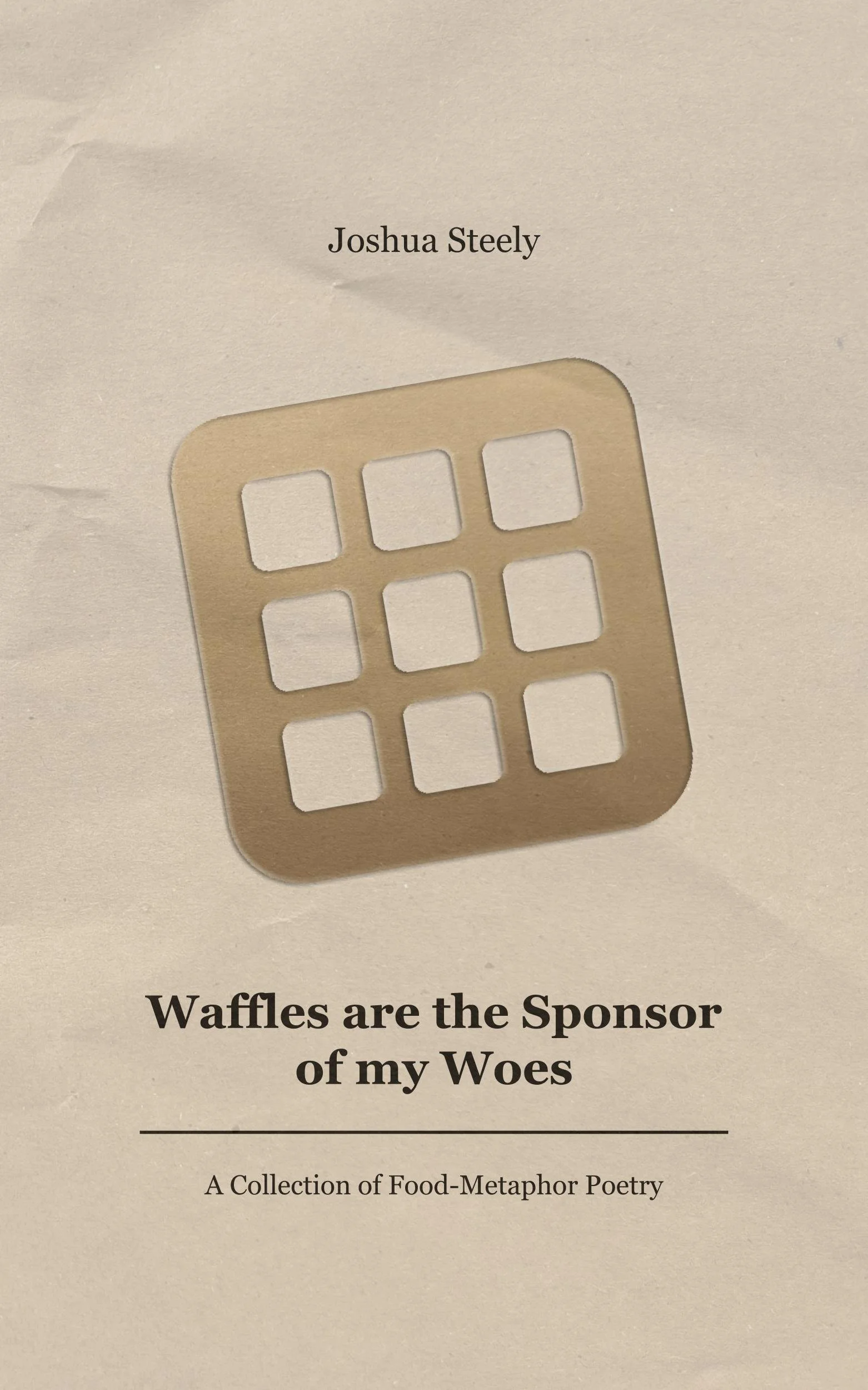
"This cooked." –Michael Howe
Joshua Steely's heart is served up on a silver platter in his debut poetry collection, Waffles are the Sponsor of my Woes. Steely's food-metaphor-based poems explore themes of Hope, Rejection, Desperation, Rage & Regret, Resignation, and Sadness as if steps for the recipe of a hopeless romantic. With chocolatey tears and stained shirts, readers can experience the feeling of grasping at straws that so inspired many of the poems within.
While Waffles are the Sponsor of my Woes is written from the perspective and experiences of a 16-19 year old boy, the emotions evoked by emptied gourds and sweet cinnamon rolls are for everyone. Is a diet from love the answer? Gorging on it until there's nothing left? Steely offers spoonful after spoonful, but each taste leaves only a desire for more...
"Waffles are the Sponsor of my Woes"
OUT NOW ON AMAZON
"Waffles are the Sponsor of my Woes" OUT NOW ON AMAZON
Why a blog?
I’ve always loved sharing my ideas with whoever will listen (or is unlucky enough to be within earshot). Most of them go nowhere after that, but a couple end up worthwhile! This site is a way for me to share my ideas with people beyond earshot, and doubles as writing practice!
I hope one day somebody may be inspired by what I’ve shared and go on to do things greater than I could have ever dreamed of. I couldn’t exactly take credit, but if I’m even a slight influence towards something greater, that’s a win.
Trying Everything (why this website is poorly maintained and I'm okay with that)
I'm going into college with a refined mindset, thanks to my experiences in highschool. I call it the "try everything… specifically" mindset.
In it, I keep an overarching goal such as "I want to improve at verbal communication" when choosing activities, and then jump into as many relevant ones as I can find.
I'm going into college with a refined mindset, thanks to my experiences in highschool. I call it the "try everything… specifically" mindset.
In it, I keep an overarching goal such as "I want to improve at verbal communication" when choosing activities, and then jump into as many relevant ones as I can find. For that goal specifically, I joined choir, a speech class, and both of my senior year's theater productions. I started a sort of podcast in my van, and a format of organized familiar conversation I call "Van Talks" in which I can talk to my friends for hours about anything. I've read books and listened to audiobooks about communication. I've worked to improve my diction through games like Bananagrams and the Merriam-Webster/New York Time's games. Everything about my senior year wrapped around improving communication skills, tying into a nice bow with my graduating Valedictorian speech. (Hence my choosing to pursue Human Communications alongside Studio Arts at college)
For college I wonder what the goal will be. Perhaps it will be "I want to improve at idea generation" or "I want to improve at consistency". Of course, I will continue working to improve on verbal communication along the way, but either one of those goals would be able to be structure my "try everything… specifically" mindset. For the "idea generation" goal, I could join the FNL improv comedy group, the art Foundry, and participate in writing and art workshops as frequently as possible. While for the "consistency" goal I could focus entirely on setting habits and sticking to them. Like: journaling every day, working out, eating healthy, reading at a certain time, maintaining a stable emotional availability level (to name a few). Thinking about it, I definitely want to attempt the "consistency" goal.
I've tried being consistent in art before, but it's a struggle. When ideas appear, they appear suddenly and without warning. Attention shifts are instant. But the motivation can only carry me so long, and some days it is nonexistent. To "draw every day" I would need the time to… and sometimes I just haven't been careful enough to set that time aside. To "journal every day" I feel I need something worthwhile to write about. Working on consistency, I will make sure to work hard on building and protecting those habits.
Speaking of consistent, this website is anything but. The thing is, I don't need to maintain it. I don't need income yet. But maybe soon. What I have so far is an incredible base to work off of. I've written blog posts, I've organized pages on the website, I've sent newsletters, I've worked with the images… I have a base set of skills to improve and expand upon when it becomes necessary. Oh, and I've handed out a whole lotta business cards with the website on it, so anybody who revisits it should be met with something new.
The time I haven't spent forcing myself to work for money I would just turn around and spend, or to work on an art blog I'd just revise, I've spent learning more- experiencing more- that I can then implement right back into my future job and writing. I’m not trying to rush into a world of stress and payments, and rather am focusing on enjoying the creative spirit when it comes. I’m embracing spontaneity in lieu of consistency for now, but perhaps the college experience will be the habit-builder I need to set me up as a more consistent adult.
but maybe I’ll keep this website sporadic for the fun of it.
The Deck Box Initiative
To take initiative is to do something even if you don’t necessarily want to do it.
I want to clean off my shelf, but these deck boxes that I made (I think) months ago, are still there trying to prompt me to write an Instructable about the process and the result. I even wrote a draft… that now I can’t find… of course. I titled it “How to make anything is 6 steps” and it went through how I idea….
wait.
I did write that Blog Post. and titled it “Downloading a Virus to make a Cardboard Deck Box” a little over a month ago. What a wild month it’s been that I would forget.
I guess I’ll continue with the idea of initiative. And pair that with spontaneity.
To take initiative is to do something even if you don’t necessarily want to do it.
I want to clean off my shelf, but these deck boxes that I made (I think) months ago, are still there trying to prompt me to write an Instructable about the process and the result. I even wrote a draft… that now I can’t find… of course. I titled it “How to make anything is 6 steps” and it went through how I idea….
wait.
I did write that Blog Post. and titled it “Downloading a Virus to make a Cardboard Deck Box” a little over a month ago. What a wild month it’s been that I would forget.
I guess I’ll continue with the idea of initiative. And pair that with spontaneity.
I wrote this on August 23rd, 2023, but never posted it:
I’m getting a turtle. Well, actually, a tortoise more likely. And no, it’s not pure spontaneity, as I understand the longevity of tortoises, and have in fact been considering getting another pet for a while now (I even looked into birds as an option… too loud). But I can still relate it to the importance of spontaneity.
Life can become bland. Monotonous even. It can feel restricted by a set schedule, and you can feel overwhelmed by the underwhelming amount of newness. (I know this, even as a mere 16 year-old. I’m guessing it doesn’t get easier, rather more and more restricted by work and plans and kids like me.) What I do know for sure doesn’t change is that each of us gets ONE life. One life we can easily lose to the boredom of what we believe to “just be the way it is”. It doesn’t have to be.
To initiate change, there are of course steps leading up to things, but only one large tipping point
I want this post to be a bit more in-depth than the normal text-heavy, idea-based posts, so I’ve been thinking about how to go about making it worthwhile.
What makes anything worth reading? Well, probably the worth of the knowledge the reader gains from reading it. If you get a text from your mom saying dinner is ready (which happens a lot for me) that information is only as important as how hungry you are.
What gets a reader to read the whole thing to get the takeaway in the first place? A good hook, and a early promise of worth. The promise of worth is established by strong leading points that will lead to further elaboration withing the “meat” of the text. These are often stated in “thesis statements” in essay-style texts, but due to the informality of this blog, I doubt I will use such a formal tool.
Continuity is important in a lot of ways, but especially in writing. (see how aggravating it was to suddenly switch topics? That’s why I need to work on segwaying each point more smoothly into the next.) If a post kindof meanders along, bouncing from point to point (even if they’re strong points), and then it ends when the writer is tired of writing, it’s not high in continuity. Even within a sentence (like the poor example that is the previous sentence) continuity applies. Normally, I try to read back posts to check the continuity, but if I go about this in a rushed, or day-of manner, it can often leave much to be desired.
If I were to keep this blog post going, and just write what came to mind - it may never end. That is, if my hands didn’t fatigue by the speed at which I type, and the lack of intense practice typing. (Yes, I type quickly, but no I don’t use the home row. I can still type without looking if I am familiar with the keyboard.)
oh, and I like Alfredo sauce more than Marinara on Thursdays.
Huh? What was I even rambling about there at the end…?? No wonder I didn’t post it. But hey, 16 year old me had something he was going for. Living life as if it is your one spectacular show of a life.
Perhaps initiative is spontaneity with structure. A structure that we build up for ourselves made of morals and goals and responsibilities.
Art does a great effort at bringing us back to purer spontaneity. In art there doesn’t need to be any worry about the greater effect: If it will ruin a life or a relationship or an opportunity. If you’re drawing, you can “mess it up” and make it better. You can always “fix it” with acceptance.
If I take the initiative to clean my room, it’s a spontaneous decision with a positive outcome in mind. If I take the initiative to start creating, there may not be an outcome in mind, but the action itself is almost always positive, freeing, and rewarding.
Whatever your initiative is, take it.
Downloading a Virus to make a Cardboard Deck Box
So I was trying to figure out a way to turn cereal boxes in convenient deck boxes for Magic the Gathering (and other card games) but none of the templates I found were what I wanted. And believe me when I say I really LOOKED. Every site that showed up with a deck box template I clicked on. (Not my best move-hence the title). But I did figure out what design I wanted, and set to work drawing up templates.
From the whole process I have found a six-ish step process for making most things:
The moral of the story is… don't get carried away during research. Always read the pop-ups before clicking "allow" on ANYTHING. and just don't do it on unfamiliar websites. Silly me.
So I was trying to figure out a way to turn cereal boxes in convenient deck boxes for Magic the Gathering (and other card games) but none of the templates I found were what I wanted. And believe me when I say I really LOOKED. Every site that showed up with a deck box template I clicked on. (Not my best move-hence the title). But I did figure out what design I wanted, and set to work drawing up templates.
From the whole process I have found a six-ish step process for making most things:
Step One: Describe the Vision
My ideal outcome was "A deck box I can make out of cereal boxes that has an attached lid that shuts and stays shut to assist in the storage and transfer of cards."
The more specific you can get with what you want, the easier it can be to work towards a result. The result is clear, you just have to forge the path there. If you've ever googled "book with blue cover" in hopes of remembering the title "Wonder" it may work, but "The Fault in Our Stars" and "The Great Gatsby" will also show up. Now if you look up "book with blue cover and one eyeball", the cover of "Wonder" is the first image result. Just as asking a more specific question helps produce more specific results in a browser search, so will a project's guiding question assist in creating the result you want. (This same question technique is used in AP Art classes when planning a portfolio idea.)
Step Two: Research Existing Options
I went in a deep dive when looking for deck box designs, even clicking rapidly enough to download a virus on my computer (be careful when browsing like this, my computer is fine, but yours may not be so lucky). I printed out a few designs I found, but ultimately didn't find exactly what I was looking for…
Step Three: Refine and Brainstorm
…so I brainstormed ways to make it work. I had seen plastic deck boxes with the round-ish folding box lid thing design I ended up going with, so I drew out a few rough designs on paper, and then…
Step Four: Prototype, Prototype, Prototype
…prototyped! I made one how I knew to make it and then I looked at it. The first few were just off (mainly because I hadn't measured right… but I learned more than measurements). I'm sure I altered the design a half dozen times before settling on one and making the “final” templates.
Step Five: Show It Off, Gather Feedback
I found out after I made a few boxes from the templates I'd hand-cut… that I could print the designs on cereal boxes. This revelation was immensely exciting, and really opened new possibilities with how I could design and market boxes in the future. Now, I know I can print for other projects as well! So many new ideas are being presented thanks to the challenge overcome in one project (this challenge being my lack of precision painting skills to execute the desired designs of friends).
Step Six: Never Settle For Mediocrity
Always be willing to improve a design. This isn't to say necessarily spend your whole life devoted to improving one project… sometimes good enough is good enough for that moment. But there is always room for improvement. I was able to recognize my templates I had worked (really) hard on were not the best option. Printing was far better. And if I had access to automated cutting, it would have increased production quality even further. (I don't yet… but one day!)
They work! I think…
I haven't consciously tried to apply the steps to my current cardboard crate projects, but now that I'm writing this I can confirm I did 1, 2, 3 and am currently in the midst of 4/5, making a few versions and improving my production of the different versions to use my time more efficiently.
If you want to make a cereal box cardboard deck box using my templates, I've attached them, but if you don't like the design,
just start at step 3.


“Simple Pictures are Best”
…is a children’s book I am quite familiar with. The story goes something like this:
There is a sweet old couple who lives on a farm and is getting their picture taken with one of those old throw-a-black-sheet-over-the-photographer cameras. But each time, right before he takes the picture, they think of another and another and another thing they could put in it. Eventually, they have their whole hat collection on, produce selection in their laps, and cats by their feet… and then a bull gets loose and blocks the entire picture when it finally does get taken. “Simple pictures are best” warned the photographer.
…is a children’s book I am quite familiar with. The story goes something like this:
There is a sweet old couple who lives on a farm and is getting their picture taken with one of those old throw-a-black-sheet-over-the-photographer cameras. But each time, right before he takes the picture, they think of another and another and another thing they could put in it. Eventually, they have their whole hat collection on, produce selection in their laps, and cats by their feet… and then a bull gets loose and blocks the entire picture when it finally does get taken.
“Simple pictures are best” warned the photographer.
In art we can overcomplicate everything. But it’s unwarranted. Art only needs to be as detailed as the artist wants it to be. There isn’t any rule on the minimum number of brush strokes to make a legitimate portrait. There isn’t a minimum number of glue sticks used to make a legitimate sculpture.
And for my recent AP 3D portfolio, I found just because I think it’s easy to make, doesn’t mean anybody else thinks that. The message is there, and it’s illustrated in a way as to not to provide distractions. People aren’t marveling at the detail of the braid or the dresser in my “Rapunzel” piece… they’re taken aback by the image that is presented to them, and are reminded of the dark reality they live in. The rough draft gave a similar reaction to the final piece, and the rough draft only had a string and a stick figure.
I’m at times a crippling overthinker. But thankfully with my art I’ve been able to pull back and say “Nah. I like it like this.” and be satisfied with what I’ve created whether or not anybody else agrees. Whether or not it fits into an imaginary standard of effort.
Art doesn’t have any rules to follow... so don’t bother trying.
The Scholarship Essays
Recently I’ve been writing for several scholarship applications, and I’ve seen a trend in the prompt questions. It goes something like, “Why do you want to go to college? What are you going to gain from it? How is a post-highschool education going to further your career?”
And it’s a good question.
Maybe less so for future Doctors and Lawyers and Engineers because their answers are obvious: “I’m going because it’s required for my career to have an education beyond high school.” For an artist the question is really fun.
Recently I’ve been writing for several scholarship applications, and I’ve seen a trend in the prompt questions. It goes something like, “Why do you want to go to college? What are you going to gain from it? How is a post-highschool education going to further your career?”
And it’s a good question.
Maybe less so for future Doctors and Lawyers and Engineers because their answers are obvious: “I’m going because it’s required for my career to have an education beyond high school.” For an artist the question is really fun.
It’s fun because I say “Well, I don’t actually need college. It could easily be viewed as a waste of time in my profession of choice.”
Art Majors have a 7.3% dropout rate. And hey, if those people really want to be artists even after they dropout, they can be. Formal education is not at all required for art, and that’s why this question intrigues me. An education can help, sure, but only if you learn things that you are actually going to apply. If I was going into welding art, a workshop on paper-making isn’t going to help me. (For me, paper-making is actually applicable because of my paper-based medium, but it was just an example) Some students may just pick the wrong classes and get discouraged that way. Art is quite difficult to limit to those with access to a higher education.
Here are a few of the prompts I responded to with my answers:
Why is education after high school important?
Formal education in the field I intend to enter is not important. To be an artist that succeeds is to have a market, and a way to fill that market with a certain type of art, well. No formal education required. I still plan to attend a university after college to study studio arts, but not necessarily to learn about art. I will grow tenfold as an artist not because I'm at a place of higher education, but because there is an atmosphere of growth around me with students like myself growing and learning with me. I will grow because I will be exerting an awfully large amount of effort into my work as an art major, and that effort itself will initiate the growth. College is a structure, and a structure I as an infant to the world of adulthood, need. Without the structure I would surely crumble and fall chasing my dreams. With the structure I will be built up to greater and greater things.
How will you use an education after high school to achieve your career goals and contribute to your community?
Schooling when it comes to art is quite unlike other fields. To become an engineer you must thoroughly understand all required math, and to become a doctor you absolutely need to understand the human body and the procedures you are performing. Schooling is necessary for engineering and medical fields. An artist however, just creates. The title is so broad that literally anybody can fit it. No formal education required. Sure, it helps to have certain certifications for jobs, and portfolios and resumes and the standard things. But it isn't required. An artist does whatever they feel like doing, and they do it well and with their whole soul. Whatever an artist decides to do, there only needs to be a market and a pathway to that market set for them to succeed. What I want to accomplish through my education is an improvement of my soul. If an artist produces outwardly what is within them, then I want what is within me to be the best it can be. I plan to be not only a part of the art department at my school of choice, but also a part of their honors program. Their honors program asks questions like "What is Beauty?" and "What is the Good Life?" and through it, the students tackle the hard questions that often go unanswered in people's souls. I will be learning art as an art major, of course- I will be learning new processes, and making new connections, and figuring out what works for my own creative process and what doesn't. But I will also be learning how to collaborate. How to work with my peers in creating true meaning through art. Meaning that mirrors an improved soul. Through my education I hope to improve as an artist, but synonymously, as a person- as an individual. Art education isn't required to be an incredible artist, so through my art education I instead hope to become an incredible person.
What would you like to study or train for after high school? How did you get interested in this field? Tell about any jobs, internships, or volunteering you have done in your area of interest. What motivates you to enter this field (such as, good salary, fascination, concern for people, etc.).
I want to be an artist because I love art, have loved art, and always will love art. Really, that's all there is to it, but I guess I'll explain.
Artists don't really decide if they're good at art. They instead, get told they're good at art. The elementary teacher peeks over a shoulder and sees the student is actually getting it. They actually understand how blue and green makes purple, and how to color outside the lines. Their coil pots are lopsided and their portraits are picasso. (Funny how it's the opposite, because art just as well may be described either way.) Who are they to think they can determine what is good? If the child says it's a dragon, then it's a dragon. Whether it really looks like one is irrelevant. My dragons looked like dragons though, so I knew I was an artist. Now I know I was just lucky.
I've been extremely lucky in more than one regard. Namely, my access to supplies and teachers and learning experiences. I've had the elementary, middle, and high school art teachers to tell me the best way to shade a sphere. I've had the pencils and knives at home to cut my cardboard. I know where to go for help. Not everyone gets that. Not everyone gets a part-time job at their local library at which they get to lead a half dozen workshops teaching cereal box crafts to kids. Not everyone gets to teach a high school intro art class for a week. Not everyone has an art blog by sixteen to share their ideas with the world. I've been extremely lucky. And I want to be extremely creative.
I want to keep making art because I love it, not because everyone says I'm good at it. I want to attend university for studio arts not necessarily to learn more about how everyone else thinks art should be made, but rather to learn what is not being done. I want to look at a process they teach me and try to turn it on its head and do that instead. With my one crazy, wonderful life, I want to love art.
It’s funny how these scholarship prompts-generally-are asking questions as if the teens the questions are targeting have a single clue what their life is going to be like. We don’t. I know I’m going to be hit by a metaphorical brick wall going 60 on a freeway one day and I’m going to have to change my course entirely. That’s life.
But I do enjoy these little dreams called essays. These figments of imagination and planning and interpretations of my life through my eyes. When I answer, I don’t really know what I’m saying, and if I did it’d be impossible to completely portray it in a few hundred words. What I can do is paint a partial picture of what I think happened, or what I think I believe, or what I think may happen, and show this snippet to the scholarship people
and hope I get some money out of it.
“The Thought Box” Event Idea
I can’t for the life of me remember what the events (that already exist) are called when a group of people gather, often for a business-induced workshop, and come up with ideas for a day. Plenty of incredible ideas come out of this, and have led to some of the big-name companies of today. I know that much.
I’d like to do that with a big group of teenagers and cardboard, and call it “The Thought Box”.
I can’t for the life of me remember what the events (that already exist) are called when a group of people gather, often for a business-induced workshop, and come up with ideas for a day. Plenty of incredible ideas come out of this, and have led to some of the big-name companies of today. I know that much.
I’d like to do that with a big group of teenagers and cardboard, and call it “The Thought Box”.
It could be competitive, but even more likely it would be collaborative (or both!) Teams of teenagers coming together with box cutters and hot glue, competing to solve a proposed problem with cardboard. As the event grows, and teams are eliminated, new tools (laser cutters, cricuts, various adhesives) would be introduced as available… (typing this out I realize there are several directions the idea could go. Here are a few)
The Game Show
would perhaps be the most fun, but also the most exclusive and perhaps not most beneficial. Creativity is not always best shown under pressure, especially in teenagers. But to capture the attention of viewers, a show would need to have that anxiety of a time crunch, and the emotion of elimination. It’d be doable. But is it the best choice?
The School Event
would be possible due to the accessibility of cardboard and the tools needed to work with it. Communities could easily fill entire gyms of a school solid with cardboard if asked, and most everbody has knives and glues and tapes. Schools could structure such an event to encourage class colaboration, and could use it in a format similar to homecoming, with grades competing, or just with individual classrooms. With groups of engineering and art students inevitably taking a hold of the competition, leadership dynamics and lessons will emerge that may be beneficial to further learning experiences.
The Summer Camp
…to quote Napoleon: “Summer camps, summer camps, summer camps.” Camps would be able to bring like minded groups of individuals together for the experience of creating in a collaborative atmosphere nonstop for a week or so. The naturally competitive air of cabins would be heightened by the actual competition. The possibility of a light-bulb idea in the middle of the night, and excitedly waking up cabin mates to share and the implement the idea on projects would be unique to the camp experience.
The idea is only an idea so far,
but it sure could be a cool reality.

The Value of Walking Away
…not from this website. Don’t worry. I’m talking about the value of walking away from an art project.The sunk cost fallacy applies to art… more than I’ve ever wanted to let it because I am absolutely a completionist. If I start a project, I want nothing more than to check another “completed” box.
…not from this website. Don’t worry. I’m talking about the value of walking away from an art project.
The sunk cost fallacy applies to art… more than I’ve ever wanted to let it because I am absolutely a completionist. If I start a project, I want nothing more than to check another “completed” box.
The troubles arise when the project is either larger than expected, or I lose interest part of the way through. Luckily, I have a couple examples I overcame the “larger than expected” issue:
I started a mural on my bedroom wall in July of 2023 after around a month trying to figure out the best design for it. I’m glad I waited for the right idea because I love how it turned out… but it was a much larger project than expected. It’s worth noting that, before the mural (and the 100 head project) the only project that took me more than a day or two was the 64 cube pixel art I made in a little under a week. (School projects don’t count because of the divided opportunities to work on them). Suddenly, I had a project that was starting to last months, and I didn’t know how to react. Every time I looked at the unfinished wall, I felt a pit in my stomach, and a little voice tell me “Why haven’t you finished that yet?” which would often send me into a spiral of despair and self-doubt towards my success as a young artist (extreme, but true.)
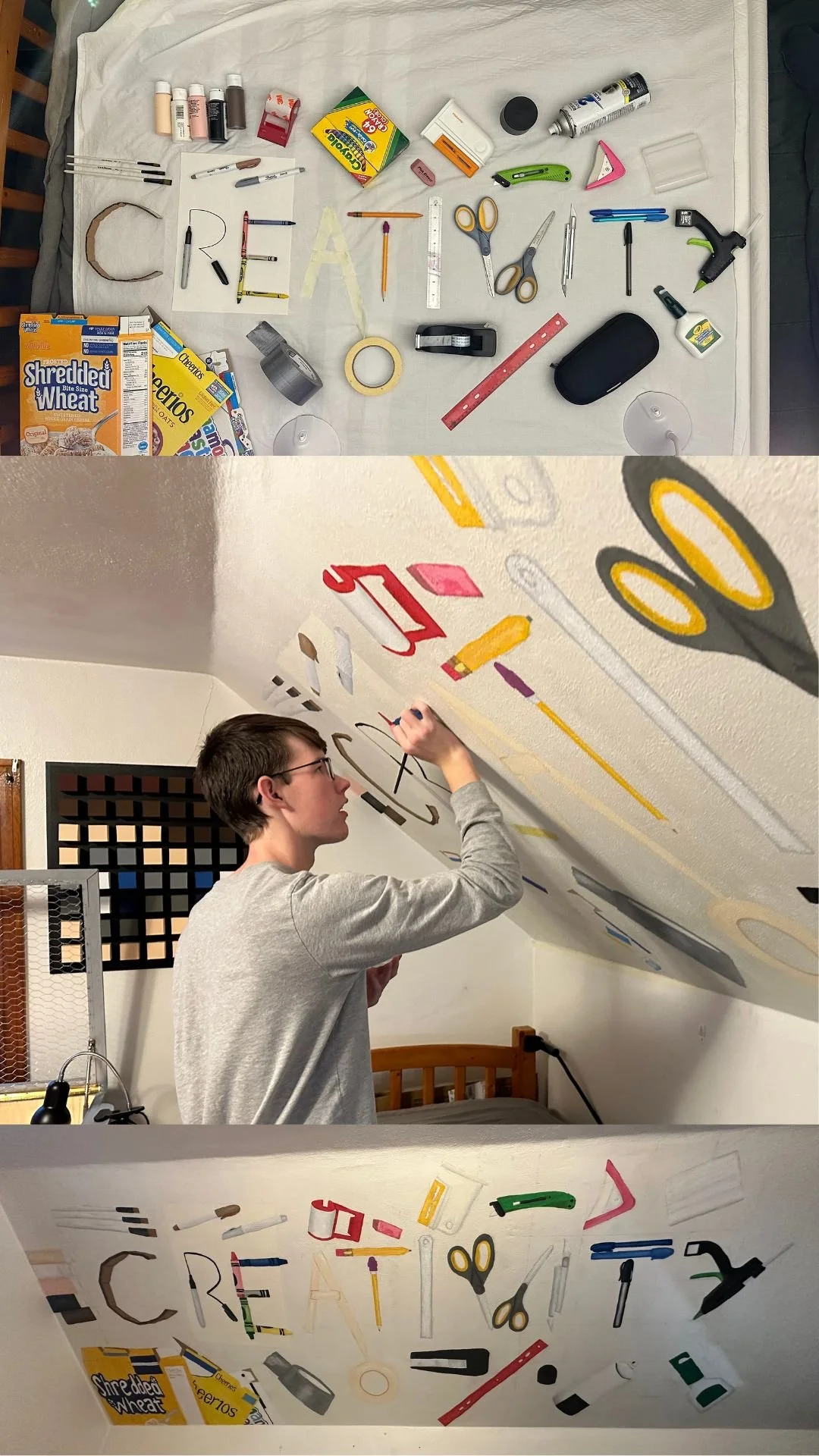
I finished it… eventually. It took several pushes, but I’m happy now with the result. Every time I look at it, I can hardly remember the wall without it.
(Same with the 100 heads… which took a little less time since I was really excited to get them out into the world, and the “pushes” to get them done were more frequent.)
I finished those large projects, and now am able to take on some bigger projects with the assurance from their success. What I have also learned though is: that motivation for large works can’t be momentary.
I mean, these two projects weren’t started on a whim. There were months leading up to each of them where I wanted to do something like it, but hadn’t quite come up with what. The planning phases were robust, and spanned far more than a few days. (For the heads, I had even done a smaller distribution of a dozen or so in my school before thinking of the hundred travelling ones. And for the mural, I sat on the idea for weeks before deciding what I would paint.) And of course, I continued to complete smaller projects while these were looming in the background. Sticking to one piece is simply unrealistic. Artists can say they have “worked on this piece for six years” because it’s on-and-off work, not constant, every day for six years. They work on other things and live their life inbetween sessions.
All this to say I know now that: I can’t make stuff without consistent justification behind it. Here’s a different example:
I recently (a month or so ago) started another decently large project: Turning a plastic crate into a Thneed factory. I’ve been documenting it through my Instagram, and a few people really enjoy seeing progress. But that enjoyment isn’t enough for me to feel motivated towards the project. So now, every time I see it I (similarly to the 100 heads and Mural,) somehow shame myself for not working on it, and send myself down a spiral into which I don’t make any art. (NOT what we want.)

I’m at a point today where what I really want to do is draw what I’ve built so far, and then finalize a cool illustration. I don’t want to finish the large sculpture. This is my one life, so why waste time doing something I don’t want to, that I don’t have to?
I have all the justification I need to scrap hours of work to pursue something I want to do more.
Looking for a particular post?
-
2023
48
- Jan 12, 2023 Hamsters Jan 12, 2023
- Jan 12, 2023 Art Museum Sketching Jan 12, 2023
- Jan 12, 2023 Frogs for a Good Cause Jan 12, 2023
- Jan 12, 2023 Art in Trigonometry Jan 12, 2023
- Jan 12, 2023 Free Caricaturist Jan 12, 2023
- Jan 12, 2023 Disney Mashup w/ @k.steely_the_artist Jan 12, 2023
- Jan 12, 2023 Art Studio in a Van Jan 12, 2023
- Jan 12, 2023 There’s a House in my Boot! Jan 12, 2023
- Jan 12, 2023 Minecraft Dungeons was a Spark Jan 12, 2023
- Jan 12, 2023 [Insert Straw Pun Here] Jan 12, 2023
- Jan 12, 2023 Oh Christmas Tree Oh Christmas Tree Jan 12, 2023
- Jan 12, 2023 Why Sketchbooks are the Greatest Thing Ever Jan 12, 2023
- Jan 12, 2023 How to make the Perfect Christmas gift Jan 12, 2023
- Jan 12, 2023 I drew a house Jan 12, 2023
- Jan 12, 2023 I designed my own Rodeo Stampede Animals Jan 12, 2023
- Jan 12, 2023 MiPads Jan 12, 2023
- Jan 12, 2023 2d or 3d Art? Which do I prefer? Jan 12, 2023
- Jan 15, 2023 Utilizing Other Peoples’ Energy Jan 15, 2023
- Jan 16, 2023 Goodwill Builds (ft. Waffle Blanket) Jan 16, 2023
- Jan 19, 2023 I spy with my artistic eye… Jan 19, 2023
- Feb 4, 2023 Art Teacher Simulator Feb 4, 2023
- Feb 15, 2023 Proportional Importance Feb 15, 2023
- Feb 23, 2023 How to sketch a sculpture Feb 23, 2023
- Feb 27, 2023 Overdoing it Feb 27, 2023
- Feb 28, 2023 Old Vehicles into Park Benches Feb 28, 2023
- Mar 27, 2023 The Word of the Day is Patience Mar 27, 2023
- Apr 5, 2023 How to have a Productive Break Apr 5, 2023
- Apr 5, 2023 Define Useless… Apr 5, 2023
- Apr 25, 2023 My Kind of American Football Apr 25, 2023
- Apr 26, 2023 Behind the Business (Cards) Apr 26, 2023
- May 7, 2023 Preserved Through Planning May 7, 2023
- May 26, 2023 The significance of June 25th May 26, 2023
- May 28, 2023 The Heads or Tails Machine May 28, 2023
- May 30, 2023 The Legend that is Harry Smiles May 30, 2023
- Jun 7, 2023 Thoughts about My First Ever Workshop Jun 7, 2023
- Jul 2, 2023 Now THAT’S how you run an Art Camp Jul 2, 2023
- Jul 10, 2023 Duck Architecture is SO COOL Jul 10, 2023
- Jul 22, 2023 Blank Space: The Game you 100% Make Up Jul 22, 2023
- Jul 29, 2023 The Tipping Point (by Malcolm Gladwell) Jul 29, 2023
- Aug 13, 2023 Creativity > Efficiency Aug 13, 2023
- Aug 30, 2023 I want a taco truck Aug 30, 2023
- Sep 15, 2023 “It’s Not Her.” Sep 15, 2023
- Sep 27, 2023 The Biggest Decision of my Life (so far) Sep 27, 2023
- Sep 30, 2023 A post about Purpose Sep 30, 2023
- Oct 11, 2023 The Idea Box Oct 11, 2023
- Oct 22, 2023 A Tentative Return to Social Media Oct 22, 2023
- Nov 15, 2023 Artistic “Style” Nov 15, 2023
- Dec 23, 2023 An Audacity Evaluation Dec 23, 2023
-
2024
17
- Jan 13, 2024 The Value of Walking Away Jan 13, 2024
- Feb 18, 2024 “The Thought Box” Event Idea Feb 18, 2024
- Feb 24, 2024 The Scholarship Essays Feb 24, 2024
- Mar 2, 2024 “Simple Pictures are Best” Mar 2, 2024
- Mar 9, 2024 Downloading a Virus to make a Cardboard Deck Box Mar 9, 2024
- Apr 14, 2024 The Deck Box Initiative Apr 14, 2024
- May 29, 2024 Trying Everything (why this website is poorly maintained and I'm okay with that) May 29, 2024
- Aug 26, 2024 (In)Finite Enthusiasm Aug 26, 2024
- Oct 4, 2024 I called it! (unsurprisingly) Oct 4, 2024
- Oct 25, 2024 Meaning in Materials and Autobiographical Art Oct 25, 2024
- Oct 31, 2024 On Adaptability and Switching Majors Oct 31, 2024
- Nov 16, 2024 What Francisco de Goya, Nick Cave, and Nathan Foley have in common. Nov 16, 2024
- Nov 16, 2024 Art and “the Media” Nov 16, 2024
- Dec 5, 2024 SPACESHIP (Visualizing Childlike Wonder and Creativity) Dec 5, 2024
- Dec 8, 2024 A Checklist Conclusion (Part 1) Dec 8, 2024
- Dec 25, 2024 A Checklist Conclusion (Part 2) Dec 25, 2024
- Dec 26, 2024 My mom said I should write about the ewok child. Dec 26, 2024
-
2025
15
- Jan 29, 2025 Blastoff in 3… 2… Jan 29, 2025
- Feb 2, 2025 “So you’re the Cardboard Guy?” Feb 2, 2025
- Feb 4, 2025 “Are you happy with that?” Feb 4, 2025
- Feb 13, 2025 Asking More Questions Than the Students… Feb 13, 2025
- Mar 11, 2025 Prioritizing Creativity Mar 11, 2025
- Mar 25, 2025 Brainstorming some Improvements Mar 25, 2025
- Apr 5, 2025 The Pilot Episode Apr 5, 2025
- Apr 25, 2025 Emphasizing Impermanence Apr 25, 2025
- May 22, 2025 Artistic Autonomy May 22, 2025
- Aug 4, 2025 Ideas? Meet your Makers. Aug 4, 2025
- Aug 5, 2025 En Masse Aug 5, 2025
- Aug 12, 2025 Observation, Creation, Communication Aug 12, 2025
- Sep 23, 2025 Communication is an Art Form Sep 23, 2025
- Nov 13, 2025 Islands in an Ocean of Words Nov 13, 2025
- Dec 9, 2025 Enjoy the Waffling Dec 9, 2025
-
2026
11
- Jan 6, 2026 “Cardboard” in 300 words Jan 6, 2026
- Jan 6, 2026 Choosing Cardboard Jan 6, 2026
- Jan 16, 2026 Buried Under the Weight of a Thousand Shoulds Jan 16, 2026
- Feb 22, 2026 You Can't Throw Away Experience Feb 22, 2026
- Mar 22, 2026 Embellish Everything Mar 22, 2026
- May 2, 2026 Start it Up! May 2, 2026
- May 3, 2026 Lesson Plans, Volume 1 May 3, 2026
- May 7, 2026 Explanation Clarification May 7, 2026
- May 25, 2026 First Bite Conversations May 25, 2026
- Jul 7, 2026 What silence says… Jul 7, 2026
- Jul 23, 2026 Like a Smiling Headless Chicken Jul 23, 2026