
blog
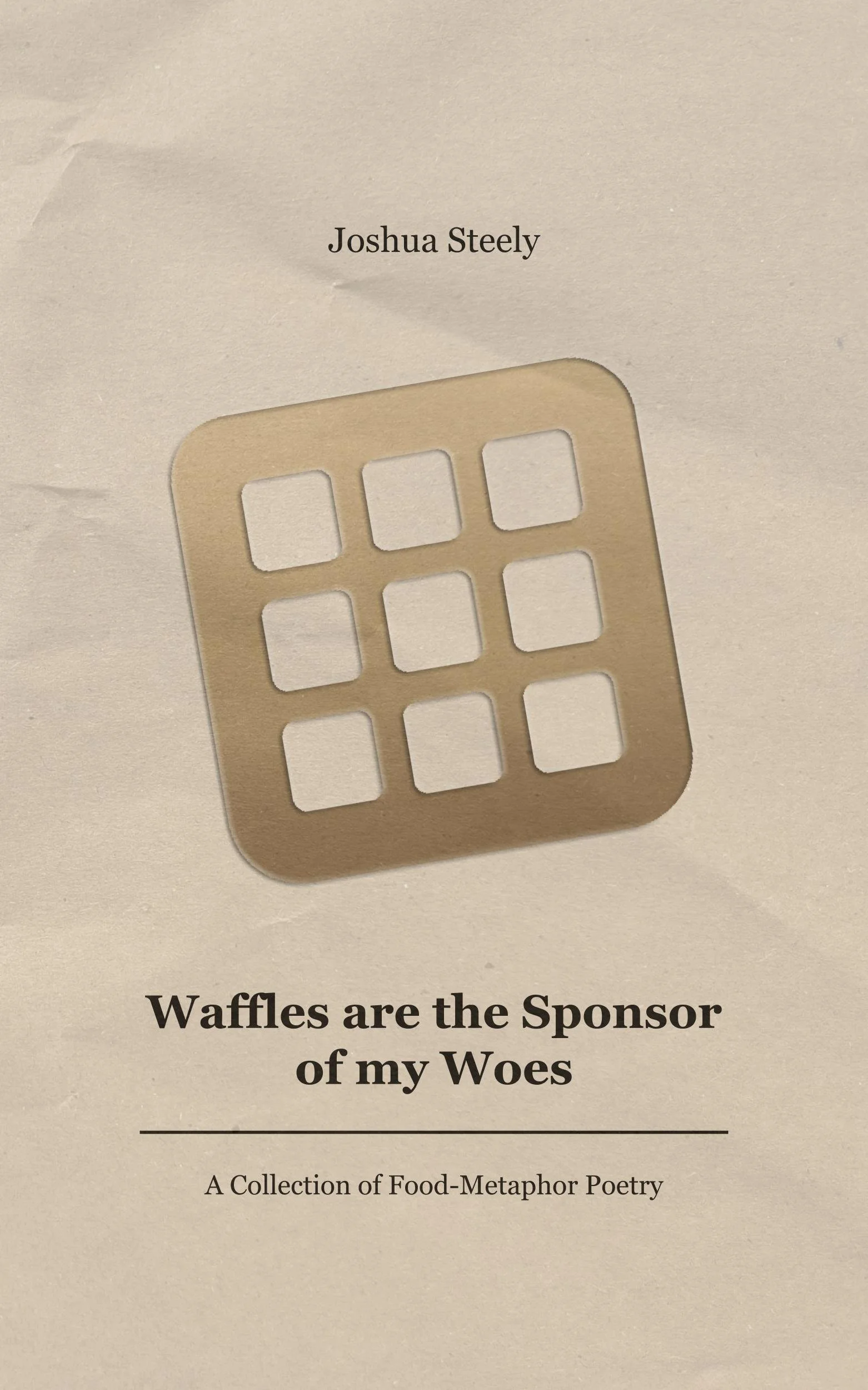
"Waffles are the Sponsor of my Woes"
OUT NOW ON AMAZON
"Waffles are the Sponsor of my Woes" OUT NOW ON AMAZON
"This cooked." –Michael Howe
Joshua Steely's heart is served up on a silver platter in his debut poetry collection, Waffles are the Sponsor of my Woes. Steely's food-metaphor-based poems explore themes of Hope, Rejection, Desperation, Rage & Regret, Resignation, and Sadness as if steps for the recipe of a hopeless romantic. With chocolatey tears and stained shirts, readers can experience the feeling of grasping at straws that so inspired many of the poems within.
While Waffles are the Sponsor of my Woes is written from the perspective and experiences of a 16-19 year old boy, the emotions evoked by emptied gourds and sweet cinnamon rolls are for everyone. Is a diet from love the answer? Gorging on it until there's nothing left? Steely offers spoonful after spoonful, but each taste leaves only a desire for more...
"Waffles are the Sponsor of my Woes"
OUT NOW ON AMAZON
"Waffles are the Sponsor of my Woes" OUT NOW ON AMAZON
Why a blog?
I’ve always loved sharing my ideas with whoever will listen (or is unlucky enough to be within earshot). Most of them go nowhere after that, but a couple end up worthwhile! This site is a way for me to share my ideas with people beyond earshot, and doubles as writing practice!
I hope one day somebody may be inspired by what I’ve shared and go on to do things greater than I could have ever dreamed of. I couldn’t exactly take credit, but if I’m even a slight influence towards something greater, that’s a win.

Art and “the Media”
There are a few parts to this thought: 1) How I wish art was portrayed, 2) How art is often portrayed, and 3) How I idealize a partnership of media and art (how I think maybe I could make both work) Here it goes:
There are a few parts to this thought: 1) How I wish art was portrayed, 2) How art is often portrayed, and 3) How I idealize a partnership of media and art (how I think maybe I could make both work) Here it goes:
The Portrayal of Art
The best part of art is… heh. just kidding—there are so many good parts. It’s therapeutic, it’s an outlet for thought, it’s an expression of self, it’s a way to share without language barriers, it’s a cultural connection point, it’s an eliciting of emotions unlike any other. All of that is great. One part however, that it isn’t viewed as great often enough, is art being “accessible”. Once you start calling yourself an artist, as I have, it’s easy enough to preach on the lack of barrier into the world of art, but those who insist on saying they are “bad at drawing” are the ones who need to understand “drawing” is nowhere near the conclusion of “art”. Are sculptists fantastic at drawing? not necessarily.. I wouldn’t even say that I’m very good at drawing, in relation to the countless more practiced artists out there. Good is relative, and always an unfair term to use when referring to art. Art is personal, not subjectifiable. Art is like a childhood blanket. It looks like rags to everyone else, but to that one person… it’s everything. The power of art is that that attachment can be shared (but sure, not with everyone). Not everyone’s going to look at a white canvas and be prompted to contemplate the emptiness in their soul without love. Most people will just think it’s stupid, and the artist didn’t try. I used to be that person. Art is accessible because “art” is a way of looking at the world, and anybody can choose to alter their perception just that little bit. I just wish art was portrayed more often as this deeper connection of people with the world around them, and not as some out-of-reach “talent” given to a select few individuals.
The Idealized Relationship of Artist, Art, and Media
I’ve tried, over the years, a few methods of involving myself in video and content creation, but none of them stuck. I tried with Minecraft (of course) and with art, but I was too naive to see how the industries actually functioned. With more open eyes I can now see past the curtain a little clearer, and am considering stepping into it once again with a renewed idea.
Basically, I want to consistently make “fan art”.
But not only as a “fan”, instead as someone who is willing to look further into the media itself and explain a bit more about the subject and the medium I choose to re-envision a part of it in.
I really enjoy the matter I discussed in-depth in the post “Meaning in Materials…” in terms of using something to make the art that more closely relates to the art. For example, if I were to do a drawing of a Red Robins, I could use a standard ball point pen I had lying around… or I could use the set of four crayons I got as kid when I went to Red Robins for my birthday. Which has more meaning and makes the art worth more? (Again, keep in mind the value of art is hardly ever in the physical item—unless it’s jewelry in which case the precious gems have alternate value points—it is most typically in the meaning and layers of thought behind it.) The crayons would give a vividly different appearance than a ballpoint pen, but would also mean far more because of their emotional connection to the establishment. We are, first and foremost, emotional creatures. Art simply has an innate ability to tap into that emotion.
If I am to reenter the field of entertainment with a renewed purpose, I think that purpose should be similar to my core intention for this blog: Connecting my interests to “art” (a unique way of viewing the world).
Just thinking about the breadth of possibilities makes me overflow with excitement. (I was talking a mile a minute to my Mom about the potential of such a focus).
By not saying “Oh I’ll just stick to Minecraft” or “Oh I’ll just stick to making stuff out of cardboard” (even though there are COUNTLESS ways to go with either of those mediums) I can instead connect them, along with a multitude of my other interests, to new things as I find them. I do also quite enjoy the game “Satisfactory” and have played a little “Stardew Valley” and I admit, a bit of “Fortnite”. How then, can I connect those interests to art and explore the aspects of the games I am most interested in through mediums off of the screen that I can then relay through other peoples’ screens? In other words: How do I show what I appreciate about things I appreciate to others? That is the question I think expanding into content media could answer.
To be realistic, and not just naively optimistic, I can and will create a feasability plan (because thanks to Innovate WithIN I know how they work). I can look into the practical creation of the media, and which outlets to use. I can look into Patreon and sources of income and ask things like: how could the different streams be used as marketing? And of course most importantly, how can I provide something useful to people that will inspire them to create their own magic? How can I encourage others to follow their innermost desire to express themselves through the multitude of mediums available to them? If someone doesn’t like to draw, how can I show them the zillion other choices they have?
There is the business aspect to view practically, if I am to pursue this as an outlet for art and an opportunity for financial feasibility; but there is also the aspect of how I function as a person. What I have observed over the years (and those close to me have also observed) is overflowing passion… that quickly dissappears entirely. They can be called “phases” or “obsessions” or really anything that refers to a finite period of interest. During those times, I’m all in—super invested in that thing, whatever it may be—but then after a while I move on to something else. Such is why I have not been able to do something like content creation consistently… because my interests have changed too quickly and I have been too young to recognize that, or be aware of the brain patterns. Now that I am more aware, I can plan for those kinds of shifts in obsession, and adjust the plan to fit the changes.
So maybe this is a possibility: create, as I love to create, and connect whatever I am currently obsessed with to art, as I have been able to consistently revisit with this blog! I know I will always want to explore more with creativity, and will always be able to return to it, whatever the interest (art is too broad to ever be irrelevant) so maybe I could make this work. Maybe, just maybe…
…this is the right angle for my content creation.

What Francisco de Goya, Nick Cave, and Nathan Foley have in common.
Since I’m in the academic mindset as I write this, a fun thing to note is the drastic difference in ease of synthesizing topics you already know versus those you don’t. While for classes, I need to research nearly entirely new material for the topics the papers need to address, for this blog I can instead draw from all of the art I am and have already been experiencing. Because I already know so much (relatively, about art), and am actively learning and reflecting so much about art, it’s a whole lot easier to write about. Hence where the strange array of artists comes from…
I’ve been writing a lot of papers recently for my various classes, and once I finish this I should probably work on another one… but as a conversation with a friend recently reminded me: this website is a healthy outlet! and health is crucial when in the frenzy of finishing a semester strong.
Since I’m in the academic mindset as I write this, a fun thing to note is the drastic difference in ease of synthesizing topics you already know versus those you don’t. While for classes, I need to research nearly entirely new material for the topics the papers need to address, for this blog I can instead draw from all of the art I am and have already been experiencing. Because I already know so much (relatively, about art), and am actively learning and reflecting so much about art, it’s a whole lot easier to write about. Hence where the strange array of artists comes from. I can pull not only from new experiences that prompt the reflection, but also from anything previously absorbed. It’s fun!
Fransisco de Goya
Probably the most famous of the three (and definitely the most dead) the Spanish painter Goya lived from 1746 to 1828. This isn’t a history blog, so I’ll get write to it: This is how Goya painted at first…

Señora Sabasa Garcia, c. 1806/1811, oil on canvas, Andrew W. Mellon Collection
…this is how he painted when war broke out in Spain…

The Third of May 1808
…and this is how he painted after Spain fully was devoured by war and his health began to fail:

Saturn Devouring His Son
Let’s just say… his work changed. quite a bit.
Why did it change? Well, as a painter, he likely drew upon what he saw. He began as a commissioned artist, painting beautiful portraits, and gained popularity, recognition, and wealth through that avenue. As his country (that he surely loved) began to fall into ruin, however, his perception of the world changed. He started to relay that change through his paintings, now reflecting the disastrous state of his world. His health declining surely didn’t help, as his thoughts became darker and he painted his famous 14 “Black Paintings” never meant for publication. He seemed to draw his inspiration from two things: the State of his Country, and the State of Himself.
(As for why I know about Goya, I researched him for a Spanish project in high school. I’m sure he was quite an influential painter, I just never would’ve looked into his history if not for the assignment. It’s a bit dark for my taste. But hey, he helps prove the point I’m getting to…)
Nick Cave
My Ideation and Interpretation class (ART-101) was recently introduced to the “Sound Suits” works of modern artist (born in 1959), Nick Cave. He creates performance-based works that don’t allow for discrimination of race due to their full body-suit coverage and outlandish appearances:

Nick Cave’s “Soundsuits”
They’re wild, and there’s a lot to them, but I’m most interested in the button dealer. Pause. A button dealer? Yeah. When our professor introduced Cave to us, he showed us an interview clip that included the story of Cave’s unique need for buttons (for the suits of course). As he was searching, Cave just happened to run into this guy on the street selling a ludicrous amount of buttons. Perfect! that’s just what he needed! This guy he found actually had also recently purchased a button factory. What are the odds?? So now Cave had/has a source for thousands of buttons for his costumes. He made a connection, and that connection enabled him to create. That is, what helps him is his State of Connections.
Nathaniel Foley
That of course leaves us with the third artist, a friend and professor (at UIndy, not IWU, sadly), Nathaniel Foley, who prompted this post with his artist’s talk at the 22nd exhibition of his works titled “Flight of Obscurity” at Huntington University’s Robert E. Wilson Gallery which I had the pleasure of attending on November 15th, 2024.


One thing Foley talked about was how his Dad is an airplane mechanic and can collect discarded parts for his sculptures. (He also talked about his use of a gallery space and desire to avoid a sterile white box appearance, opting for the purposefully confrontational approach. And he talked about his use of form and angles to show motion. And how he has to fight gravity with suspension. And how the rivets and wire used are aircraft-grade, authentic to the real deal. And his limited implementation of color.) The key here though, for the sake of this synthesis, is the connection he has with aircraft. He made airplane models up until college (when he got busier) and was always around tools, working with his hands because his Grandpa and Dad were mechanics all the while. His connections and upbringing inspired his art. (See the dots connecting? Goya’s environment inspired his art, Cave’s connections inspire his art, and both Foley’s environment (growing up), and connections (family) inspire his art.) Even another element, the industry of aircraft itself, inspires Foley’s work. For example, the obscurity of the sillhouettes in his interactive booklets at gallery shows match that of military memorization of aircraft sillhouettes for identification purposes. Of course, the materials are directly pulled from the industry, and the motion represents that of planes in flight. So much is inspired by the material already out there, on top of his personal experiences.
When I asked Foley “what if your Dad was a auto mechanic instead of an aircraft mechanic? would you then make sculptures based on cars?” He nodded along and seemed to agree with the hypothetical. He believes what would have still been present, even if hsi work was based on cars instead of planes (or who knows what else), is the desire to work with his hands and create the forms along a similar style. But we’ll never know exactly how it could’ve happened, because we only have the product of what did happen.
If you haven’t yet pieced it together from my eclectic writing, the thing the three artists (and all artists, really) have in common is inspiration. Goya, Cave, and Foley all were influenced by their personal experiences, but they also all chose something specific to focus more of their attention on for continued inspiration. Goya - current events and his declining health; Cave - motion and the language of dance; and finally Foley - the riveting art of aircraft.
Therefore I will leave you with this: if your life feels asgiving you enough inspiration on its own…
just look up.

On Adaptability and Switching Majors
I’ve had to adapt, and need to adapt even more to make the best out of my ever-changing situation. Now that I know more about how life in college operates for me, I should take some time to revisit my goals and plans for reaching those goals—including the ever-present “major” decision.
As I seem to be mentioning frequently, and realizing even more frequently: change comes at you fast.
While I haven’t experienced it directly for a while, loss is one such sudden change you have to learn to deal with out of the blue (and my favorite color is red… so I’m not a fan of the blue to begin with). On most occassions you don’t get to sit there and think clearly “what would I do if x, y, or z happened to my loved one?” and even if you did I doubt your emotions would allow you to make a clear conclusion. Oh, and whatever conclusion you may have come to would never play out according to plan. I made such great plans on how I was going to be productive every day at college (cold showers, regular workouts, eating healthy), and I do get really good sleep compared to most other students… (we don’t talk about the other goals)
I’ve had to adapt, and need to adapt even more to make the best out of my ever-changing situation. Now that I know more about how life in college operates for me, I should take some time to revisit my goals and plans for reaching those goals—including the ever-present “major” decision.
A major in Art
I worry. I really do. I’m afraid that I would burn myself out filling the day with creativity. But then I go about the rest of the day dreaming of filling it with creativity. (Part of the hills and valleys—iykyk). A day will come along where I just want to create, and I’ll do it for hours and hours, and the next day I’ll waste away in disgust of myself and my lack of “productivity” and convince myself I can’t be sustainable about it (even though I’ve proven otherwise at points).
[Editing thought: I’m not sure how I want to structure this post: Do I start with my thoughts on the major decision? or do I start with the importance of adaptability in life and art? or do I jump around back and forth like the madman I am?… hmm… well we know the answer now]
Advantageous Adaptability
I could quote Randy Jackson, who is credited with “You never know what the future brings,” but I’d rather quote the sound of music, and Julie Andrews singing “What will my day be like… I wonder.” (I Have Confidence). The same amount of uncertainty carries, and the same lack of knowledge is evident whenever we think to the future. We just don’t know what’ll happen!
Therefore, the very best way to prepare for inevitable unexpectedness is to improve the traits of adaptability.
1. Flexibility 2. Acceptance 3. Compromise 4. Openness 5. Willingness to Change 6. Most of these are synonyms I just felt like numbering… the idea is there though (could be/surely has been refined by an academic).
Really, the easiest way I can think of to define adaptability is to juxtapose it with rigidity and stubborness. If something doesn’t go your way, the worst way to react is unmovingly. What do you think you will gain without any change in your methods? It didn’t work the first time… why would it work the second? When stubborness prevails, so does argument and consequent pain, power struggles, and really nothing constructive. If anything is constructive, it is a consencus of sorts, or a coming-to-agreement that has nothing to thank the stubborness for. Stubborn people will not always get what they want, so it’s best for both sides to practice flexibility.
Stories really are best, and Malcolm Gladwell tells stories quite well, especially in Talking to Strangers. He opens the book with a devastating story of (spoiler alert) a police encounter with a lady who decides to smoke during the “procedural” pull-over. The cop demands she put out the cigarette, not out of necessity, but out of stubborness and a desire to exert dominance over the inferior driver (or at least, that is how I interpret the actions). To conclude the story, the cop violently pulls the woman from her vehicle and arrests her. She then is said to have hanged herself in a cell within days. I know how little the story may seem to relate to art, and it’s quite extreme, but it’s an example of where compromise would’ve made a huge impact (saved a life). Adaptability was not evident in this interaction. At least not in any positive manner. The fault wasn’t even only on one party: the lady could have just put out the cigarette, or the cop could have just let it burn. Neither adapted to follow a predetermined set of politeness or positive values they trained and practiced for stressful scenarios like a law enforcement interaction.
While I don’t expect many people reading this blog—including myself—to regularly experience such an extreme case of unbending wills, there are much smaller conflicts to which adaptability can help stupendously. Such as art! (See how it all connects so I can say this blog has a central theme… see??)
I’m sure a great example is client work… but I can’t say I’ve ever worked closely with clients before. The commissions I have completed, the buyers tended to entrust me fully with the project after brief descriptions and minimal instruction. I trust if/as I extend into the (more) professional world, that will not be the case, and close client contact will be more expected and necessary, especially for larger works. I imagine compromises will need to be more frequently made to what may be my creative vision in order to more accurately align it with a client's.
On a project to project base, whether or not it is commission work, adapting on the fly can also prove to create a better finished piece. Say you accidentally spill coffee on a section of a portrait piece. You could either yell in frustration and shred your precious canvas, or you could incorporate the stain in a way that makes the piece even more personal. I know Bob Ross said something along the lines of “There’s no such thing as mistakes; only happy accidents” and I heard it first in elementary school when mistakes were abundant. While the saying may not fit into many areas of life, I’ve realized how excellent it is for art. Even with some of my smaller pieces, there are concessions made throughout the piece based on how the materials were behaving. Maybe an arm wouldn’t stay connected, so I end up positioning it in a way I hadn’t considered before, but looks even better. Adaptability is less of a tool to have in your toolbag, but rather a valuable skill to ever-improve and practice.
As promised, a return to the subject of Majors
To the few current college kids who may read this: How is this going for you?
To the few college graduates who may read this: How did you do it?
To the few kids reading this: …good luck!
To everyone else: Got any good duck jokes?
I love art. But do I want to learn about art? Of course! But do classes feel like creativity limiters? Sometimes, but they often spawn the best ideas in the first place! What lovely conflict. Let’s think cost: aaaaaaaaah. nope. let’s not. (a common theme in my life so far). The practicality of learning something you’re interested in is: you get better and know more. The downside is…
So anyways, about the stigma of artists not making money and the potential reality of my prospective reality of me potentially prospectively possibly (yeah I don’t know what this sentence is accomplishing). I want to be generous with money, but it’s a lot harder to do that without money. So I want a career that allows for that. I don’t know if it’s a hurdle I need to jump over, a fear I need to confront, or what, that is stopping me from seriously considering a career in art. I’ve always viewed it as an impossibility—something I would LOVE to do, but just… y’know… shouldn’t. I have “so much potential” and could “do anything I set my mind to” and my Valedictorian speech emphasized “living for memories, not money”. Reading this I feel stupid. but mainly disappointed. I don’t seem to be following my own advice. To even myself (if I look from outside of my head) I seem to not be pursuing a life I am passionate about and could succeed at if I set my mind to it. I just would need to set my mind to it as I haven’t yet.
The Super Unhelpful Feedback I Receive (which doesn’t help my ego)
Writing this down seems pushing the line of boasting, and I don’t under any circumstance desire to do such a thing, so I must preface it: this is just what I have heard. I am not saying that I am told “you could accomplish anything you set your mind to” as a boast, but as a dilemma easily interpreted as egotistical and haughty. That is not my intent. Now I will proceed:
While it is justified per the laws of child raising that my parents would say such things as, “You can do anything you set your mind to” and “You’re going to do great things, I know it,” it’s sometimes near strangers telling me these things. Can you imagine how unhelpful that is when trying to decide what career to pursue??! I wish a couple people would (in an unbiased manner) tell me exactly what I would find the most joy in and be best at and should put my time into. That’s where the adaptability and major decision are an issue: I don’t know what major I should adapt to.
Art: I could learn more about what I know I love, but worry I would snuff out the passion with too much structure.
Communications: I could read the materials I am provided and show up to classes, completing well-intended assignments and hopefully learning helpful tips along the way, perhaps eventually sparking deeper passion towards interaction in non-creative contexts.
Business: I could use my communication skills and adaptability to succeed financially, and try and maintain passions on the side to make up for the potentially mundane work of a non-centrally-creative job.
Those are some extremely biased takes, as I’m currently in an art-biased mindset after an inspiring discussion with an art faculty member. He let me know his unique perspective: Not becoming a photographer as his major would suggest after he realized he was more passionate about contributing in the ways he does today (similar to another faculty who went from a furniture design degree straight into the set design industry). This person’s input therefore was the opposite pushing me to do something I’m not passionate about. He made sure to clarify that rather than just wanting me to pursue art because he loves art, his only worry was that after seeing the potential I have through how I view art and approach life (and the skills I’ve developed thus far in writing and visual communication, etc.) that if I was passionate about it, I wouldn’t “stop trying to run before I’ve even walked” (paraphrase). I shouldn’t give up before I’ve even started. “You’re the least qualified you’ll ever be right now,” he said. Because every time I try again, I’ll improve.
Besides the general encouragement to pursue what I find most fulfilling over well, anything else, that was my main takeaway. Because yes, I’ve consistently looked at the art field as a thousand foot mountain I’ve only climbed a hundred feet of. The barrier for entry seems so far away I look at the ground and it’s almost comforting. The peak is daunting. I hope to take that advice and carry it into something I enjoy, and that just might be art. I said in my Valedictorian speech “I’m planning on pursuing art, and I’m sure you all know it’s a veeerrryyy lucrative career… (It’s not) but I’m not worried about it! Because I know for a fact that I would rather live in a van and make art than live in a mansion without joy.” (or something along those lines).
Boy do I want that line to stay true.

Meaning in Materials and Autobiographical Art
With college comes a slew of self-reflection, and I have the privilege of being in a class called “Ideation and Interpretation” which prompts this reflection through art. My most recent piece represents a huge part of my life, and while I won’t be sharing the details online for obvious reasons, I will share the generalized takeaways…
With college comes a slew of self-reflection, and I have the privilege of being in a class called “Ideation and Interpretation” which prompts this reflection through art. My most recent piece represents a huge part of my life, and while I won’t be sharing the details online for obvious reasons, I will share the generalized takeaways that those who know me could more accurately interpret. I hope they take it well, and not with regret, as (like a sea turtle) I am so much stronger because of my experiences.
The Assignment:
Our task was to create a diptych (set of two pieces that inform each other) related to Ecclesiastes 1:9 (What has been is what will be, and what has been done is what will be done, and there is nothing new under the sun.) a kind of desperate cry about the omnipresence of the past, versus Isaiah 43:19 (Behold, I am doing a new thing; now it springs forth, do you not perceive it? I will make a way in the wilderness and rivers in the desert.) praising an ever-new present. The pieces were to be based off of an artifact (beit from a museum or our own lives) as it relates to time. The prompt was generally percieved as a “What did this used to look like, and what does it look like now?” relation to time, going as deep as the artist wanted it to. Some toys, items from their youth, or things significant to their parents were common. Lots of colorful pieces being compared to a worn, old, used look of the second—a fair representation of time.
Once I understood the prompt, an item popped right into my mind: a spyglass.
Choosing your Materials
Something rightfully emphasized in the introduction to this project was the importance of the materials for informing the piece. If you choose wood, perhaps the idea you are trying to portray is reliability, frequency, or even flammability. How smooth you render the wood can communicate the age of the item, or how much care was put into its production. Is the wood painted? stained? partially burnt? chipped? sanded and left natural? sharpied? marked, beat-up, missing? Every little detail can communicate something in the final piece—and that’s just talking about wood! What if you chose clay? plasticine? wax? glass? sand? canvas? paper? metal? an old blanket? Every material can communicate something wildly different from the others—and still be interpreted differently by each observer because of their past experiences. People may someday interpret my works (as I expect they will be primarily cardboard) and think… “now why is it made out of cardboard?” unknowing that I simply just love cardboard. Any elaborate explanation they came up with might mean something to them, and be a valuable learning experience… but I probably didn’t intend it. I have used cardboard from meaningful boxes in the past, for projects like the Surebonder Commission:

The Surebonder Commission/Trade
I used not only random boxes I already had, but a box that Surebonder used to send me their glue guns. This can be seen by the visible text to the right of center.
But, most of my projects are made from cereal boxes I’ve collected from my family, friends, and my community, which I almost said means little to the project, but that would be incorrect. Even just using the cereal boxes I’ve collected translates to: something from a community of people I care about (the box) is used in this project, no matter who is recieving it. Materials mean something, whether or not they are intended to mean anything at all.
For this assignment, I chose wood for one figurine, and plasticine for the other. Completely intentionally. The intentions may be made more clearly shortly, in the explanation of the project’s completeness. But first,
Some Benefits of Autobiographical Art:
I’m no therapist (yup, that’s right. DEFINITELY not a therapist). However, even I can tell you how surpressing the past doesn’t help with either the present or the future. You (yes you) are always going to be a culmination of your past, and will always be looking to repair broken relationships or fix things you broke while trying to repair broken relationships, or at the hindsight of realizing you didn’t actually fix it and you made it worse and now you have to do your very best to fix THAT all the while learning how to LIVE LIFE *gasp*. (Anyways,) Wherever you go, there you are, and your past is what makes you, you. Now back to art! Art is a fantastic resource to work through the past on your own, but also with other people. By explaining your work and giving them a way to visualize it, you open a path for them to relate to you and help heal the hurt or celebrate the joy that is communicated through your work.
What I’m learning more and more being around the art department is how little the (what I’ll call) “percieved skill” in a work matters. I say this to denounce my past interpretations of all modern art being “stupid” because it doesn’t look like a photorealistic elephant made from crayons. Instead, it is an artist trying to communicate something; often an abstract idea that can’t be put into a recognizable image. It instead needs to be relayed through a combination of feelings and expressions communicated through materials, shapes, colors, and way more thought than you could think would go into it. And yet still more thought can always be taken from the final work than went into it. Not to get too off track, but we had a group critique of our first project, and our professor had us first describe what we saw and try and interpret the work before the artist themself spoke. It was eye-opening, because it made hugely obvious the inability of any artist to communicate one clear message through a work. I know what I was trying to accomplish with this piece…

An assignment for Amazon. Mine did not win, but I mentally won because I learned more about perspective and informing the viewer in ways more visually intuitive than the little paragraph of words you attach.
…but everyone interpreted it differently. Did they all see the footprint I spent an hour carving out? Not necessarily. Was everyone’s attention drawn to the same thing? Nope. Did they overanalyze my use of red (when I just like the color)? Of course.
WOW am I off-topic. This was not an auto-bigoraphical piece, but it was interpreted by different people differently despite me having one (and really only one) idea of the message I was hoping for it to communicate. So while your art may communicate something to you, it may communicate something entirely different to someone else. When it is from your own past, however, the most valuable part of the process is putting on paper (or in sculpture or other medium) how you feel so that you can analyze it. It is the most self-centered art, but that is often the most beneficial for the artist themself. They can finally release something into the piece that they’ve had to carry with them for so long. While the past will stay with them, now they can view it in front of them and make more sense of it. Improved clarity on the topic is attained.
“Reality is a One-Way Mirror” — My Project (finally)
As I’ve mentioned, these pieces (plural because it was a diptych: two sculptures contextualized by the window) are meaningful beyond explanation to me. But I’ll do my best to explain some of the meaning that may resonate with somebody somewhere.


My item was a spyglass I recieved right before entering middle school from an incredibly influential person in my life. When I was given it, they told me they would be there to guide me through the trials of middle and high school and pick me up should I stumble. Well, six months later they were out of my life and unreachable. They simply weren’t there. Not dead, just not present. The spyglass was put in a box for a move and didn’t receive much attention for those six years I had hoped for mentorship and didn’t receive it.
My project reflects this in a way that relates to any past experience with a window of one-way glass showing how we view reality. We can look back all we want on the past, and what we have experienced, or others have experienced, but no matter how hard we try and look into the future… a mirror stops us. You can’t see the future.
On the side of the past, happily looking towards the future is perhaps the most innocent boy I’ve ever been, expectantly imagining a future in which joy is all I see.
On the side of the present, looking back, weeping, sobbing, reaching desperately towards the glass, longing to warn or change or prepare… is me now. It’s me after the experiences (beyond just the spyglass) I could’ve never expected or planned for.
Perhaps my future self will look back at me now in pity, experiencing greater joy than I could ever think possible. Perhaps he will think of me as lucky after he has undergone worse. I can try to prepare myself, but
I will never know my future; only my past.
…That’s a bit of a dark ending. How about a joke? Who just spent their precious time reading this and will never get that time back? Hah: You. But I spent even longer writing it.
I called it! (unsurprisingly)
I’ve written all about how “I want to pursue art for fun, not as a career.” and yet proceeded to attend Indiana Wesleyan for their art program. An incredible program it is, that I will continue to be involved in… but no longer as a major.
I’ve written all about how “I want to pursue art for fun, not as a career.” and yet proceeded to attend Indiana Wesleyan for their art program. An incredible program it is, that I will continue to be involved in… but no longer as a major. Shortly into the semester I changed my (triple) major to not include Studio Arts, and dropped one of my two art classes. The time requirement was stretching me so thin (already) that I couldn’t put much energy into either of the art classes while staying on top of my other 5. Besides, cardboard is everywhere, just like learning opportunities when it comes to art. I’d argue nobody needs formal education to succeed in art. But it has its benefits!
IWU’s art program has faculty there to help and guide you every step of the way. Beit idea formulation, a roadblock in the middle, final touches, and safety along the way, you have someone there to help you. Approaching art without the help can be far more daunting, and take more willpower and more determination to succeed. Yes, the classes take willpower, but to make it on your own would be a bit different. You’d need to source your help elsewhere- through friends, coworkers, and family members. You would need to seek people who can critique your work and offer genuine feedback instead of only praise. My choir director said something in a rehearsal the other day that stuck out to me. It was, “I’m a coach, not a cheerleader.” and I hadn’t thought to distinguish the two before. Typically coaches (in highschool) have to juggle both the supporting and the instructing roles. My director, on the other hand, lets the cheering be done by a select group of students, and directs his energy fully towards instructing us to be the best we can be. IWU’s art faculty can be both cheerleaders and coaches depending on what you need at that moment. To go without faculty in the arena of art is to source those roles to volunteers within your day-to-day life.
I came home for fall break, and spent the entire first day making a boat.

and a lovely boat it is.
What’s crazy to me is how I spent 8 to 10 hours on this boat (in a single day), but find it hard to focus on reading for more than 10 minutes. Surely it’s something about cardboard and hot glue that just channels my energy into a project… but I’m not sure.
What’s also worth mentioning, is that this project wasn’t an assignment. It wasn’t for a class that would give me an arbitrary grade that I could base my self worth off of. No, this project was for a commission I acquired, based off of reference images I sourced, and skills that I decided to use or improve, and is representative of what I can do on my own (with general feedback from my family, and the fantastic idea of making a sleeve for the deck box to attach the mast to- oh wait you didn’t know that this is just a costume for a deck box for MTG did you. Yeah there’s a deck box that comes out of the deck of the ship). I didn’t have any help from a professor, is what I’m trying to say.
You don’t need a formal education to pursue art, and you don’t have to be a full-time artist just because you love making art.
Highlight that sentence, because it’s what’s been playing through my mind on repeat as I switch the Studio Arts major to a Business Admin minor to go with my communications and honors degrees. I can still pursue art! I just won’t have to rely on it for income, and that’ll make it all the more enjoyable for me. Cardboard is free, I’ve got connections in the hot glue world, and marketing just takes asking around and talking to people! There is absolutely no reason for me to stop making art when I can make the time for it. But no, I will not be graduating with an art degree anymore. Though,
I hate to say I told me so.
(In)Finite Enthusiasm
I want to continue to be as thrilled as now about every aspect of college I am and will soon be experiencing. The food, friends, and faculty that make Indiana Wesleyan University what it is.
I want to continue to be as thrilled as now about every aspect of college I am and will soon be experiencing. The food, friends, and faculty that make Indiana Wesleyan University what it is.
But if I’m anything, I’m a realist. So I know I won’t be riding this high for long. The lack of personal space and quiet will get to me. I will feel overworked and/or unable to keep up. Something might challenge me (I might lose at bananagrams!) I might put too much on my plate in the cafeteria or in the metaphor of time distribution. The possibilites are quite endless for things to go wrong, but also to go right.
I heard this past week that the best way to approach classes is with an “insatiable desire to learn and grow”. There is always something to learn, you just have to be open to learning it. That can be a struggle. Maybe the prof is a bit monotonous and his voice soothes you to sleep… during a lecture. People who’ve seen me in classes know I tend to lounge, occasionally put my head down/close my eyes… and then go on to be completely engaged and attentive all the while. I know it will come across as disinterest to many, but the interest is there. Some lessons are too slow is all. Everyone learns differently, the way I do it is just quickly in most areas, and with a LOT of behind-the-scenes studying and researching classmates don’t typically see and I don’t need to share. For art classes, I’m not sure how I’ll be, because the demos are normally very attention-grabbing and interactive. We shall see.
I know the enthusiasm will be there for art, and even if I’m not a fan of a project result as a whole, I’ll still find a part of it to be excited about. Maybe an improved skill or one little bit I’m proud of. There’s no way I can be enthusiastic about everything. Some things are meant to be less interesting. It’s like contrast in art: things look a lot lighter with a dark background and vice versa. Similarly, events in life are a lot happier after you’ve experienced far worse. You’d only know to expect better if you’ve experienced it. I hope college will be my “better” and I can…
continue to be healthily and heartily enthusiastic.
“Happiness is excitement that has found a settling down place, but there is always a little corner that keeps flapping around.”
Trying Everything (why this website is poorly maintained and I'm okay with that)
I'm going into college with a refined mindset, thanks to my experiences in highschool. I call it the "try everything… specifically" mindset.
In it, I keep an overarching goal such as "I want to improve at verbal communication" when choosing activities, and then jump into as many relevant ones as I can find.
I'm going into college with a refined mindset, thanks to my experiences in highschool. I call it the "try everything… specifically" mindset.
In it, I keep an overarching goal such as "I want to improve at verbal communication" when choosing activities, and then jump into as many relevant ones as I can find. For that goal specifically, I joined choir, a speech class, and both of my senior year's theater productions. I started a sort of podcast in my van, and a format of organized familiar conversation I call "Van Talks" in which I can talk to my friends for hours about anything. I've read books and listened to audiobooks about communication. I've worked to improve my diction through games like Bananagrams and the Merriam-Webster/New York Time's games. Everything about my senior year wrapped around improving communication skills, tying into a nice bow with my graduating Valedictorian speech. (Hence my choosing to pursue Human Communications alongside Studio Arts at college)
For college I wonder what the goal will be. Perhaps it will be "I want to improve at idea generation" or "I want to improve at consistency". Of course, I will continue working to improve on verbal communication along the way, but either one of those goals would be able to be structure my "try everything… specifically" mindset. For the "idea generation" goal, I could join the FNL improv comedy group, the art Foundry, and participate in writing and art workshops as frequently as possible. While for the "consistency" goal I could focus entirely on setting habits and sticking to them. Like: journaling every day, working out, eating healthy, reading at a certain time, maintaining a stable emotional availability level (to name a few). Thinking about it, I definitely want to attempt the "consistency" goal.
I've tried being consistent in art before, but it's a struggle. When ideas appear, they appear suddenly and without warning. Attention shifts are instant. But the motivation can only carry me so long, and some days it is nonexistent. To "draw every day" I would need the time to… and sometimes I just haven't been careful enough to set that time aside. To "journal every day" I feel I need something worthwhile to write about. Working on consistency, I will make sure to work hard on building and protecting those habits.
Speaking of consistent, this website is anything but. The thing is, I don't need to maintain it. I don't need income yet. But maybe soon. What I have so far is an incredible base to work off of. I've written blog posts, I've organized pages on the website, I've sent newsletters, I've worked with the images… I have a base set of skills to improve and expand upon when it becomes necessary. Oh, and I've handed out a whole lotta business cards with the website on it, so anybody who revisits it should be met with something new.
The time I haven't spent forcing myself to work for money I would just turn around and spend, or to work on an art blog I'd just revise, I've spent learning more- experiencing more- that I can then implement right back into my future job and writing. I’m not trying to rush into a world of stress and payments, and rather am focusing on enjoying the creative spirit when it comes. I’m embracing spontaneity in lieu of consistency for now, but perhaps the college experience will be the habit-builder I need to set me up as a more consistent adult.
but maybe I’ll keep this website sporadic for the fun of it.
The Deck Box Initiative
To take initiative is to do something even if you don’t necessarily want to do it.
I want to clean off my shelf, but these deck boxes that I made (I think) months ago, are still there trying to prompt me to write an Instructable about the process and the result. I even wrote a draft… that now I can’t find… of course. I titled it “How to make anything is 6 steps” and it went through how I idea….
wait.
I did write that Blog Post. and titled it “Downloading a Virus to make a Cardboard Deck Box” a little over a month ago. What a wild month it’s been that I would forget.
I guess I’ll continue with the idea of initiative. And pair that with spontaneity.
To take initiative is to do something even if you don’t necessarily want to do it.
I want to clean off my shelf, but these deck boxes that I made (I think) months ago, are still there trying to prompt me to write an Instructable about the process and the result. I even wrote a draft… that now I can’t find… of course. I titled it “How to make anything is 6 steps” and it went through how I idea….
wait.
I did write that Blog Post. and titled it “Downloading a Virus to make a Cardboard Deck Box” a little over a month ago. What a wild month it’s been that I would forget.
I guess I’ll continue with the idea of initiative. And pair that with spontaneity.
I wrote this on August 23rd, 2023, but never posted it:
I’m getting a turtle. Well, actually, a tortoise more likely. And no, it’s not pure spontaneity, as I understand the longevity of tortoises, and have in fact been considering getting another pet for a while now (I even looked into birds as an option… too loud). But I can still relate it to the importance of spontaneity.
Life can become bland. Monotonous even. It can feel restricted by a set schedule, and you can feel overwhelmed by the underwhelming amount of newness. (I know this, even as a mere 16 year-old. I’m guessing it doesn’t get easier, rather more and more restricted by work and plans and kids like me.) What I do know for sure doesn’t change is that each of us gets ONE life. One life we can easily lose to the boredom of what we believe to “just be the way it is”. It doesn’t have to be.
To initiate change, there are of course steps leading up to things, but only one large tipping point
I want this post to be a bit more in-depth than the normal text-heavy, idea-based posts, so I’ve been thinking about how to go about making it worthwhile.
What makes anything worth reading? Well, probably the worth of the knowledge the reader gains from reading it. If you get a text from your mom saying dinner is ready (which happens a lot for me) that information is only as important as how hungry you are.
What gets a reader to read the whole thing to get the takeaway in the first place? A good hook, and a early promise of worth. The promise of worth is established by strong leading points that will lead to further elaboration withing the “meat” of the text. These are often stated in “thesis statements” in essay-style texts, but due to the informality of this blog, I doubt I will use such a formal tool.
Continuity is important in a lot of ways, but especially in writing. (see how aggravating it was to suddenly switch topics? That’s why I need to work on segwaying each point more smoothly into the next.) If a post kindof meanders along, bouncing from point to point (even if they’re strong points), and then it ends when the writer is tired of writing, it’s not high in continuity. Even within a sentence (like the poor example that is the previous sentence) continuity applies. Normally, I try to read back posts to check the continuity, but if I go about this in a rushed, or day-of manner, it can often leave much to be desired.
If I were to keep this blog post going, and just write what came to mind - it may never end. That is, if my hands didn’t fatigue by the speed at which I type, and the lack of intense practice typing. (Yes, I type quickly, but no I don’t use the home row. I can still type without looking if I am familiar with the keyboard.)
oh, and I like Alfredo sauce more than Marinara on Thursdays.
Huh? What was I even rambling about there at the end…?? No wonder I didn’t post it. But hey, 16 year old me had something he was going for. Living life as if it is your one spectacular show of a life.
Perhaps initiative is spontaneity with structure. A structure that we build up for ourselves made of morals and goals and responsibilities.
Art does a great effort at bringing us back to purer spontaneity. In art there doesn’t need to be any worry about the greater effect: If it will ruin a life or a relationship or an opportunity. If you’re drawing, you can “mess it up” and make it better. You can always “fix it” with acceptance.
If I take the initiative to clean my room, it’s a spontaneous decision with a positive outcome in mind. If I take the initiative to start creating, there may not be an outcome in mind, but the action itself is almost always positive, freeing, and rewarding.
Whatever your initiative is, take it.
Downloading a Virus to make a Cardboard Deck Box
So I was trying to figure out a way to turn cereal boxes in convenient deck boxes for Magic the Gathering (and other card games) but none of the templates I found were what I wanted. And believe me when I say I really LOOKED. Every site that showed up with a deck box template I clicked on. (Not my best move-hence the title). But I did figure out what design I wanted, and set to work drawing up templates.
From the whole process I have found a six-ish step process for making most things:
The moral of the story is… don't get carried away during research. Always read the pop-ups before clicking "allow" on ANYTHING. and just don't do it on unfamiliar websites. Silly me.
So I was trying to figure out a way to turn cereal boxes in convenient deck boxes for Magic the Gathering (and other card games) but none of the templates I found were what I wanted. And believe me when I say I really LOOKED. Every site that showed up with a deck box template I clicked on. (Not my best move-hence the title). But I did figure out what design I wanted, and set to work drawing up templates.
From the whole process I have found a six-ish step process for making most things:
Step One: Describe the Vision
My ideal outcome was "A deck box I can make out of cereal boxes that has an attached lid that shuts and stays shut to assist in the storage and transfer of cards."
The more specific you can get with what you want, the easier it can be to work towards a result. The result is clear, you just have to forge the path there. If you've ever googled "book with blue cover" in hopes of remembering the title "Wonder" it may work, but "The Fault in Our Stars" and "The Great Gatsby" will also show up. Now if you look up "book with blue cover and one eyeball", the cover of "Wonder" is the first image result. Just as asking a more specific question helps produce more specific results in a browser search, so will a project's guiding question assist in creating the result you want. (This same question technique is used in AP Art classes when planning a portfolio idea.)
Step Two: Research Existing Options
I went in a deep dive when looking for deck box designs, even clicking rapidly enough to download a virus on my computer (be careful when browsing like this, my computer is fine, but yours may not be so lucky). I printed out a few designs I found, but ultimately didn't find exactly what I was looking for…
Step Three: Refine and Brainstorm
…so I brainstormed ways to make it work. I had seen plastic deck boxes with the round-ish folding box lid thing design I ended up going with, so I drew out a few rough designs on paper, and then…
Step Four: Prototype, Prototype, Prototype
…prototyped! I made one how I knew to make it and then I looked at it. The first few were just off (mainly because I hadn't measured right… but I learned more than measurements). I'm sure I altered the design a half dozen times before settling on one and making the “final” templates.
Step Five: Show It Off, Gather Feedback
I found out after I made a few boxes from the templates I'd hand-cut… that I could print the designs on cereal boxes. This revelation was immensely exciting, and really opened new possibilities with how I could design and market boxes in the future. Now, I know I can print for other projects as well! So many new ideas are being presented thanks to the challenge overcome in one project (this challenge being my lack of precision painting skills to execute the desired designs of friends).
Step Six: Never Settle For Mediocrity
Always be willing to improve a design. This isn't to say necessarily spend your whole life devoted to improving one project… sometimes good enough is good enough for that moment. But there is always room for improvement. I was able to recognize my templates I had worked (really) hard on were not the best option. Printing was far better. And if I had access to automated cutting, it would have increased production quality even further. (I don't yet… but one day!)
They work! I think…
I haven't consciously tried to apply the steps to my current cardboard crate projects, but now that I'm writing this I can confirm I did 1, 2, 3 and am currently in the midst of 4/5, making a few versions and improving my production of the different versions to use my time more efficiently.
If you want to make a cereal box cardboard deck box using my templates, I've attached them, but if you don't like the design,
just start at step 3.


“Simple Pictures are Best”
…is a children’s book I am quite familiar with. The story goes something like this:
There is a sweet old couple who lives on a farm and is getting their picture taken with one of those old throw-a-black-sheet-over-the-photographer cameras. But each time, right before he takes the picture, they think of another and another and another thing they could put in it. Eventually, they have their whole hat collection on, produce selection in their laps, and cats by their feet… and then a bull gets loose and blocks the entire picture when it finally does get taken. “Simple pictures are best” warned the photographer.
…is a children’s book I am quite familiar with. The story goes something like this:
There is a sweet old couple who lives on a farm and is getting their picture taken with one of those old throw-a-black-sheet-over-the-photographer cameras. But each time, right before he takes the picture, they think of another and another and another thing they could put in it. Eventually, they have their whole hat collection on, produce selection in their laps, and cats by their feet… and then a bull gets loose and blocks the entire picture when it finally does get taken.
“Simple pictures are best” warned the photographer.
In art we can overcomplicate everything. But it’s unwarranted. Art only needs to be as detailed as the artist wants it to be. There isn’t any rule on the minimum number of brush strokes to make a legitimate portrait. There isn’t a minimum number of glue sticks used to make a legitimate sculpture.
And for my recent AP 3D portfolio, I found just because I think it’s easy to make, doesn’t mean anybody else thinks that. The message is there, and it’s illustrated in a way as to not to provide distractions. People aren’t marveling at the detail of the braid or the dresser in my “Rapunzel” piece… they’re taken aback by the image that is presented to them, and are reminded of the dark reality they live in. The rough draft gave a similar reaction to the final piece, and the rough draft only had a string and a stick figure.
I’m at times a crippling overthinker. But thankfully with my art I’ve been able to pull back and say “Nah. I like it like this.” and be satisfied with what I’ve created whether or not anybody else agrees. Whether or not it fits into an imaginary standard of effort.
Art doesn’t have any rules to follow... so don’t bother trying.
Looking for a particular post?
-
2023
48
- Jan 12, 2023 Hamsters Jan 12, 2023
- Jan 12, 2023 Art Museum Sketching Jan 12, 2023
- Jan 12, 2023 Frogs for a Good Cause Jan 12, 2023
- Jan 12, 2023 Art in Trigonometry Jan 12, 2023
- Jan 12, 2023 Free Caricaturist Jan 12, 2023
- Jan 12, 2023 Disney Mashup w/ @k.steely_the_artist Jan 12, 2023
- Jan 12, 2023 Art Studio in a Van Jan 12, 2023
- Jan 12, 2023 There’s a House in my Boot! Jan 12, 2023
- Jan 12, 2023 Minecraft Dungeons was a Spark Jan 12, 2023
- Jan 12, 2023 [Insert Straw Pun Here] Jan 12, 2023
- Jan 12, 2023 Oh Christmas Tree Oh Christmas Tree Jan 12, 2023
- Jan 12, 2023 Why Sketchbooks are the Greatest Thing Ever Jan 12, 2023
- Jan 12, 2023 How to make the Perfect Christmas gift Jan 12, 2023
- Jan 12, 2023 I drew a house Jan 12, 2023
- Jan 12, 2023 I designed my own Rodeo Stampede Animals Jan 12, 2023
- Jan 12, 2023 MiPads Jan 12, 2023
- Jan 12, 2023 2d or 3d Art? Which do I prefer? Jan 12, 2023
- Jan 15, 2023 Utilizing Other Peoples’ Energy Jan 15, 2023
- Jan 16, 2023 Goodwill Builds (ft. Waffle Blanket) Jan 16, 2023
- Jan 19, 2023 I spy with my artistic eye… Jan 19, 2023
- Feb 4, 2023 Art Teacher Simulator Feb 4, 2023
- Feb 15, 2023 Proportional Importance Feb 15, 2023
- Feb 23, 2023 How to sketch a sculpture Feb 23, 2023
- Feb 27, 2023 Overdoing it Feb 27, 2023
- Feb 28, 2023 Old Vehicles into Park Benches Feb 28, 2023
- Mar 27, 2023 The Word of the Day is Patience Mar 27, 2023
- Apr 5, 2023 How to have a Productive Break Apr 5, 2023
- Apr 5, 2023 Define Useless… Apr 5, 2023
- Apr 25, 2023 My Kind of American Football Apr 25, 2023
- Apr 26, 2023 Behind the Business (Cards) Apr 26, 2023
- May 7, 2023 Preserved Through Planning May 7, 2023
- May 26, 2023 The significance of June 25th May 26, 2023
- May 28, 2023 The Heads or Tails Machine May 28, 2023
- May 30, 2023 The Legend that is Harry Smiles May 30, 2023
- Jun 7, 2023 Thoughts about My First Ever Workshop Jun 7, 2023
- Jul 2, 2023 Now THAT’S how you run an Art Camp Jul 2, 2023
- Jul 10, 2023 Duck Architecture is SO COOL Jul 10, 2023
- Jul 22, 2023 Blank Space: The Game you 100% Make Up Jul 22, 2023
- Jul 29, 2023 The Tipping Point (by Malcolm Gladwell) Jul 29, 2023
- Aug 13, 2023 Creativity > Efficiency Aug 13, 2023
- Aug 30, 2023 I want a taco truck Aug 30, 2023
- Sep 15, 2023 “It’s Not Her.” Sep 15, 2023
- Sep 27, 2023 The Biggest Decision of my Life (so far) Sep 27, 2023
- Sep 30, 2023 A post about Purpose Sep 30, 2023
- Oct 11, 2023 The Idea Box Oct 11, 2023
- Oct 22, 2023 A Tentative Return to Social Media Oct 22, 2023
- Nov 15, 2023 Artistic “Style” Nov 15, 2023
- Dec 23, 2023 An Audacity Evaluation Dec 23, 2023
-
2024
17
- Jan 13, 2024 The Value of Walking Away Jan 13, 2024
- Feb 18, 2024 “The Thought Box” Event Idea Feb 18, 2024
- Feb 24, 2024 The Scholarship Essays Feb 24, 2024
- Mar 2, 2024 “Simple Pictures are Best” Mar 2, 2024
- Mar 9, 2024 Downloading a Virus to make a Cardboard Deck Box Mar 9, 2024
- Apr 14, 2024 The Deck Box Initiative Apr 14, 2024
- May 29, 2024 Trying Everything (why this website is poorly maintained and I'm okay with that) May 29, 2024
- Aug 26, 2024 (In)Finite Enthusiasm Aug 26, 2024
- Oct 4, 2024 I called it! (unsurprisingly) Oct 4, 2024
- Oct 25, 2024 Meaning in Materials and Autobiographical Art Oct 25, 2024
- Oct 31, 2024 On Adaptability and Switching Majors Oct 31, 2024
- Nov 16, 2024 What Francisco de Goya, Nick Cave, and Nathan Foley have in common. Nov 16, 2024
- Nov 16, 2024 Art and “the Media” Nov 16, 2024
- Dec 5, 2024 SPACESHIP (Visualizing Childlike Wonder and Creativity) Dec 5, 2024
- Dec 8, 2024 A Checklist Conclusion (Part 1) Dec 8, 2024
- Dec 25, 2024 A Checklist Conclusion (Part 2) Dec 25, 2024
- Dec 26, 2024 My mom said I should write about the ewok child. Dec 26, 2024
-
2025
15
- Jan 29, 2025 Blastoff in 3… 2… Jan 29, 2025
- Feb 2, 2025 “So you’re the Cardboard Guy?” Feb 2, 2025
- Feb 4, 2025 “Are you happy with that?” Feb 4, 2025
- Feb 13, 2025 Asking More Questions Than the Students… Feb 13, 2025
- Mar 11, 2025 Prioritizing Creativity Mar 11, 2025
- Mar 25, 2025 Brainstorming some Improvements Mar 25, 2025
- Apr 5, 2025 The Pilot Episode Apr 5, 2025
- Apr 25, 2025 Emphasizing Impermanence Apr 25, 2025
- May 22, 2025 Artistic Autonomy May 22, 2025
- Aug 4, 2025 Ideas? Meet your Makers. Aug 4, 2025
- Aug 5, 2025 En Masse Aug 5, 2025
- Aug 12, 2025 Observation, Creation, Communication Aug 12, 2025
- Sep 23, 2025 Communication is an Art Form Sep 23, 2025
- Nov 13, 2025 Islands in an Ocean of Words Nov 13, 2025
- Dec 9, 2025 Enjoy the Waffling Dec 9, 2025
-
2026
11
- Jan 6, 2026 “Cardboard” in 300 words Jan 6, 2026
- Jan 6, 2026 Choosing Cardboard Jan 6, 2026
- Jan 16, 2026 Buried Under the Weight of a Thousand Shoulds Jan 16, 2026
- Feb 22, 2026 You Can't Throw Away Experience Feb 22, 2026
- Mar 22, 2026 Embellish Everything Mar 22, 2026
- May 2, 2026 Start it Up! May 2, 2026
- May 3, 2026 Lesson Plans, Volume 1 May 3, 2026
- May 7, 2026 Explanation Clarification May 7, 2026
- May 25, 2026 First Bite Conversations May 25, 2026
- Jul 7, 2026 What silence says… Jul 7, 2026
- Jul 23, 2026 Like a Smiling Headless Chicken Jul 23, 2026