
blog
"Waffles are the Sponsor of my Woes"
OUT NOW ON AMAZON
"Waffles are the Sponsor of my Woes" OUT NOW ON AMAZON
"This cooked." –Michael Howe
Joshua Steely's heart is served up on a silver platter in his debut poetry collection, Waffles are the Sponsor of my Woes. Steely's food-metaphor-based poems explore themes of Hope, Rejection, Desperation, Rage & Regret, Resignation, and Sadness as if steps for the recipe of a hopeless romantic. With chocolatey tears and stained shirts, readers can experience the feeling of grasping at straws that so inspired many of the poems within.
While Waffles are the Sponsor of my Woes is written from the perspective and experiences of a 16-19 year old boy, the emotions evoked by emptied gourds and sweet cinnamon rolls are for everyone. Is a diet from love the answer? Gorging on it until there's nothing left? Steely offers spoonful after spoonful, but each taste leaves only a desire for more...
"Waffles are the Sponsor of my Woes"
OUT NOW ON AMAZON
"Waffles are the Sponsor of my Woes" OUT NOW ON AMAZON
Why a blog?
I’ve always loved sharing my ideas with whoever will listen (or is unlucky enough to be within earshot). Most of them go nowhere after that, but a couple end up worthwhile! This site is a way for me to share my ideas with people beyond earshot, and doubles as writing practice!
I hope one day somebody may be inspired by what I’ve shared and go on to do things greater than I could have ever dreamed of. I couldn’t exactly take credit, but if I’m even a slight influence towards something greater, that’s a win.
Brainstorming some Improvements
I've been thoroughly unable to write down my thoughts about the 4th, 5th, and now 6th Cardboard Club Meetings for weeks now. Whether other things came up, or I sat down to write, only to meet frozen fingers, nothing has been typed until now. I'm almost happy I waited (even though it's been driving me insane) because now I have plenty to talk about…
I've been thoroughly unable to write down my thoughts about the 3rd, 4th, and now 5th Cardboard Club Meetings for weeks now. Whether other things came up, or I sat down to write, only to meet frozen fingers, nothing has been typed until now. I'm almost happy I waited (even though it's been driving me insane) because now I have plenty to talk about.
Cubes and Crayons
Trying to teach 8-14 year-olds geometry is HARD. The Cubes and Crayons workshop increased my respect for math teachers SO much. It was just… difficult to get boys excited about the 11 different nets for a cube. I brought in some foldable cardboard nets that they enjoyed interacting with, but then asked them to think beyond their years, and come up with the remaining 6 unique geometric nets. They couldn't. To be fair, I don't even think I could have either.
This is why teachers start with the easy stuff. As I found through that workshop, the ordering of information needs to make sense. I messed it up a second time by throwing in 20 minutes of "How to fold a zine" which, looking back, didn't make sense to be included in the context of the workshop AT ALL. After that, I threw another impossible challenge at them, trying to get teams of two to have one person describing a 3D shape, and another building it. While some of these shapes I hadn't even talked about yet…
If I write any more about the Cubes and Crayons workshop, I think I'll start breaking things. It's fair to say I, the teacher, learned far more from that meeting than the members did. It was poorly structured on my part due to not assessing and properly adapting to their current skill levels. I threw too much at them, so it bounced back and smacked me upside the head. Hence my delay in writing about it. I was hoping the gut feeling of disgust at my idiocy would dissipate, but alas… it definitely didn't.
Brainstorming
The 4th meeting went a bit better. This time I showed them a bunch of fancy pencils and erasers, had a massive paper covering the table that they could doodle on, and then an acronym to explain.
It wasn't overly-complicated like the Cubes and Crayons meeting.
I'm actually quite fond of my "YOU PLAN" acronym for Brainstorming. It seems quite nifty in explaining the eventually subconscious steps you should take when developing a larger idea.
I explain it decently well on the handout [attached] but the idea is: you recognize your own ideas, other ideas, and then really understand what your goal is; then you prototype and learn from the prototype, adjusting it and defining your next steps with the project.
The kids didn't even know what an acronym was. So I again overestimated their level–but this time it was quickly explainable. There were reference points and business' acronyms they knew to compare it to.
Then I had them try to apply the acronym, and it went alright. One guy brainstormed a tower project, one brainstormed a miniature chair gallery show, and another brainstormed a tshirt (which got surprisingly complicated!) It was a smaller group, but that allowed for a lot of one-on-one dialogue, which is certainly helpful in learning something cognitive like acronym application.
More TShirts
Cardboard Club is idealized to be this group of kids who can learn and grow together to create awesome things out of cardboard that do more than look cool. They are supposed to learn character growth and teamwork principles that they can apply to other areas of their life. They are supposed to create things that will benefit more than just themselves, and may better their community. Cardboard Club is meant to be bigger than a once-a-week class.
So of course we need tshirts.
To tackle this necessity, for the fifth meeting I brought in my Cricut and Laptop, alongside some larger sheets of cardboard and some pencils. Members were traced onto the cardboard, and then cut out model shirts and drew up some designs. Then using the designs I showed them how to create them on Cricut Design Space, then sent a couple to be cut out of paper so they could see it in action. I promised that their designs would be made a reality by their next meeting, so they can wear them for a photoshoot.
The shirts will be cool. I got over the failure of the geometry lesson. Hopefully kids will stop getting sick, going on vacations, and joining rugby teams because I want them at my cardboard club meetings.
All is well.
On another note, I used pliers to eat Chickfila recently, and it's got me thinking about improvements. (just kidding- literally anything else has prompted me to think of improvements)
Even thinking of improvements has me thinking of how to improve thinking of improvements, because if you focus on it too much, you won't acknowledge the improvements you have made, and then you'll burn out. I don't want to burn out.
The end of the semester in college is a lot, but it's manageable. Using tools like lists and calendars and actually staying on task can make it a breeze. But slack on those lists and that calendar for even a little bit, and you've lost optimization. But don't take it too far, because not scheduling breaks will tire yourself out before even half of the list is done (learned that the hard way). You can't go all-in, one-track-minded, on the concept of "consistency". The entire point is that it's an ongoing, never-ending path (called life). To maintain that analogy, there are stumbles along the way–sticks you absolutely HAVE to pick up and those few that actually have poison ivy on them–and there will be glorious sights to see. "Improvement" is therefore not always picking up the pace and doing things faster (because then you're more likely to stumble AND miss the glorious sights) but it is instead to pace yourself, and enjoy everything along the way.
A mentor of mine told me recently that he had experiences of a lifetime in his twenties before he got married, and he rightfully misses them. But he won't ever remember them as fondly as he recalls his daughter doing something stupid and all the time they "waste" together because now he consciously enjoys the time. His 20s were impressive, but he was always "looking towards the next big thing" and never stopping to enjoy it. Unsurprisingly, he told me to "enjoy the moments as they happen."
Because no moment happens twice.
Prioritizing Creativity
A hobbyist’s observation of priority management.
Unrelated, yet related to Cardboard Club, this post is generally a hobbyist’s observation of priority management.So I’ve been looking at Indeed recently, just browsing job applications for my current dream career: “executive assistant” (basically a boujee secretary) and they all mention the importance of the ability to prioritize. Now, school has taught me a whole lot about organizing my time and choosing what activities to drop–I’ve had my fair share of overcommitment–but I expect these positions are looking for more than just school plates being spun. Art can function as an escape for some, as an outlet for others, and as a job for few. But for anybody to take time out of their day to do art requires some level of prioritization. I can speak from some experience in all three of these categories.
as an escape
art can be a way to lose yourself for a time. Sometimes I cut out business cards and just let myself rest. It’s a mundane task: aligning and slicing rectangle after rectangle, clearing the excess buildup, and avoiding the blade. It has an ultimate goal. A lot of larger, repetitive requirements for art projects can provide the same “mindless” escape. It can be like painting a wall white: it prepares the surface for a greater end goal, but is a very simple, boring task. This boringness can be an escape. Other times it is the unending detail that can capture a person’s full attention. Focusing extremely hard on a sculpt or a drawing can distract an individual from their other problems (though whether they do it in a healthy manner or not is up to them).
When people use art as an escape, there is little prioritization of creativity present, and rather more prioritization of self (that is, if they are choosing the escape willingly). It manifests as a therapy rather than necessarily an act of conscious creativity.
as an outlet
art can be a way to express and share creativity. I certainly use it as such: Hello?? This website's entire point is to be an outlet for sharing my creativity! When somebody chooses to use art as their outlet, they are more actively prioritizing it in their life. They could have chosen any number of other things to do with their time: binge watch their latest show, sleep more, go out more, exercise more, do literally anything else. Instead, they make art. Hopefully they do so in a healthy, constructive manner (which isn't hard to achieve with the therapeutic and self-expressive nature of many creative practices) but art can also be an outlet for communication. As a Human Communications major, I continue to notice similarities in how art is taught, and how talking to people is taught. There is a point you are trying to make, and then a billion ways to attempt to make that point, all of which can be misinterpreted to the slightest or largest degree. Satire can be hilarious… if people know it as such.
When people use art as an outlet, they begin to prioritize it more actively in their regular lives, understanding or beginning to understand the importance of a healthy form of self-expression and communication.
as a job
I asked WonderSpace what my job title really is, and they helped clarify that I'm not "part-time" due to the church's employee handbook and hour requirements, etc. Instead, I'm technically a contractor–an artist-for-hire. Same as the dude who fixes your chimney, 'cept I'm coming in once a week for two hours to teach some kids teamwork and design thinking. (I guess I have to change my incorrectly assumed LinkedIN job title now…)
I've written before about how against professional art jobs I am personally, and yet technically I'm already doing it. But Cardboard Club doesn't feel like professional work, because it's not full-time. Instead, I can work on the preparations in my spare time throughout the week, culminating into these final meetings.
When art becomes a job generally though, it is suddenly prioritized differently (this is similar to when you're in an art class). Suddenly, there are deadlines. Deadlines set by other people, that you can't just up and change. When I'm working on meeting plans for the next Cardboard Club, I know when that event is going to happen whether I'm ready or not. And yet, teachers don't seem to care! I continue to get more schoolwork and things to study, but the next Monday doesn't approach any slower. So I need to arrange my priorities accordingly. Instead of doing that reading due in two days–even though schoolwork normally trumps my art time–I instead make sure to reach a further point in my meeting prep. I have to prioritize the art, the creativity, over the schoolwork. Art doesn't tend to feel as loose when there is a deadline, but incredible work can still come of it. Without deadlines, often things don't get done! Therefore deadlines, or art as a job, can be two sides of the same coin.
Flipped Priorities
Josh, why are you writing this post right now? Don't you have homework that's more important? Are your priorities wrong right now?
So uh… yeah I have homework I should be doing right now. But I thought it'd be funnier to write a short essay about priorities. And yet I also think this writing has critically important subsurface motives.
I could be reading a required passage right now, studying Mandarin, or making progress on a large project, but instead I am actively prioritizing Creativity. If I never chose art over academics, I could hardly call myself an artist. Now, I'm not exactly forfeiting my grades in place of a little writing either. Those assignments aren't due for plenty of time, because I've prioritized and organized other parts of my life to stay on top of things. Sometimes though, I just need to escape, use art as an outlet, and work on my website instead of dragging my eyes across a mandatory book. Doing this little bit of creative work will empower me through the more stiff-collared tasks. So really,
my priorities are just right.

Asking More Questions Than the Students…
…seems to be a fantastic way to faciliate learning.
Whenever a member of my Cardboard Club asks a question, my first goal is for them to answer it on their own. Of course, I am there to give guidance and provide my expertise… but they are the ones who ultimately do the learning, and my just giving them the answers won’t help grow their curiosity in the long run.
Through leading these workshops (meetings) I am learning more and more about constructive teaching practices; such as leaving room for creativity, constantly adapting, allowing room for a little risk, asking for constant reflections, and encouraging teamwork (to name a few). The list continues to grow as I continue to challenge the group of boys with the medium of cardboard.
…seems to be a fantastic way to faciliate learning.
Whenever a member of my Cardboard Club asks a question, my first goal is for them to answer it on their own. Of course, I am there to give guidance and provide my expertise… but they are the ones who ultimately do the learning, and my just giving them the answers won’t help grow their curiosity in the long run.
Through leading these workshops (meetings) I am learning more and more about constructive teaching practices; such as leaving room for creativity, constantly adapting, allowing room for a little risk, asking for constant reflections, and encouraging teamwork (to name a few). The list continues to grow as I continue to challenge the group of boys with the medium of cardboard.
“Teamwork Towers”
This past Monday, February 10th, Cardboard Club undertook my “Teamwork Towers” challenge. (Because really, it was a hugely fun experience with a lot of moving parts, and deserves the name “challenge” above the bland “workshop” title.) We had five of the six boys return, so an adult stepped in to make it an even six.
The idea was decently simple: Split the boys into teams and have them make a tower. Covering the “Teamwork” and “Tower” parts of an aptly-named workshop. But I wasn’t about to leave it at that.
Even the splitting of the teams was strategic. Last week at the first meeting, I noticed two of the boys were quiet and already friends, so they had kept to themselves and not branched out to meet the other members much. So I made them team captains.
Everyone loves being a team captain, so they hardly noticed that I had purposefully split them up. I soon had 3 members each on team pink and team blue, inspired by the colors of the mechanical pencils I’d brought. Before they started, I warned both teams that if any member cut or burned themselves, the whole team would be disqualified; I showed them their limited supplies including a measly five hot glue sticks and only one of each tool; and I warned them about the intermittent challenges to come…
“FREEZE”
The first challenge was simple: at a random time, I would say the word “freeze” and the last team to stand completely still would have to take a time-out from building for 60 seconds. Mind you, I did this challenge first, so they were in quite the frenzy when I sat down at the table and whispered “freeze.” to which team blue was responsive, and a member of team pink nervously rocked back and forth at. Team blue won. Construction continued, with a delayed start for team pink.
“Tower Swap”
As they continued developing the base of their towers, both teams became more and more proud of—and attached to—their work. So 20 minutes in, I called a time-out. “Team Pink, pick up your pencils. Team Blue, do the same. Now switch towers.” If I’d have waited any longer for this challenge, there may have been an all-out brawl. But as it stood, there was just little enough finished that they accepted their fates shortly. Construction continued, with teams rethinking their game plans according to the new foundations before them.
“Cleanest Crafters”
Time really flew in this meeting. The hectic collaboration on completely unstable structures paired with the frantic energy surrounding the spontaneous challenges created a buzzing room. Nobody was bored, I can promise you that.
To snap the members back to reality, I paused them again at 30 minutes. This time I had prepared a spectating parent to look and see which teams’ area was cleaner. And it’s a good thing I prepped her, too, because once I explained that the cleanest group would get extra supplies, the pink team tried to straighten their area despite instructions to freeze. It was to no avail, however, as the blue team’s space was deemed cleaner (to no surprise of me, as the adult participant was in the blue team). The blue members were each awarded with a selection from supplies including unlimited glue, tape, tall cardboard tubes, full size hot glue, and more. They made their selections and continued construction with 20 minutes remaining. Shortly after, a member of the pink team even said something aloud about keeping their workspace clean, proving that the lesson had been learned.
The Cutting Challenge
With 10 minutes to spare, I asked each team to choose a volunteer for a challenge, giving the hint that these volunteers should be confident in their knife skills. Each team chose a member, and then I told them the two volunteers would not be returning to their team to finish the towers, but instead would be competing head-to-head for a Golden Craft Knife (I almost wrote “XActo Knife” before remembering it was Westcott brand, and XActo isn’t a type of knife—it’s a company). Blue team immediately started cheering on their volunteer as the challenge was revealed:
On two pieces of corrugated cardboard (one for each competitor) I had drawn what I see as a simple crown with a circle in the middle. The boys’ challenge was to cut this out using XActo knives, and whichever was deemed best cut, won. 8 minutes later neither of the boys had fully cut out the crown (likely in part because I warned them if either cut themselves they would automatically lose—so they were being extra careful—and because the corrugation was extra tough, especially compared to the cereal boxes they had previously learned on) One had cut out the crown shape but only partially the circle, and the other had cut out the circle but only partially the crown. There was no more time, and there had to be a winner. And to have a winner there has to be a loser.
At this point I realized I didn’t like the competition idea because of the idea of that latter: a “loser”. In that moment I wanted every member to feel equal, and felt like giving only one of them the prize was detracting from the other’s self-worth. This is coming from the same boy who is used to winning. Even back in 5th grade, the graduation/awards ceremony had me standing up every few minutes to receive a new certificate or pin. I was never on the losing side, really, and even if I was, I knew I could’ve worked harder and felt undeserving of the award anyways. But here, deciding which 11 year old to hand the golden knife to, I felt conflicted. After only knowing the boys for a total of 3 hours, I already felt an emotional attachment to them—a kind of fierce care—and wanted only their success.
One of the boys won the golden knife, and he was happy. The other boy seemed to be alright with the situation. But I can’t stand the idea of him growing up resigning himself to the losing side. For future “competition” in Cardboard Club, there will be no “losers”. We are all creating, and it is not for the goal of being better than others, it is for the goal of bettering others.
The “Exit Chat”
The first meeting left me with next to no time to ask the boys reflective questions—my primary form of educating/learning. This time I knew I needed to leave time for more discussion to drive home the points that a silly exercise like building towers out of cardboard can teach. Here were the questions I had prepared:
Who did you get to know better through this workshop? Which tower was your favorite? What was the funnest part of the process? What did you learn about teamwork and working together? Who was the MVP constructor of your team? What was most difficult about the tower building? Which tower do you think should win? Do you wish you had more time? more tools? Which challenge was the most difficult? most enjoyable? What crafting skills do you want to improve? How can I improve future meetings? Who all has taken Geometry and knows what a “net” is? Did you have fun? Did you learn something?
When every team member pointed to their teammates in response to the “Who did you get to know better…” I should have been less surprised. I suppose I was just pleased it had worked! Those two boys I had split up as team captains were no exception: they too got to know their teammates a little better.
Questions like “Who was the MVP…” had the teams complimenting each other, building one another up with praise of their contributions, making everyone feel like a valued member.
After the rushed construction, they all certainly wished they’d had more time, and suddenly the example tower I’d brought in looked a bit more impressive… (even if I did spend five times longer on it)

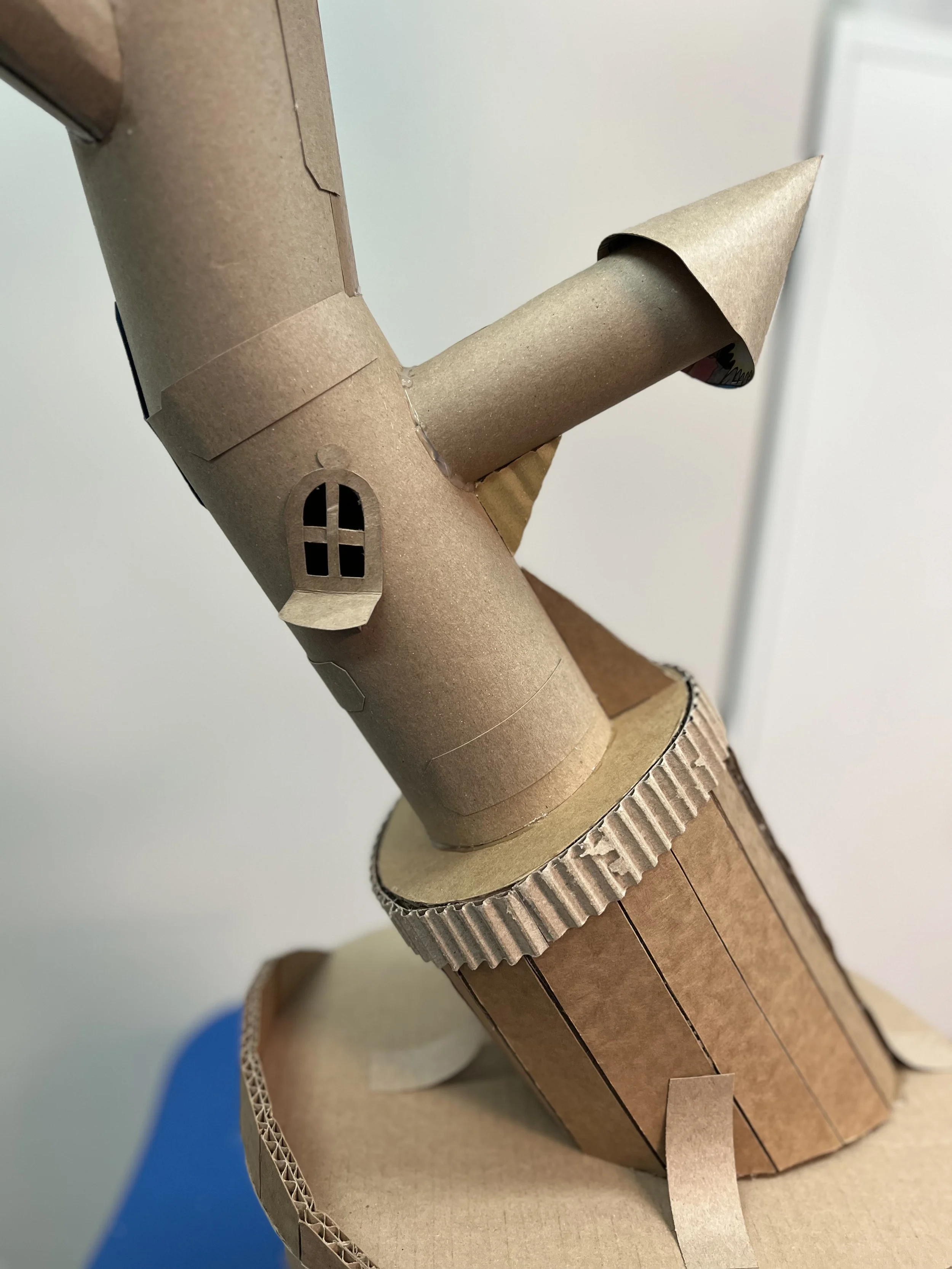


What really got me though, was the captain of the blue team’s response to the “Did you learn something?” question I’ve commited myself to asking after each meeting.
It took him a bit. First, his response to “Did you have fun?” was a quick absolutely, but he sat there for a minute considering what he may have learned through the whole thing. I was about to say we skip him and come back, but then he said this:
“I learned that we aren’t supposed to only have one friend.”
“Why do you say that?” I responded, my metaphorical jaw having dropped at the depth of the response. “Well, Jesus had a lot of friends, so he wants us to have a lot.”
An incredible answer.
And yet another reminder of the impossible nuance of communication. Never can one person control every aspect of communication. I never would have imagined an answer so perfect. I mean, I just told them to make a tower for crying out loud! Yes, the intention to learn aspects of teamwork was there, but they didn’t learn exactly what was in my mind…
they learned what formed in their own mind.


“Are you happy with that?”
yes. I am. Quite pleased, in fact.
The first meeting of the Cardboard Club at College Wesleyan Church through WonderSpace (henceforth reffered to as just “Cardboard Club”) was a massive success. It was a “skills workshop” highlighting the four major tools I use in my cardboard endeavors, and I’m happy to say I neither underprepared nor overprepared! I somehow hit it right on the spot with two double-sided documents, including a thorough agenda, and a trifold they could take home and reference…
yes. I am. Quite pleased, in fact.
The first meeting of the Cardboard Club at College Wesleyan Church through WonderSpace (henceforth reffered to as just “Cardboard Club”) was a massive success. It was a “skills workshop” highlighting the four major tools I use in my cardboard endeavors, and I’m happy to say I neither underprepared nor overprepared! I somehow hit it right on the spot with two double-sided documents, including a thorough agenda, and a trifold that they could take home and reference. The “Agenda” you see (a.k.a. word vomit) was actually pretty handy! When we got to knives and glue guns sections I even held up the paper and read verbatum some of my prepared remarks. The “Trifold” you see (which will be improved for future meetings) was printed on cardstock, and handed to each member to use during the meeting for referencing things like the 5x5 grid, and then to take home and use the “Practice By:” activities listed underneath the safety tips for each tool. The most precious moment to me (after admitting how proud I was of the silly trifold) was when the youngest boy said something along the lines of “I like your trifold and I’m gonna use it!” The comment made all the annoyance of designing worth it.


Introductions
I’ve belted out “Be Our Guest” in front of large crowds, performed presentations to intense judging panels, given a Valedictorian speech to the entire graduating class and their families, and already led half a dozen workshops for tweens. So I should be a pro at public speaking…
And yet I was terrified of this handful of unknown 8-14 year-old boys and their mothers.
I think it was partially due to the emotion I had put into this workshop that was different from my performances and previous workshops. With the ones at NMPL, I had managers to lean on and who already knew the kids. With the performances and prepared speeches, I was going off an exact script without interruptions. With this one, I was going in blind, and with far less social support. I was fully in charge. There was no “capital A” Adult to introduce me, and instead I was to initiate the entire meeting. Huge difference.
So there I stood in my fancy apron and Ft. Wayne Children’s Zoo baseball cap at 5:34 with a 5:30 expected start time, not sure what to say. But I knew I would want to know these boys’ names. What happened next makes me violently cringe, but it worked. Hear me out:
I said my name… and then had each of them say theirs (and what they would like us to call them). REVOLUTIONARY tactics… I know! The next part is huge though: I then said each of their names in order, making sure I got them right. How teacher-like of me. So proud.
Surely that was the extent of the awkwardness… right? WRONG. I then had each person (including the Moms on the couch, whose names were included in the practice) go around the group and say each other person’s name. We had to have heard them all three dozen times by the end. That was my first success, because there was little-to-no chance I would forget their names, and it saved me from the need for nametags. And it was a bit of an introduction to how the Club will run: inclusively, making sure everyone present is involved. It showed that not only do I need to know their names and they know mine (which is conveniently in large print on my apron) but that they also need to know each others’ names, implying present and future cooperation.
This activity took an entire sixth of my alloted time (15 minutes). We hadn’t even started with the…
rulers!
When each of the members came in, I had neatly laid out a ruler, pencil, and white sheet of paperboard (previously called cereal box cardboard, now to be reffered to officially as paperboard) at each spot. They sat down, and only minimal ruler swinging commenced. It was surprisingly well-behaved and quiet before the introductions. (I don’t expect that to last as they get to know each other—but that’s fine by me since I know how to channel the energy constructively) After they went through the “name game circle of pain,” they were warmed up enough to hear me say, “so this meeting is going to be way less exciting than future ones…” since we were just going through the tools. And then I was met with the anticipated eye rolls when I said we were starting with rulers.
When I asked who all knew how to use a ruler, everyone raised their hands. But then I had them divide a sheet of paperboard in half and draw a line down the middle. I saw who could measure and who could draw a straight line in one simple task—and it was similar to my expectations. There is always that one boy who is confident in his ability, but it looks just… horrible; then there is the boy who suddenly isn’t so confident after being tested; and luckily there are those that improve leaps and bounds with just a little coaching. But no. Not everyone was correct in saying they could use a ruler. And oh, the straight line was the easy part compared to 15 minute attempts at drawing a 5 by 5 grid… as was expected. It really is trickier than I would know after drawing so many. How do you start? How do you keep your ruler straight? It took patience, but we got them through the exercise, and those who recognized they may need a little improvement now know what to practice. That was rulers.
Scissors
It’s cool to see tool skills stack on each other. For the boys’ next task, they were to cut a straight line with their pair of Westcott Soft-grip Titanium-Bonded Scissors (#notsponsored) and they could use the ruler to draw a straight line and follow that with their scissors instead of winging it; so most did that. There was a hilarious moment when I was passing out the pairs and nerded out about scissors: I showed them all my Non-Stick Glide-Adjustable pair and straight-up told them, “this is the best pair of scissors out there. You all get the second best for now because they’re cheaper…” and the parents laughed. I guess I showed my real dedication to the tools, because one of the boys adopted my enthusiasm enough to say by the end “I’m gonna ask my Mom for these exact scissors and glue gun” at which I melted into a puddle of pride.
The straight lines were easy for the boys, so I quickly moved them all onto attempting cutting curves and more detailed objects. They could draw a quick scribble on a sheet of paperboard, and then try and cut along that line. There was no reason I should have prepared lines for them to cut along, since the freedom was readily appreciated. I moved some of them along to circles, and observed as they failed to produce anything better than my past 4 year’s worst circle. Instead of keeping them to my lofty standards though, I instead asked them the title of this post: “Are you happy with that?” and they almost always said yes. Which surprised me. But then I knew how lightly to point out areas that were subpar, and where to congratulate them for their improvements and hard work. Their response let me know what their own standards were, so I could meet them there instead of leaving them far below my own. I found it to be an extremely valuable question and learning tool for myself and the students. If they were “happy with it” and it was horrible, then I could point out ways they could improve that may increase their happiness with it. I let them know what “better” to shoot for, instead of just criticizing their impressive progress. I learned that questions can operate both as encouragement and instruction. They allow the student to engage by considering their emotions/experience and formulating a response and thus allow the teacher to gauge how the student is progressing. I wonder if the best teacher asks just as many questions of the students as the students ask of him. Such as: “Is that how you should be holding the knife?”
Yes… the third grader got a knife…
and it was just as sharp as every other brand new XActo blade I brought for the workshop. It’s a good thing I’m actually a top-tier crafter, because the Church didn’t have a single knife to contribute. Only when preparing for the meeting did I realize that I have an actual arsenal’s worth of craft knives after my years of collecting and Christmasses. So I nerded out about knives to these boys for 10 minutes, explaining the different types and trying my best to teach them a little safety before handing them out like I had the rulers and scissors. When it did come time to hand them out, a Mom kindly (and quickly) stood up and started helping supervise the boys’ hand placement and pressure usage. No matter how long I’d talked about the knives, it didn’t matter. They would never know what the right amount of pressure and pull was until they started actually cutting. Neither would they have a subconscious understanding to KEEP YOUR HAND OUT OF THE PATH OF THE KNIFE. Nor would they necessarily know how to hold them, or even which side of the blade cuts. So with acute spectating and guidance, we got them all cutting straight lines, trying our best to keep the table from collecting cuts (I had two large cutting mats, but they didn’t get full coverage… I’ll get more for next time). Then moved on to curved cuts, while all the while we were nudging their hands further and further away from the path of the blades. Some moments we just had to be like “no. you just… that’s wrong.” and it’s okay, because we had set a precedent of communication with the first two tools. They understood to listen and learn, because I know what’s best 99% of the time with these tools.
Knives went surprisingly smoothly, with nobody getting cut. Sadly though, we were really patient with their experimentation, and only left 15 minutes for all of…
Hot Glue Guns.
Nope, they weren’t sitting out heating up this whole time, so the boys went over to my armoire and plugged their choice gun into the nifty array of extension cords I’d strapped underneath the table. Then while the guns were heating up, I passed around a scrap box of cardboard and started giving another speech. I showed off my array of guns, including the wireless variety (which they found as cool as I first had) and all the types of sticks I have (fabric, glow-in-the-dark, glitter, full-size length and drying speed variations, etc.). I took so long talking about it that a couple kids started gluing before I finished. I paused them to get across one point: when the hot glue touches you: rub it to dry it faster. Which I think is key. Because no matter how hard you try and stay out of the glue’s path… it will get you eventually. With my limited time, I therefore emphasized what to do when it does happen instead of going on about how to make it not happen. (Little did they know, I touch hot glue to smooth it out all the time when it’s still hot. Really, it’s about timing and knowing when it’s cool enough… but they don’t need to experiment with that yet) Even with only a measly five minutes of gluing, the boys constructed a greatsword, a helmet, and dual shields. It was incredible to watch. And nerve-wracking to watch the parents accumulate in the doorway, knowing my time had run out 6 minutes ago. When I panicked about time aloud though, one Dad gestured to his kid and said “nah, he can stay” so I wrongly assumed the other parents would be fine with it running a little later. Now I know to watch the clock closer, and have the kids ready to leave on time, instead of literally starting entire projects at 7. Time management is always a learning curve.
Thankfully, I did get to ask part of the exit ticket idea I had prepared.
The goal was to field any criticisms and feedback the kids had before they told their parents all about it. Then if there was anything negative, I could address it instead of losing a member. However, I ran over time instead of bringing everyone back together as I’d hoped. So instead, I asked each boy as he left “Did you have fun?” and “Did you learn something?” and they all noted affirmative. In future meetings I hope to be far more reflective of projects, and leave room for idea generation and getting to know each other. A third of the time will likely be spent on growing as a group as opposed to all of the time being spent towards individual skills and projects. I asked and answered wordily in the meeting’s agenda, “What might this club do next?: Field some ideas, encouraging the wild and seemingly unattainable ones. The bigger, the better. Explain the bargaining chip [the kids’] age and affiliation is, and how to utilize it when communicating to big business. We also would be providing a service at no charge to the businesses (unless they offer funding, of course) so there is only logistical stress provided by agreeing.” These big ideas could include anything from a school project day to collaborating with Little Caesars on an advertisement using their pizza boxes. I can easily imagine this group of boys making it onto local television as we create more and more influential projects.
Just you wait and see.
“So you’re the Cardboard Guy?”
Yup! That’s me!
Even though she seemed a bit hesitant to use the title, I am now ready to fully embrace it.
Yup! That’s me!
Even though she seemed a bit hesitant to use the title, I am now ready to fully embrace it.
The “Ready, Set, Launch” WonderSpace event yesterday, February 1st (2025) was FANTASTIC. It was really quite different from the first week I went, all the way back in December, and I think that’s mainly because I felt official this time. I’m now an actual employee—not just a random guy trying to build stuff with kids—and that credibility makes all the difference. This time I felt like I belonged, and that I really was in a position of (some) authority, especially in regard to the Cardboard Construction Zone I was helping in. Once somebody takes ownership of an activity—as I have been given the chance to with WonderSpace’s Cardboard Creativity efforts—they are so much more invested, and more willing to assert themselves for the sake of its success. The Cardboard Construction Zone was ALIVE today, as many adults happily pointed out, and I happily observed. It was hugely rewarding to be a part of the team that inspired the participation. The adults were primarily referring to the construction of the “Church,” but I’ll get to that. First,
The “Rocket Ship”

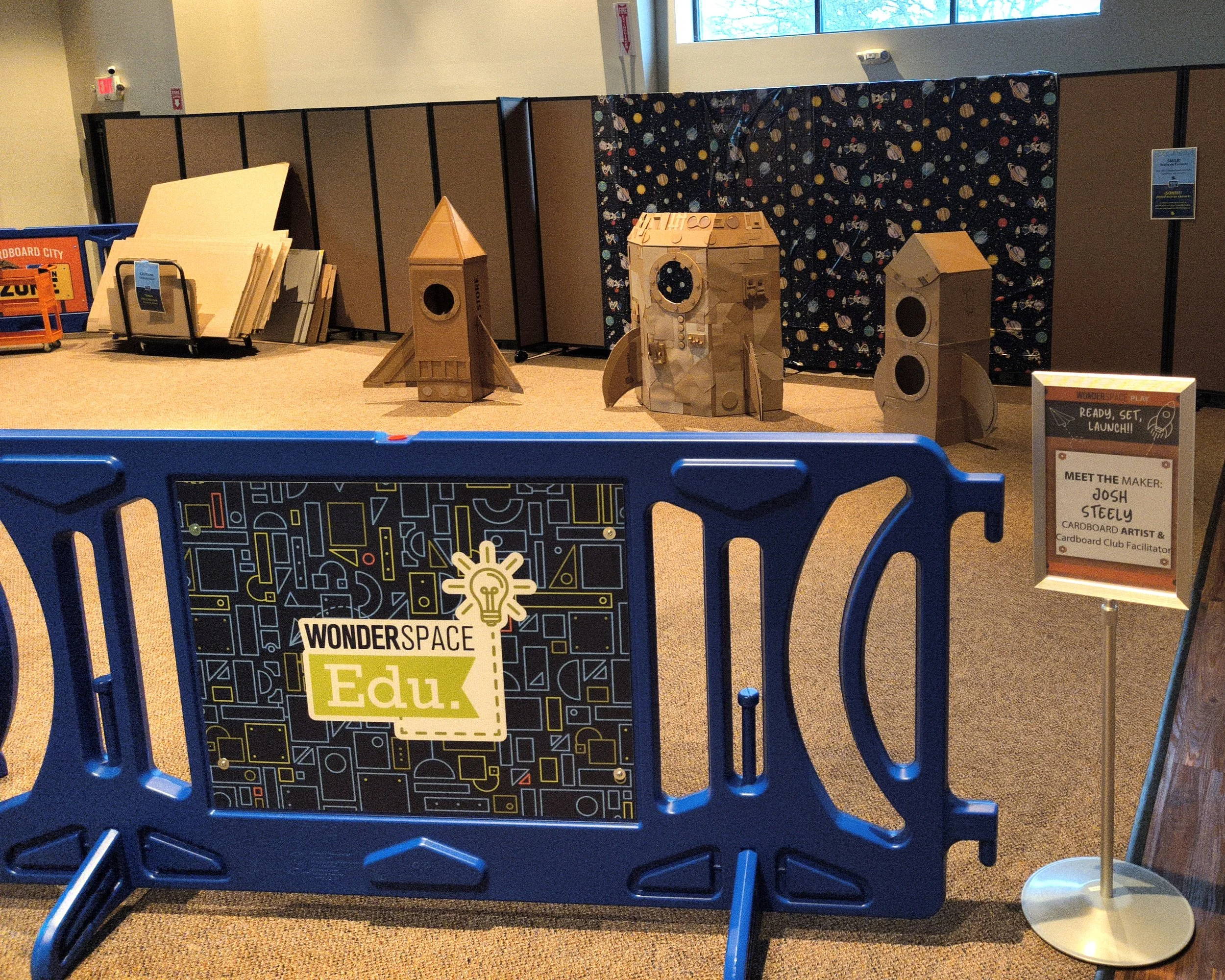
My three spaceships at the February 1st PLAYdate before the event began.
For this event, I brought three preconstructed rocket ships, two of which were made just for this event and a third which was repurposed from the Runway Show I’ll finally be able to stop mentioning in every single blog post. I had a blast making all three, but I made them all in a studio, by myself, in consequently a completely different manner than the rocket ship I had the priveledge of helping construct at the event itself. Let’s call the boy Tom, since I never did catch his actual name.
Tom wanted to build a Rocket Ship, and I was there, ready to help. I thought I knew what the construction process would entail… since I had made three rocket ships of my own, after all. I was a pro, right? Well, it turns out he wanted something with bits similar to mine, but a LOT would be different.
What made the process so eye-opening to me was how I was able to engage him with the process opposed to prior attempts. Before, I would assume what the child wanted built, and then just build it. With Tom’s Rocket Ship, I instead let him dictate every step of the process. We had a sheet of cardboard, and instead of turning it straight into a usable box, I asked him to draw how big he wanted the window. He drew a much smaller hole than I would’ve, and made the walls much closer together than I had envisioned. So we worked off of that. I showed Tom how to use the Makedo screws, and he screwed the panels together, with just a little help tightening from me. Then came the roof. He wanted a pyramid-shaped cone on the ship, like I had on my left-most example. But we just had a sheet of cardboard. The process that followed was tedious for me (someone who knows how I made the original cone) but it was immensely engaging for Tom (which is what really matters). Instead of ever telling him how a step was done, I asked him how he thought it was done. That’s the crucial step. I never assumed what to do next, always asking him to point where I should cut, or how the triangles should be laid out to produce the desired shape. I knew the answer, but he didn’t, and it was so much better for him to work to figure it out instead of just watch me make it.
Sure, sometimes Tom would wander off to point at some part of the spaceship, and say things I neither caught nor understood, but when he came back I would hand him the screwdriver, and he would jump right back in to the project.
When I tell you that the rocket ship was ugly, I mean that I would be ashamed to show that… thing… to anybody I know. But Tom was so happy. It fit right on him, and so there are some fun pictures his guardian got of him looking out the tiny window of this wonky cardboard spaceship with the lopsided cone and the tiny wings. He was just so pleased. And my heart was so full of joy prompted by his smiling face.
and then I looked up to see something resembling a blanket fort, but made with massive sheets of cardboard:
The “Church”
I’m not sure if these kids are aware of what card towers are, but that’s roughly what they constructed. Sheet after sheet of massive cardboard was just thrown haphazardly up unto an utter lack of structural integrity. One wrong nudge and it all came down. And it did come down. Often.
Eventually I started contributing pillars: simply-made, vertical boxes that they could throw the sheets on top of. They loved the idea, but only one girl actually embraced the slow process and constructed a singular pillar with me. The others seemed to prefer shouting “We need more pillars!” and not making any actual effort to raise more. These are the same kids that sectioned off parts of the newly constructed cardboard fort and called them “offices” keeping everyone out per loud verbal demand.
At one point it was decided (by the loudest kids) that the building was to be a “church” and they started construction of a cross, their offices, and steeples. I never saw the cross—only heard of it—but I actually built the steeples. Well, they were already built. The kids just threw the rocket ships onto the already-caving-in roof and called them steeples. It was a sight to behold. Even the newly built dinky ship got launched onto the roof. Some of the larger freestanding structures were commondeered for walls and supports, and that was the only reason anything stood at all. If only the kids had been willing to put as much time into stability as they had flinging around the sheets of cardboard they could have constructed a very secure fort. But alas, it was only temporary anyways.
The “Monster Truck”
This is a project I was a part of that I’m still wrapping my mind around. Here’s how it went:
There was another boy, let’s call him Billy, that came up to me, a man in an apron, and asked “can you build me a car?” Now, I considered it for a moment—building him a car for two hours so he can sit in it once and leave—but instead of doing that, I told him there’s a lot of work that goes into building a car. At that, Billy went off to a chair to pout. I wouldn’t just spawn him a car. How dare I! Sadly, I’m not like a balloon-animal man. I don’t just make things appear on demand. But I am the cardboard guy, so I had to do something.
I found Billy sitting on his chair and asked him, “How are we gonna build this car?”at which he looked up, understanding now that I wouldn’t just build him one—he would have to help. “What kind of car will it be?” I asked. It turns out, he wanted a monster truck. Good to know. I would never have considered that when thinking of “cars,” and I still wasn’t quite sure what he wanted, so I handed him a pencil and held up a sheet of cardboard like an easel for him to draw the shape of the monster truck. I thought it’d be that simple… silly me. He waltzed right around that easel to a separate sheet of cardboard and drew some strange, oblong blob with some pointy things at the end. He gestured to two blobs and declared them wheels, which I could comprehend with some effort, until he made the drawing taller, at which I lost all concept of a vehicle. And yet I asked him, “What’s the first step for making this monster truck?”
Every time I asked about “the next step” or “what do we do” I could see the gears turning in these small children’s minds. They were working double time up there, trying to discern what to do. I suppose most of their experiences at this point are attempts to follow specific instructions to learn, rather than fully write their own curriculum of decisions. It was new, but they got there in the end, even if the decision was so far off from what I may have imagined. For the rocket ship, I knew how to guide Tom to get him something resembling a rocket ship, but with Billy the whole process involved learning exactly what his concept of a monster truck was.
The point of the project Billy seemed most pleased with (smiling, bubbly) was when I cut—per his request—a large tooth out of a nearby carboard sheet. (Because “Monster” truck?) We then had a large, tooth-shaped, hand-held object made out of cardboard, and he went to town thinking of all the things it may be. We quickly determined it was too big to be his own tooth, but thought: maybe a bill? a beak? a baseball bat? And then I was instructed to cut another. And then we cut a rectangle. and then we came to a halt at…
the “No Tape” Predicament.
For such a chaotic time as this event, there were a lot of identifiable common themes. One such theme being “we don’t have any tape or glue.” It’s true; the Cardboard Construction Zone was not currently supplied with any tape or glue, limiting fasteners to the Makedo blue plastic screws and kid-safe tools. (Hence why I brought a box cutter in my apron, to avoid the struggle and tedium of toddler-safe hand saws—I’m rarely even patient enough for regular hand saws!) and so both Tom and Billy at one point looked at the spaceships I had brought, made with tape and glue, and wanted their process to be just as simple. It was not. Instead of being upset about it though, and quitting the project, I simply continuously redirected them with: “What can we use instead?”and “How can we use what we have to get that result?” Sure, in most of the situations I would have also preferred just to run out to my van and grab the roll of packing tape I had sitting in there. It would’ve been an easier, cleaner solution. But instead, we problem solved with what we had. The monster truck became a rectangle with two large teeth screwed onto it. and then Billy drew some lines on the rectangle with a sharpie I was carrying, and that was it. That was it. THAT was the monster truck. After reaching that point, we were going to add wheels of some sort, but he got sidetracked helping with the Church, and then I think their family went home. I don’t know what became of the “Monster Truck”. But I learned that my “car” and just giving him that, would have given him nothing. The process we went through to create his own brainchild was worth far more. Especially the point where Billy came to terms with the lack of tape or glue, and worked with me to find a solution instead of sulking.
The “Missile”
There was, near the end of the event, a full construction process that I was hardly involved in at all. Yet I still learned from it! It was a father-daughter-friend project that actually followed the theme of the day: a missile. They constructed the large tube, the cone, the wings, and then stuck it on a kid to wobble around in. It was fantastic.
At one point I went over and asked the daughter if I could help. She was, after all, using the kid-safe saw for a massive circle (soon-to-be-cone) and it was taking far longer than my box cutter would take. But she declined the help, and I moved on. I didn’t try to force my help upon her, instead allowing her to struggle and reach her goal by her own means. It was made clear where my help was needed, and where it really wasn’t. Maybe all I needed to contribute to that project was the prebuilt spaceships as inspiration. The construction process was handled on their own from start to finish. Then came…
Witnessing the Destruction of my Spaceships.
I’m glad I came into the day’s event detached from my hard work, because those spaceships didn’t stand a chance. After being chucked around as steeples and walls (and yes, enjoyed as well-made photo ops by the littluns) the spaceships made it to the end: cleanup. We gave instructions for the kids who were still there to help us “destroy” what had been constructed, hoping they would help by removing the plastic screws to be reused in future events. They assumed, however, that the spaceships were included despite their lack of screws, and just straight-up picked the box off the ground and threw it at a wall as I watched. My fancier, more detailed spaceship seemed to gain more respect, but still a boy went up to it and just ripped off a detail. It was so strange to watch, and be okay with. This was the same rocket ship that won the People’s Choice Award at a runway show and was in an official gallery for the past month, and here, little boys were knocking it over again and again, crushing it, and then ripping off the detailed levers. It’s a good thing I understand impermanance, and seldom build things to last forever. Cardboard is much better in-the-moment than preserved to last. It’s a material meant to be aggresively played with until it disintegrates. My spaceships were no exception.
Spontaneity vs. Planning
A slight tangent here near the end of the post again with one of my favorite words: Spontaneous! I thought of a few ways to highlight it in juxtaposition to scheduled events regarding yesterday. First was the day as a whole: I had the first half planned, but then the second half just fell into place, fabulously. The first half was planned, the second, spontaneous. Second, the event at WonderSpace was a beautiful blend of planned and unplanned, with a prepared theme in “Ready, Set, Launch” and a number of completely irrelevant builds as a result, perhaps “inspired” by the preconstructed items. Thirdly, I expect the workshop on Monday, February 3rd to be a similar blend, with me either being overprepared or underprepared, and needing to adjust in the moment accordingly.
I am looking forward to…
so much. If I pause and think of all the exciting things coming up on my calendar, my heart starts racing and I wish time would move faster… (until I remind myself to slow down, since I’ll never get that time back). I’m trying to appreciate the process, and each moment along the path of life, but the big events still have a draw unlike the mundane.
First, is the workshop tomorrow where I will meet some of the boys (and hopefully a girl or two) who will be a part of the HUGELY EXCITING “Cardboard Club” I have the ABSOLUTE PRIVELEDGE of leading. I met one registered participant yesterday, but there are several other boys signed up who I may never have even seen in passing before. That’s the most likely scenario, actually, since I’m not from Marion and it’s a decently large city. I’m nervous if I linger on the unknown variables such as the attendees. I can only hope they are as willing to adapt as I am. (I expect to write a post about the Meeting, after the unknown variables and expectations become known.)
The second excitement is farther out—most likely a few months—being the construction of my new studio! I have a large role in its design, but house progress like electrical and roofing has been slow. We’re a ways off from flooring and painting, and then desk installation and move-in. Not to mention the following process of preparing curriculum for the art lessons I plan to teach there! That is the exciting part for me, especially after engaging with the kids how I did yesterday in an environment with extremely limited solutions. I can’t wait to expose the kids I teach to the infinite solutions for their design challenges, many of which we can try with my mass of accumulated art supplies paired with my shopping addiction. I mentioned the lessons to the parent of one kid who has a conflicting event (like dance or ju-jitzu) with the 5:30-7 time slot Cardboard Club occupies. When I mentioned the alternative opportunity to make art with me, the kid’s face lit up. My heart grew two sizes when I saw the excitement on her face, and the parent mentioned they would happily help expand my clientel with their homeschool group connections. (Which just makes so much sense as a demographic I should try to reach.)
AAAAAAAH I’m so excited. I need to look up some synonyms for excitement, else I run the risk of overusing the word in an attempt to convey it.
Because I am, to the fullest extent, excited for what’s to come.

Blastoff in 3… 2…
Coming into my second semester of my freshman year of college, I feel like I’m on top of things. I went through the ringer of time-management realizations the first semester, almost certain half of the times I was sick were from stress. Re-entering the arena, I’ve reevaluated my degree once again, and redistributed my time accordingly. I’m no longer giving tours at IWU, but the choice to open up my schedule led to it being filled right away with a new, incredible opportunity: WonderSpace
“I know I’m not an ordinary 10-year old kid” Auggie Pullman says in the opening scene of the 2017 book adaptation of Wonder, but it’s a good thing, since we all know ordinary isn’t nearly as exciting as extraordinary.
Coming into my second semester of my freshman year of college, I feel like I’m on top of things. I went through the ringer of time-management realizations the first semester, almost certain half of the times I was sick were from stress. Re-entering the arena, I’ve reevaluated my degree once again, and redistributed my time accordingly. I’m no longer giving tours at IWU, but the choice to open up my schedule led to it being filled right away with a new, incredible opportunity:
WonderSpace
How I learned about WonderSpace is the coincidence of my life. I made a spaceship based on childhood wonder and won People’s Choice at a runway show, after which a random Dad tapped me on the shoulder and asked about my helmet. Then from him I heard about wonder space… What are the odds…? I’m shook.
WonderSpace turns out to be practically on IWU’s campus, operating out of College Wesleyan Church as part of their community outreach. It’s an organization that offers three services: WonderSpace BLUE for grief groups, WonderSpace EDU for child literacy, and WonderSpace PLAY (what I get to be involved in) for constructive play.
In their play space, WonderSpace has a cardboard city, and during their playdates they have a “Cardboard Construction Zone” for families and kiddos (PreK-4th grade) to build/play in. So of course, that is what I gravitated towards, and what the staff noticed my aptitude for.
Through a generally informal interview process (I suppose I proved my people skills in conversations and cardboard skills at the Runway show and on my website) I’m now employed!
I will therefore be helping facilitate the Cardboard Construction Zone at future Saturday PLAY Dates, contributing some foundational pieces at themed events like February 2025’s “Ready, Set, Launch!” day. And most excitingly, I will be teaching workshops each Monday from 5:30-7pm for a newly organized “Cardboard Club” targeting 8-14 year olds in the community who would like to extend their creativity with cardboard! (The only way to come CLOSE to understanding my excitement is to be near me in person as I gush about the possibilities and a smile widens past my ears) This Club will hopefully foster a community of young creatives who can share my enthusiasm about cardboard and its malleability, affordability, and environmental ability. Unlike one-off workshops, this group will emphasize collaboration, and working together from week-to-week, growing as a club spanning a 6-year age range, more than just individuals. This is a potential 3-year project, since I still have more college left, and WonderSpace isn’t going anywhere. Through this group I will be able to grow tremendously as an educator, communicator, and artist. The potential is extraordinary.

I’ve also made strides towards considering career paths. I’m currently looking into “Internal Communications Specialist” positions, and noticing what seems to my like a match of interest. ‘Organizing and managing a large group of individuals for a common goal, utilizing newsletters and mass-communication software.’ It would allow for remote work, which may permit me to pursue the lifestyle I’ve currently dreamed up. I can always do art on the side, and evolve this website as I grow. I’m finding ways to throw communications principles in here already, maybe one day there will be a post without mentioning art… (but then I’d have to be TRYING not to mention it, since art is everywhere.)
There are ideas brewing… now we have to wait and watch what sticks.

My mom said I should write about the ewok child.
So I’m tempted to discuss anything else out of spite.
Perhaps I could add to the growing number of posts on here discussing the role of social media as an artist, including my recent observation of “reposting” that makes so much sense, but was only noticeable when I finally looked. I could add onto that about the stigma of copying other artists, when that is among the best ways to learn. Or I could pivot and talk about the potential post title that kept me up the other night until I wrote it down: “Shameless Self-promotion and Ignoring the Celebrity Status.” Hey, wait a minute. This is the Christmas Season in America! I could have it all! (Confirming your suspicions: that’s a jab at consumerism) I’ll start with the ewok.
So I’m tempted to discuss anything else out of spite.
Perhaps I could add to the growing number of posts on here discussing the role of social media as an artist, including my recent observation of “reposting” that makes so much sense, but was only noticeable when I finally looked. I could add onto that about the stigma of copying other artists, when that is among the best ways to learn. Or I could pivot and talk about the potential post title that kept me up the other night until I wrote it down: “Shameless Self-promotion and Ignoring the Celebrity Status.” Hey, wait a minute. This is the Christmas Season in America! I could have it all! (Confirming your suspicions: that’s a jab at consumerism) I’ll start with the ewok.
“I made an ewok. He kinda cute.”


One of the ways I’m making social media work for me now is by being more intentional while on it. I’ve gone out and looked for the cardboard artists I admire, and have taken note of the projects they’ve made that I “wish I could do.” most importantly though, I’ve engaged with other artists through the platforms. I comment things with more substance than “Wow!” or “Cool!” and if I have questions about a process, I just ask! This ewok made by @pizzadadcomic is just one of the projects I’ve engaged with and resulted in a creation of my own!

Another realization is key (for my personal growth) in this project: I didn’t rush it. That’s new. In the past, I’ve seen something like this, and have been like “that would be cool to make” and moved on. This time, I commented on the post, getting a response from the creator (motivation) but then held off to make it until—well—until I had time. Which was a two-day period several weeks later (12/23-24/2024). I did make mine on a smaller scale, but with similar technique, and similar results! It was reassuring to know that I could make something like that, and I did. I’m looking forward to “copying” more cardboard artists to learn and practice further techniques.
Those are my primary thoughts on the ewok project, and it seems to segue well into the thoughts I had recently on the celebrity status.
When interacting with people online, it’s SO easy to disaccosiate them from reality. They are, quite literally, a curated image for you to view. Personally, I know I make sure not to put out thoughts, ideas, and projects that would prompt people to view me as crude, angry, or indulgent. Other creators go as far as to wear a box over their head when recording any videos of themself, so as not to reveal their “real” identity. (@hectorsector13) They become a new person in their videos. So it makes sense why it becomes so easy for viewers and consumers to forget the reality of creators’ humanity. Don’t.
When interacting with Wesley Hall (pizzadadcomic) as shown above, his humanity was obvious. He’s a very down-to-earth kind of creator, very friendy, and helps at a makerspace in his community, so he surely has some experience guiding. On the opposite end of the scale would be somebody like Taylor Swift. Is she less human? No. In fact, she has the same capacity as Wesley Hall as an individual. What she does have that he does not, is a following a million times larger. More people want to interact with her, but it’s impossible for her attention to spread that far. So people get left out, and she achieves “Celebrity Status” because demand outweighs supply. Desired interaction outweighs her capacity.
Honestly, the easiest way to avoid acknowledging the celebrity status is to not be aware of their fame in the first place. There are people out there who don’t know who Taylor Swift is, and if they bumped into her on the street, would be just as likely to say “watch where yer goin!” to her as to anyone else. This lack of reverance happened recently to me with the CEO of Praisecharts, Ryan Dahl. I was surrounded by friends who are well-versed in the music world, and treated him with a sort of admiration (so it seemed) while I, on the other hand, was quick to hand him one of my cereal box business cards, and would you look at that! he’s now subscribed to my newsletter! (Thanks Ryan!) All this to say that Charles Duhigg would say and I would then say, “dehumanization spoils communication.” When interacting on social media, the last thing we should do is dehumanize, or let a celebrity status keep us from positive interpersonal communication.
Moving right along, I suppose I talked a bit about copying other artists to learn, but there’s another story to add! Professor Soderstrom told me once of his dislike of Picasso’s work. He thought it was pointless, and absurd (I’m paraphrasing), that is, until he did several art studies of the works. You see, Picasso knew how to paint realism exquisitely, but turned to the more expressionist form of art because it could communicate his message more effectively. Just because the works suddenly looked a whole lot weirder, doesn’t mean they didn’t have an even greater level of meaning behind them. Soderstrom only recognized the meaning when he studied them more deeply. Copying artists is good. (Just don’t profit off their work, there are laws in place.) The greater level of attention mimicry requires, cultivates a deeper appreciation for anything.
The last thing on my wishlist for this post is a comment about the “reposting” I’ve noticed by many popular artists on social media. I always wondered how they kept cranking out all this incredible work, posting daily projects that appear to have taken weeks. Well now I know. A single project can have as many as a dozen posts, spread over progress updates, the final piece, and adaptations of the piece to various media trends. And then—here’s the kicker—when they don’t have anything new to post, they repost an old project with common words like “throwback,” or they hold up in quick succession a slew of their works in a new reel. This is all sweet and dandy, but I don’t save my work! Maybe 10% of it is still in my possession besides photos. I don’t often save sketches if they’re on loose paper or in spiral-bound books, and I certainly don’t hold on to commissioned works or gifts I’ve made intended for others. I suppose I can repost the photos, but I cannot simply place them in a new context—only use what I already have.
I guess I’m a day late in finishing this post, so I can only say “Happy Holidays” after checking off my wishlist of comments. To respect the new observation about reposting, I’ll leave you with a random concluding thought from one of my past blog posts. Enjoy:
I have all the justification I need to scrap hours of work to pursue something I want to do more.

A Checklist Conclusion (Part 2)
If you didn’t read part one, click here for things to make slightly more sense. Read it? Great. Here’s the second part:
If you didn’t read part one, click here for things to make slightly more sense. Read it? Great. Here’s the second part:
First, the promised portfolio.
This was the second pdf design of the semester, and they both thoroughly reminded me why I am NOT a graphic designer. Everything was aggravating. With sculpture, I most often enjoy the process and the result. With graphic design, I tend to despise the process and only like the result if I push through an extraordinary amount of frustration. Web design is a bit of a happy medium, since a site is more interactive than an immovable pdf. Alas, there was a requirement to be met, so I met it as I was able.


It looks fine… I just wasn’t proud of it. So I was ecstatic when a moment of inspiration hit me in the shower the morning after.
If you’re here on purpose, and not just reading over somebody’s shoulder, you know that I love cardboard. In fact, I make a lot of cubes out of the stuff and have business cards made from cereal boxes… so why not a cardboard portfolio?
Picture this: artists from all over are wanting a position at some fancy firm, and come from all corners of the world with a massive canvas portfolio or fancily formatted website, all nothing you haven’t seen before. All until a guy hands you a 12” by 12” cube.
On this cube is his work, with one face introducing him as an artist, and the other five showing work and process photos to give you just a couple sides of his art. (I think this is genius…) The cube could even fold out, (as Prof Soderstrom suggested) containing more images of work, or even a sculpture custom-made for the application recipient. Maybe I apply for a furniture company, and inside this cube is a little living room all made from cardboard. If I apply for a desk position, it could be a cubicle. Like opening a music box from a piano applicant. Of course, jobs that are requesting portfolios of work are art-related positions, but the cube would certainly stand out in any application process. As of this moment I have yet to design one (as again, it would be at least 6 faces of graphic design work, even if I take it in a sculptural direction), but I certainly plan to if and when I apply for creative positions down the road.
As for the feedback I received during the conversation, sadly there was little. But it’s because I was so prepared! He was running a bit behind that morning, so I let him know I had already written at length all of my responses to the questions, and sent him the link to the part 1 post per his request. (I also delivered to him a copy of “Christina Katerina and the Box” by Patricia Lee Gauch which may have taken upwards of 5 of the 15 minutes to explain.) The next few minutes were spent excitedly chattering about the idea of a cube portfolio, as detailed above, and my dilemma with pdf graphic design. He thanked me for the preparation and grace allowing him to get back on schedule for his next meeting, but did not leave without discussion of the last question: What are your goals for next semester in the studio? As the first post explained, I will not be occupying an IWU studio the 2025 spring semester, as I am no longer a Studio Arts Major. Professor Soderstrom has introduced me to potential careers in “Design Thinking” (basically, creative-based HR), various firms, and other art jobs with the hopes I pursue a creative career. He seems convinced I would make a fantastic designer, and I can’t beg to differ. In the meantime though, I plan to complete my college degree and find opportunities on the weekends and over breaks to experience the worlds of art, education, HR, and business a bit more before launching into a full-time position following graduation.
Even so, those plans seem far off compared to the fast-approaching return to college and the 2025 Spring Semester. So what’s next? I’ll give you a hint…
I think it’s gonna be Wonderful.
A Checklist Conclusion (Part 1)
Finals are this week for my first semester of college, and my Ideation and Interpretation class is taking ours in a way I think fits perfectly with the class, and I might as well talk about it:
We were given three questions to prepare for a one-on-one 30 minute conversation between the professor and each pupil. There is no final essay or big test (the professor said he didn’t even know what he could put on a test) that wouldn’t make sense. Instead—because IWU is a small enough school it’s doable—Prof Soderstrom will conduct an official dialogue with each of us reflecting on the semester and how we have learned and grown as artists and people. We also will construct a detailed portfolio and answer a question regarding the joining of creativity and the kingdom of God throughout, but as a Human Communications Major the conversation is the portion I’m most excited about. (I will post the portfolio pdf on this website following its completion)
I’m writing this post in two parts: The first part (what you’re reading right now) is my form of preparation for the conversation…
Finals are this week for my first semester of college, and my Ideation and Interpretation class is taking ours in a way I think fits perfectly with the class, and I might as well talk about it:
We were given three questions to prepare for a one-on-one 30 minute conversation between the professor and each pupil. There is no final essay or big test (the professor said he didn’t even know what he could put on a test) that wouldn’t make sense. Instead—because IWU is a small enough school it’s doable—Prof Soderstrom will conduct an official dialogue with each of us reflecting on the semester and how we have learned and grown as artists and people. We also will construct a detailed portfolio and answer a question regarding the joining of creativity and the kingdom of God throughout, but as a Human Communications Major the conversation is the portion I’m most excited about. (I will post the portfolio pdf on this website following its completion)
I’m writing this post in two parts: The first part (what you’re reading right now) is my form of preparation for the conversation. I am going through and answering the questions how I expect I may answer them in a couple days. I can go in-depth here, outlining my ideal response, and perhaps even reference the post when I answer him in person. The second part (what you’ll be able to read in a week or so) will be my reflection on the conversation after it has taken place. Prof Soderstorm always has this way of sparking ideas I’ve never even considered, so no matter how thorough I am in my preliminary thoughts and organization, I know his input will add more to consider.
Without further ado, here are my preparatory remarks to the following questions:
How have you grown in your sense of form this semester?
Okay, this is the least exciting one for me, as it’s quite practical. As an art class, they are supposed to give us more tools to use as artists to then do the exciting thing: make stuff with meaning. That’s what a “sense of form” entails: an understanding of how to use tools to best communicate an idea. Whether an artist wants to believe it or not, there are sets of rules that can make a piece “work” better. Those rules can include color theory (which I know little about) , intentional shapes, a slew of symbolism, materials, linework, texture… if I sat here for fifteen minutes just thinking of all the methods of creating “form” I might think up a whopping 1% of the list. And I’d be impressed with myself. “Form” is incredibly broad, and that’s why the question is asking for “improvement” and not “mastery”. You can always improve your use and understanding of form.
One of the things I learned about throughout the ART-101 course was massing variation (clumps of little things in contrast to large blank spaces) which showed up the most in my Amazon project and my photography of the diptych. In the Amazon project I used massing to highlight the “A” by intentionally adding more small layers around it; and in the photographs I left a vast expanse of black in the bottom of one, to draw the viewer's eye up to the small sculpture set atop it.
Another tool I learned more about was the visual rhythm gained from using a pattern. Both from a typeface in the Amazon project (which showed up more in my preliminary shoebox than my wall hanging) and from golden ratio exercises. Sometimes young artists like myself can get stuck in the “I have to make something new and unique and awesome” phase and then never really create. These patterns give some structure to the projects, and insure the result will have some kind of order to it.
There are surely several other ways I learned “form” throughout the course, but those (along with the “meaning in materials” I’ve written about) are the standouts.
How have you grown in your sense of concept this semester?
Well this question is thoroughly answered in my latter two projects: the diptych and the spaceship. Neither was just a “this would look cool” idea, but instead had layers and layers of meaning behind them. The diptych was quite personal, and I wrote extensively about my choice of mediums and the impact of autobiographical art in a blog post. And the spaceship boasted the visualization of childhood creativity, fulfilling a dream of mine in which every refrigerator box magically transforms into a spaceship or car or fort of some sort. I wrote about it and the runway show it was a part of in another recent blog post.
Generally, I learned (or at least it has been effectively restated) that art is a way of looking at the world. The skills in concept creation assist in finding new ways to convey an idea in the physical space (as I am primarily a sculpture artist).
This, as a college-level course, taught me about using art to mean something to the viewer–using it to prompt thoughts from an audience–similar to my AP 3D class in highschool. In that class, I had a whole year to think of and create a portfolio that drew from how “Fudged-Up” this world is to inspire a heart of reflection and change in the viewers. The dark subject matter was portrayed in an in-your-face diorama blatantly pointing out flaws in daily life. Suicide, overdosage, drunk driving, body dismorphia, child trafficking, and political deception were all visualized in a fairy-tale format to juxtapose our distance from the make-believe to the very real truth in front of us. While Cinderella’s pumpkin carriage isn’t real, some vehicles look worse than a smashed vegetable after a moment of irresponsibility.
While we had less time and fewer projects to grow a sense of concept in this 4 month course as opposed to my year-long AP class, the diptych and spaceship show my continued growth well.
What are your goals for next semester in the studio?
Well, I will not be in the studio next semester–at least not the school-provided space. As I dropped my Studio Arts Major earlier in the semester, I will just be taking the occasional art class as my schedule allows. To answer this question I expect to talk about my new personal studio I hope to be working on over winter break and prepping for use in the spring. While it will not be for specifically school-oriented projects, it will be for creative use, and I hope to make some epic stuff in the space. The floor will be Cheerios boxes and the walls the color of cheerios. And I will be the cheeriest guy in the world when I’m in that space, creating, unbothered by the abundance of worry education can happily provide.
I hope to visit others in the Center Hall studios to encourage their works, and provide my limited insight and ideas occasionally, but will need to bring pictures of my work to share as opposed to dragging friends into a nearby studio to see what I’m up to.
As I continue to work in a studio I hope to grow in my practical sculptural skills, learn new tools and methods for working with cardboard, and make more connections in the art world through media and events. I hope to bring work to a show this coming summer, and network with fellow midwest artists, hopefully planning and executing some collaborations! Due to my schedule, I will need to plan out time to work in the studio if I am to get anything done. Because of the slightly increased distance, I will need to be more intentional with my art time, but I believe it will be to my benefit. Having a very personal, official, more permanent studio space will allow for my creativity to flourish in larger, more complex projects, and I couldn’t be more excited for it!
In preliminary conclusion, I love that the final includes this conversation. Reflection is such an important part of the artistic process, and being given the chance to formally reflect with an instructor sounds invaluable. I will be completing the additional portfolio assignment throughout the week, and reflecting on my conversation in a second post. If you aren’t also a college student, try answering these questions by replacing “studio” with “year”. I think you’ll find more of an answer than you may expect! After all, humans are awesome in that
we can only experience more than we already have, never less.

SPACESHIP (Visualizing Childlike Wonder and Creativity)
Indiana Wesleyan University held their (I think he said seventh) annual Art & Design runway show this past Tuesday, December 3rd, and I had the privilege of taking part! Out of the 44 submissions, there were awards (via a panel of judges) given for Best in Show, Most Creative Design, Most Structural Design, one other (sorry I forget), and then a People’s Choice Award voted on by the audience. Each of the medals awarded were hand-crafted by our very own Professor Daniel Hall, who did some incredible work, and had the joy of tying each one around a winner’s neck.
Indiana Wesleyan University held their (I think he said seventh) annual Art & Design runway show this past Tuesday, December 3rd, and I had the privilege of taking part! Out of the 44 submissions, there were awards (via a panel of judges) given for Best in Show, Most Creative Design, Most Structural Design, one other (sorry I forget), and then a People’s Choice Award voted on by the audience. Each of the medals awarded were hand-crafted by our very own Professor Daniel Hall, who did some incredible work, and had the joy of tying each one around a winner’s neck.
The show featured a (really awesome) shadow box each costumed participant stood behind before walking onto a stage. Then they did a little lap, potentially a big reveal, and then walked down a curved runway to showcase their work to the seated audience. There were emcees that introduced each artist/model and read a small excerpt each artist submitted about his or her work.
As a student of the Ideation and Interpretation foundations art class, I was required to create a wearable sculpture for it, but of course I was more than happy to comply. I believe IWU opens entries to individuals beyond students, but exterior involvement has been minimal. Still, the turnout is fantastic, and the experience of witnessing all the student work firsthand is unmatched. Gallery work is one thing, watching the artist (in most cases.. some had alternative models) wear their own work and walk in front of you, is a whole ‘nother thing.
The 2024 theme was “Transformation” and prompted several biblical metaphors of transformation in Christ. We performed brainstorming activities in class in which we chose a word, such as “order” or “peace” or “rigidity” and then found its opposite in “chaos” or “flowing” fitting to whatever the artist’s particular interests were. Then we were left to figure out how to transform the first into the second, or vice versa, through a wearable sculpture. I’m careful not to say “costume” because some entries were not fully covering the individuals–some were placed atop other garments. The criteria were pretty much just “follow the prompt and school policies”. Otherwise, we were left to decide whatever mediums would work best to execute our ideas.
My Entry
It will come to no surprise that I chose to make my wearable sculpture entirely out of cardboard.

My words for the brainstorming activity were “Ordinary” and “Wonderful” and whether subconsciously influenced by the book Wonder or the movie “Despicable Me” I knew right away that I really wanted to make a spaceship. And what better way than to follow every child’s dream and transform a large box into one?? The idea would be to visualize the creativity each child has in the head about refrigerator boxes they see, with the skills I have as a legal adult and mental child.
The main challenge arose when I had to figure out how to logistically show a plain box… and then a full-blown spaceship. Yada yada yada thinking thinking thinking: solution. I eventually decided to only add details to one side, the “inside,” of the box, start with the plain exterior facing the audience, and then fold the box open for a dramatic reveal.
I finished up the spaceship and made sure it logistically closed and opened… but then having four walls seemed like a bit much so I decided on a facade 3-wall design with a “do not press” sign on the fourth next to a launch button. It still felt like something was missing though: a helmet


So I made a helmet.
Very anticlimactic writing here, folks. I needed a helmet so I made one. Luckily, I had some prior experience with a helmet I made for my brother (I wrote an Instructable about it) So it was only a matter of time before I had a cardboard astronaut helmet before me.

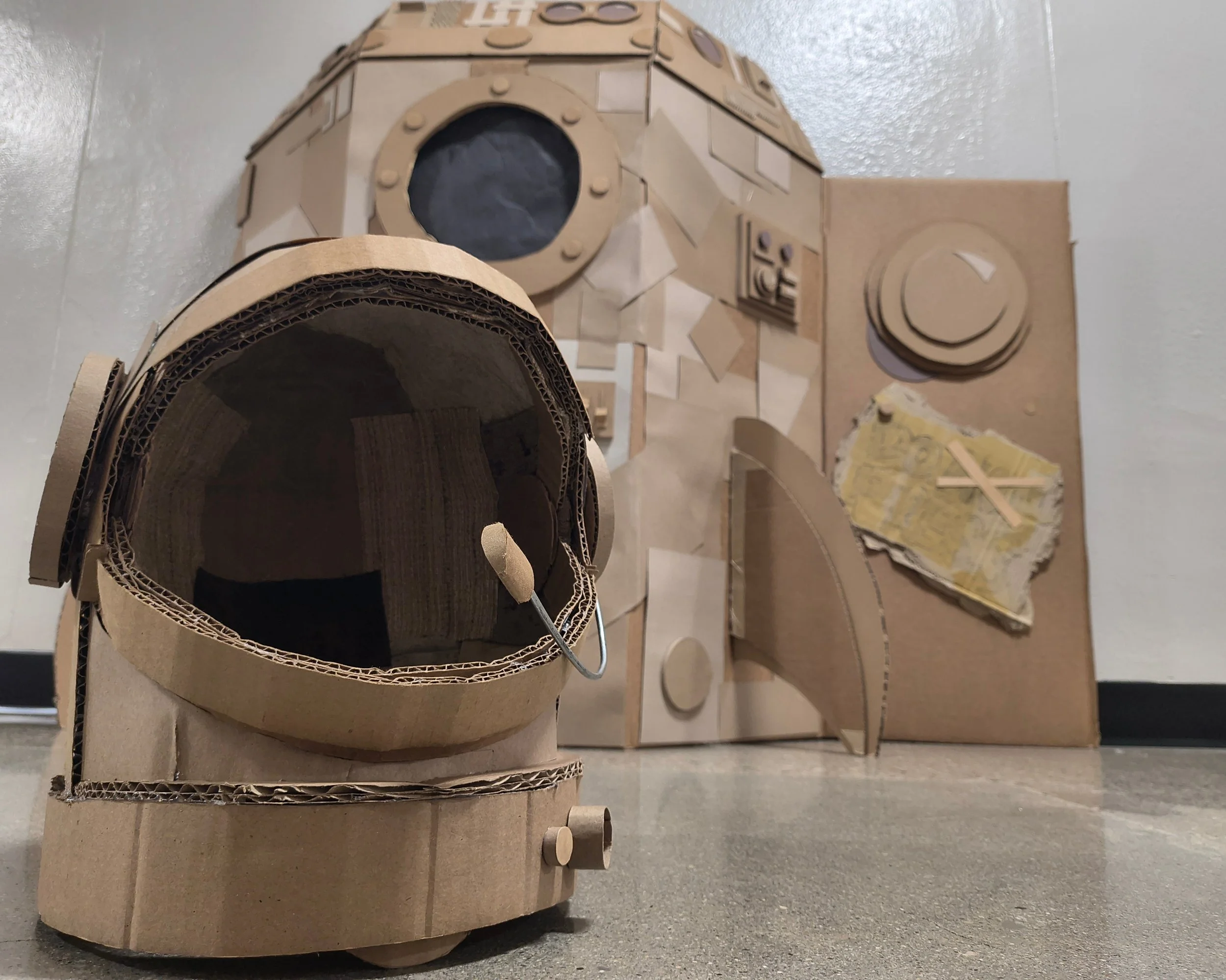


Then came the acting recruitment.
A crucial part of the transformation was the audience recognizing that I was representing the average child. As a 6’2” male obviously in college, that isn’t always easy to do. But it is, after all, the creativity of the child that willed the box to become a spaceship, so it wouldn’t make any sense if I carried the box on stage. What made plenty of sense was to have my Mom do it. So she lugged the box up onto the stage with a label “Trash” and then walked off, happy to have disposed of what she deems fit for the recycle. (For the record, my Mom is very supportive of my cardboard endeavors… she just wishes I would leave some floor space free of cardboard at times). Then when she had exited and the crowd was a bit confused (I was last, and nobody had left their costume on stage yet…) I did a little wobbly hop up onto the stage from the audience, wearing my astronaut helmet. The audience was surely confused as a bumbling, lanky boy stumbled on stage, and was shocked when I folded out the unassuming box into a rocket. They must have liked it quite a bit, because I won their votes and the People’s Choice Award!
Better than the recognition though, was the opportunity to share my love of cardboard with an audience, and potentially inspire the transformation of everyday recycle, what I really believe is the most accessible sculptural art medium, into something incredible. I will never be able to make the coolest thing out of cardboard, but that’s not the goal. The goal is to make stuff just good enough to
inspire others to make things that are truly amazing.

Because I know the art department and their speed of releasing photos to the artists, I am going to post this without any paparazzi style photos (actually including me), and add them when I receive them. I was unfortunately running late and missed the individual photos, so I’m hoping there is at least one good one out there I might get eventually. There is a short clip on the @iwuartdesign Instagram that I’ll link here in the meantime (I show up at the very end for a second!) Enjoy!
Looking for a particular post?
-
2023
48
- Jan 12, 2023 Hamsters Jan 12, 2023
- Jan 12, 2023 Art Museum Sketching Jan 12, 2023
- Jan 12, 2023 Frogs for a Good Cause Jan 12, 2023
- Jan 12, 2023 Art in Trigonometry Jan 12, 2023
- Jan 12, 2023 Free Caricaturist Jan 12, 2023
- Jan 12, 2023 Disney Mashup w/ @k.steely_the_artist Jan 12, 2023
- Jan 12, 2023 Art Studio in a Van Jan 12, 2023
- Jan 12, 2023 There’s a House in my Boot! Jan 12, 2023
- Jan 12, 2023 Minecraft Dungeons was a Spark Jan 12, 2023
- Jan 12, 2023 [Insert Straw Pun Here] Jan 12, 2023
- Jan 12, 2023 Oh Christmas Tree Oh Christmas Tree Jan 12, 2023
- Jan 12, 2023 Why Sketchbooks are the Greatest Thing Ever Jan 12, 2023
- Jan 12, 2023 How to make the Perfect Christmas gift Jan 12, 2023
- Jan 12, 2023 I drew a house Jan 12, 2023
- Jan 12, 2023 I designed my own Rodeo Stampede Animals Jan 12, 2023
- Jan 12, 2023 MiPads Jan 12, 2023
- Jan 12, 2023 2d or 3d Art? Which do I prefer? Jan 12, 2023
- Jan 15, 2023 Utilizing Other Peoples’ Energy Jan 15, 2023
- Jan 16, 2023 Goodwill Builds (ft. Waffle Blanket) Jan 16, 2023
- Jan 19, 2023 I spy with my artistic eye… Jan 19, 2023
- Feb 4, 2023 Art Teacher Simulator Feb 4, 2023
- Feb 15, 2023 Proportional Importance Feb 15, 2023
- Feb 23, 2023 How to sketch a sculpture Feb 23, 2023
- Feb 27, 2023 Overdoing it Feb 27, 2023
- Feb 28, 2023 Old Vehicles into Park Benches Feb 28, 2023
- Mar 27, 2023 The Word of the Day is Patience Mar 27, 2023
- Apr 5, 2023 How to have a Productive Break Apr 5, 2023
- Apr 5, 2023 Define Useless… Apr 5, 2023
- Apr 25, 2023 My Kind of American Football Apr 25, 2023
- Apr 26, 2023 Behind the Business (Cards) Apr 26, 2023
- May 7, 2023 Preserved Through Planning May 7, 2023
- May 26, 2023 The significance of June 25th May 26, 2023
- May 28, 2023 The Heads or Tails Machine May 28, 2023
- May 30, 2023 The Legend that is Harry Smiles May 30, 2023
- Jun 7, 2023 Thoughts about My First Ever Workshop Jun 7, 2023
- Jul 2, 2023 Now THAT’S how you run an Art Camp Jul 2, 2023
- Jul 10, 2023 Duck Architecture is SO COOL Jul 10, 2023
- Jul 22, 2023 Blank Space: The Game you 100% Make Up Jul 22, 2023
- Jul 29, 2023 The Tipping Point (by Malcolm Gladwell) Jul 29, 2023
- Aug 13, 2023 Creativity > Efficiency Aug 13, 2023
- Aug 30, 2023 I want a taco truck Aug 30, 2023
- Sep 15, 2023 “It’s Not Her.” Sep 15, 2023
- Sep 27, 2023 The Biggest Decision of my Life (so far) Sep 27, 2023
- Sep 30, 2023 A post about Purpose Sep 30, 2023
- Oct 11, 2023 The Idea Box Oct 11, 2023
- Oct 22, 2023 A Tentative Return to Social Media Oct 22, 2023
- Nov 15, 2023 Artistic “Style” Nov 15, 2023
- Dec 23, 2023 An Audacity Evaluation Dec 23, 2023
-
2024
17
- Jan 13, 2024 The Value of Walking Away Jan 13, 2024
- Feb 18, 2024 “The Thought Box” Event Idea Feb 18, 2024
- Feb 24, 2024 The Scholarship Essays Feb 24, 2024
- Mar 2, 2024 “Simple Pictures are Best” Mar 2, 2024
- Mar 9, 2024 Downloading a Virus to make a Cardboard Deck Box Mar 9, 2024
- Apr 14, 2024 The Deck Box Initiative Apr 14, 2024
- May 29, 2024 Trying Everything (why this website is poorly maintained and I'm okay with that) May 29, 2024
- Aug 26, 2024 (In)Finite Enthusiasm Aug 26, 2024
- Oct 4, 2024 I called it! (unsurprisingly) Oct 4, 2024
- Oct 25, 2024 Meaning in Materials and Autobiographical Art Oct 25, 2024
- Oct 31, 2024 On Adaptability and Switching Majors Oct 31, 2024
- Nov 16, 2024 What Francisco de Goya, Nick Cave, and Nathan Foley have in common. Nov 16, 2024
- Nov 16, 2024 Art and “the Media” Nov 16, 2024
- Dec 5, 2024 SPACESHIP (Visualizing Childlike Wonder and Creativity) Dec 5, 2024
- Dec 8, 2024 A Checklist Conclusion (Part 1) Dec 8, 2024
- Dec 25, 2024 A Checklist Conclusion (Part 2) Dec 25, 2024
- Dec 26, 2024 My mom said I should write about the ewok child. Dec 26, 2024
-
2025
15
- Jan 29, 2025 Blastoff in 3… 2… Jan 29, 2025
- Feb 2, 2025 “So you’re the Cardboard Guy?” Feb 2, 2025
- Feb 4, 2025 “Are you happy with that?” Feb 4, 2025
- Feb 13, 2025 Asking More Questions Than the Students… Feb 13, 2025
- Mar 11, 2025 Prioritizing Creativity Mar 11, 2025
- Mar 25, 2025 Brainstorming some Improvements Mar 25, 2025
- Apr 5, 2025 The Pilot Episode Apr 5, 2025
- Apr 25, 2025 Emphasizing Impermanence Apr 25, 2025
- May 22, 2025 Artistic Autonomy May 22, 2025
- Aug 4, 2025 Ideas? Meet your Makers. Aug 4, 2025
- Aug 5, 2025 En Masse Aug 5, 2025
- Aug 12, 2025 Observation, Creation, Communication Aug 12, 2025
- Sep 23, 2025 Communication is an Art Form Sep 23, 2025
- Nov 13, 2025 Islands in an Ocean of Words Nov 13, 2025
- Dec 9, 2025 Enjoy the Waffling Dec 9, 2025
-
2026
11
- Jan 6, 2026 “Cardboard” in 300 words Jan 6, 2026
- Jan 6, 2026 Choosing Cardboard Jan 6, 2026
- Jan 16, 2026 Buried Under the Weight of a Thousand Shoulds Jan 16, 2026
- Feb 22, 2026 You Can't Throw Away Experience Feb 22, 2026
- Mar 22, 2026 Embellish Everything Mar 22, 2026
- May 2, 2026 Start it Up! May 2, 2026
- May 3, 2026 Lesson Plans, Volume 1 May 3, 2026
- May 7, 2026 Explanation Clarification May 7, 2026
- May 25, 2026 First Bite Conversations May 25, 2026
- Jul 7, 2026 What silence says… Jul 7, 2026
- Jul 23, 2026 Like a Smiling Headless Chicken Jul 23, 2026